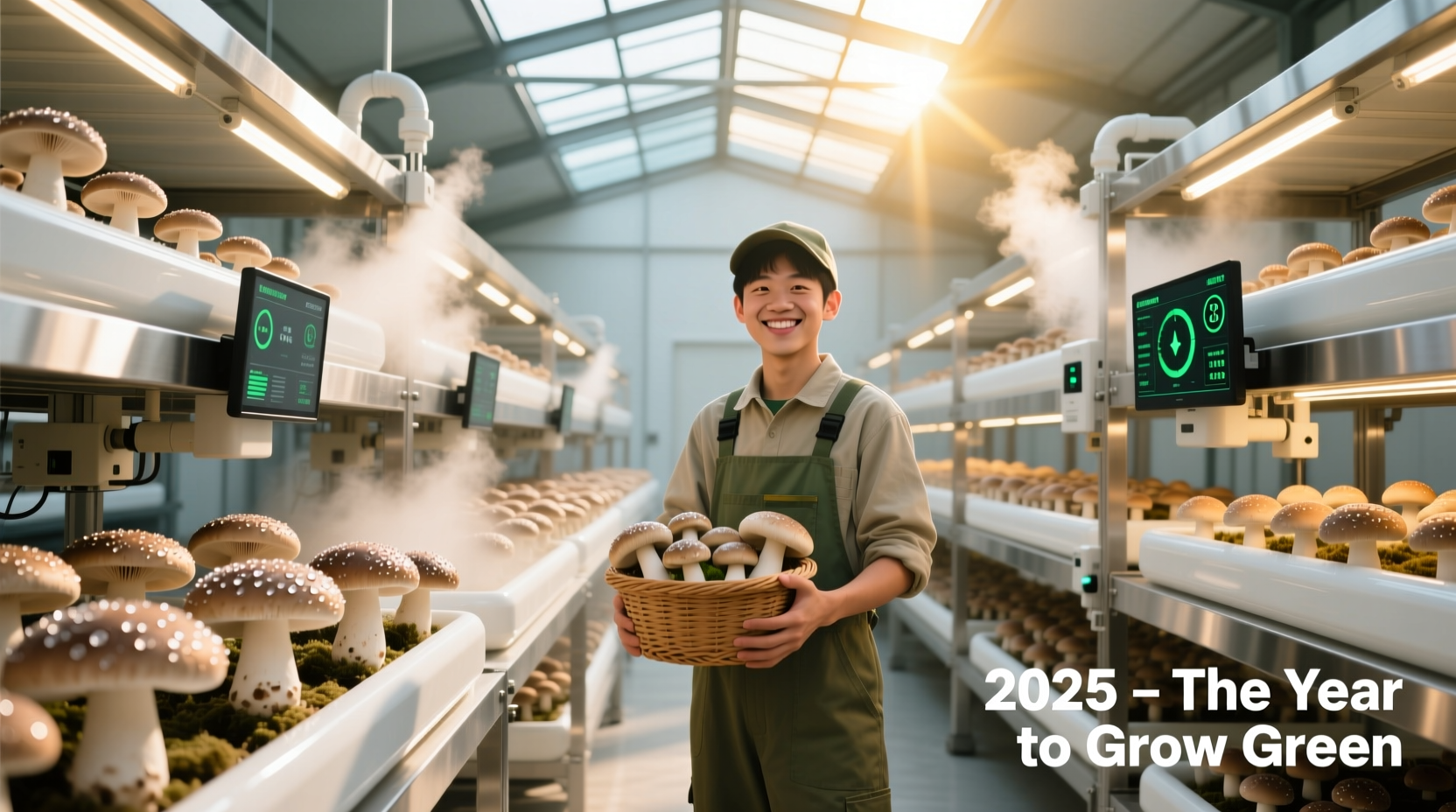
This guide is designed to help you start small, keep costs low, and learn the process from scratch.
Why Mushrooms in 2025? The Perfect Home Hobby
· Sustainability: Mushrooms can be grown on agricultural waste products (like coffee grounds, straw, cardboard).
· Health & Flavor: Nothing beats the taste and nutritional punch of home-grown, fresh mushrooms.
· Low Space & Cost: You can start on a countertop, in a closet, or under a sink with a minimal investment.
· The “Wow” Factor: Growing your own gourmet food is incredibly satisfying.
Phase 1: The Mindset & Planning
Before you buy anything, let’s get the basics down.
- Choose Your Mushroom:
For beginners,some species are far more forgiving than others.
· 🥇 Top Recommendation: Oyster Mushrooms
· Why: Fast-growing, aggressive (outcompete contaminants), and grow on a huge variety of materials.
· Varieties: Blue, Pink, Golden, Pearl, Phoenix. Blue Oysters are particularly fast and hardy for beginners.
· 🥈 Great Second Choice: Shiitake Mushrooms
· Why: Incredible flavor and a longer shelf life than oysters.
· Note: They are slower and require a hardwood-based substrate (sawdust or logs), making them a slight step up in complexity.
· Avoid for Now: Morels, Chanterelles, and Porcini. These are very difficult and have complex life cycles not suited for a first-time project.
- Understand the Lifecycle (Simplified):
- Spawn: The “seed” of mushroom farming. It’s a sterile material (like rye grain) that has been fully colonized by the mushroom mycelium (the root network).
- Substrate: The “soil” or food source. This is what you mix the spawn into. For oysters, this can be pasteurized straw, hardwood pellets, or even coffee grounds.
- Colonization: The mycelium grows through the substrate, turning it white and fuzzy. This happens in a dark, warm environment.
- Fruiting: Once fully colonized, you expose the block to fresh air, high humidity, and light, which triggers the growth of the actual mushrooms (the “fruits”).
Phase 2: The “Start Small” Setup: The Bucket Tek
The 5-Gallon Bucket Method is perfect for beginners growing Oyster mushrooms. It’s cheap, effective, and requires minimal equipment.
What You’ll Need:
· 1x 5-gallon food-grade plastic bucket with lid (~$5 at a hardware store)
· 1x Drill with a 1/4″ or 1/2″ drill bit
· 1-2 lbs Oyster Mushroom Grain Spawn (Buy this online from a reputable supplier like “North Spore,” “Field & Forest,” or “Mushroom Mountain”)
· Substrate: Pasteurized Straw or Hardwood Fuel Pellets (found at hardware stores) or a mix.
· A large pot for pasteurizing (if using straw)
· A clean workspace (wipe everything down with 70% isopropyl alcohol)
· A spray bottle for misting
· A small space like a closet, garage, or a clean corner of a room.
Phase 3: The Step-by-Step Process
Step 1: Prepare the Bucket
Drill holes all over the sides and bottom of the bucket,spaced about 4-6 inches apart. These holes are where the mushrooms will fruit. Clean the bucket thoroughly.
Step 2: Prepare the Substrate
· For Straw: Chop the straw into 1-3 inch pieces. Submerge it in a pot of 160-180°F (71-82°C) water for 1 hour. Drain and let it cool completely until it’s just warm to the touch.
· For Hardwood Pellets: Pour pellets into the bucket and cover with boiling water. Let them soak and expand into sawdust, then cool completely.
Step 3: Layer Spawn & Substrate
Once your substrate is cool,create layers in the bucket:
- A 2-inch layer of substrate.
- A handful of spawn, spread evenly.
- Repeat, pressing down gently as you go, until the bucket is full. The top layer should be substrate.
- Put the lid on the bucket.
Step 4: The Colonization Phase (The Waiting Game)
Place the bucket in a dark,warm spot (65-75°F / 18-24°C is ideal). Leave it alone for 2-3 weeks. You don’t need to do anything except watch for white, fluffy mycelium to start appearing through the holes. Do not open the lid.
Step 5: The Fruiting Phase (The Exciting Part!)
Once the block is fully colonized(completely white inside the holes), it’s time to fruit!
- Move the bucket to your fruiting area. This area should have:
· High Humidity: Mist the air around the bucket and the inside of the holes 2-3 times a day.
· Fresh Air: A slightly cracked window or a small fan in the room is perfect.
· Indirect Light: A few hours of ambient light from a window tells the mushrooms which way to grow.
· Cooler Temps: Oysters prefer 55-65°F (13-18°C) for fruiting. - Watch for Pins: In a few days, you’ll see tiny mushroom “pins” forming in the holes.
- Mist and Wait: Continue misting to keep the pins moist. They will double in size almost daily!
Step 6: Harvest!
Harvest your oysters when the edges of the caps are still slightly curled under,before they fully flatten out. Use a clean knife or your hand to twist and pull the entire cluster from the bucket.
Troubleshooting for Beginners
· Green/Black Mold: This is contamination. If it’s a small spot, you can sometimes cut it out with a clean spoon. If it’s widespread, the batch is lost. This is why cleanliness is so important!
· No Pins Forming: The block might be too dry. Soak the entire block in cold water for 12-24 hours, then put it back into fruiting conditions. Also, check your fresh air and light.
· Long, Spindly Stems with Tiny Caps: This means not enough fresh air exchange (FAE). Increase airflow.
· Drying Out or Browning Pins: Not enough humidity. Mist more frequently.
Scaling Up & Next Steps
Once you’ve successfully grown your first bucket, the world is your oyster (mushroom)!
· Try Other Methods: Move on to using grow bags or small monotubs.
· Grow Other Species: Try Shiitake on supplemented sawdust blocks.
· Clone Your Best Mushrooms: Learn to take a tissue sample and grow it on agar to create your own spawn.
· Sell at a Local Farmer’s Market: A single bucket can produce 2-3 pounds of mushrooms, making a small-scale side hustle possible.
Starting a mushroom farm in 2025 is not just about the food; it’s about connecting with a fascinating natural process. It’s part science experiment, part gardening, and 100% rewarding.
Happy growing! 🍄
