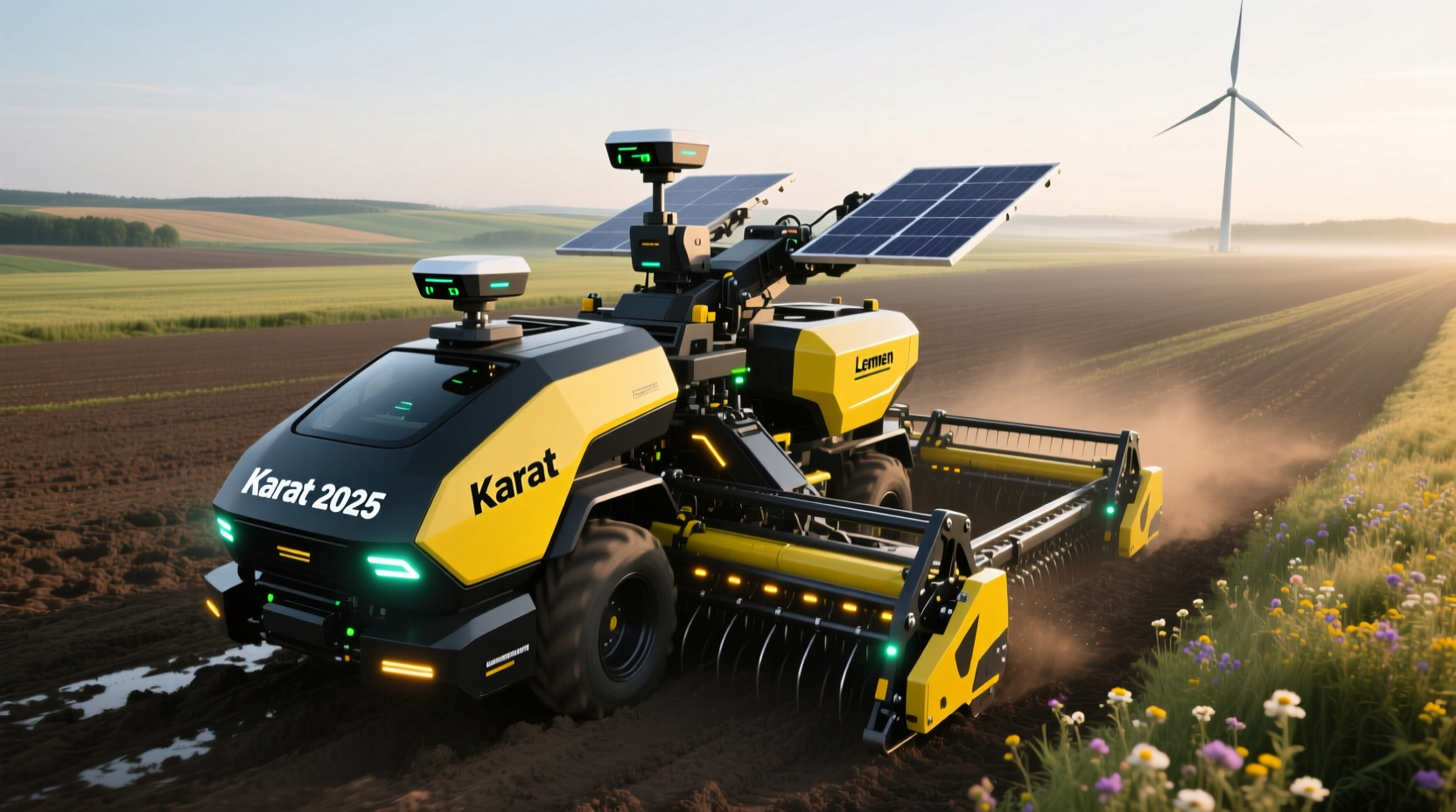
Of course. The announcement that Lemken is preparing its Karat cultivator for autonomous operation in 2025 is a significant step in the evolution of smart farming. Here’s a detailed breakdown of what this means, the technology behind it, and the implications for farmers.
What is the Lemken Karat?
First, it’s important to understand the implement itself. The Lemken Karat is a line of compact disc harrows and cultivators known for their:
· Versatility: Used for primary and secondary tillage, seedbed preparation, and incorporating residue.
· Efficiency: Designed for high work rates with low horsepower requirements.
· Precision: Provides a consistent, level seedbed, which is crucial for uniform germination.
By making this specific, widely-used implement ready for autonomy, Lemken is targeting a core and frequent tillage operation.
What “Preparing for Autonomous Operation” Means in 2025
This doesn’t necessarily mean Lemken is building a fully autonomous, driverless tractor. Instead, they are adopting a more pragmatic and increasingly common approach: “retrofitting” the implement to work with existing autonomous tractor solutions.
This involves several key technological integrations:
- The “Brain”: Implement Control and Communication
The Karat will be equipped with a sophisticated control system that can communicate with an autonomous prime mover (tractor). This uses the ISO 11783 (ISOBUS) standard, but extends it to a higher level of automation (often referred to as TIM – Tractor Implement Management).
· The implement can tell the tractor what speed, power, and hydraulic functions it needs.
· It can automatically raise, lower, and adjust its working depth based on pre-set parameters or real-time conditions.
- The “Eyes”: Sensors and Perception
To operate safely and effectively without a human operator, the cultivator needs to perceive its environment. This includes:
· Obstacle Detection: Cameras, LiDAR, and radar sensors mounted on the implement or the tractor can detect unexpected obstacles like people, animals, or debris in the field and trigger an immediate stop.
· Implement Monitoring: Sensors on the Karat frame and discs monitor load, blockages, and working depth, making micro-adjustments on the fly for perfect results.
- The “Nervous System”: Interface and Safety
· User Interface: The farmer will plan the operation using farm management software on a tablet or computer. They define the field boundaries, headlands, and working paths.
· Safety Systems: This is non-negotiable. Multiple, redundant safety systems will be in place:
· Geofencing: The autonomous system is confined to a pre-defined GPS boundary.
· Remote Stop: The farmer can stop the entire operation instantly from a remote control unit (a “deadman’s switch”).
· Automatic Stop: The system stops if it loses GPS signal, encounters an obstacle, or has a communication failure.
The Likely Workflow for a 2025 Autonomous Karat Operation
- Planning: The farmer uses a digital map to plan the cultivator’s path for a specific field.
- Hitching: The farmer physically hitches the “autonomy-ready” Karat to a compatible autonomous tractor (e.g., from brands like John Deere, Fendt, or Case IH that are developing their own autonomous platforms).
- Activation: On the field headland, the farmer initiates the autonomous system via a control unit, steps away from the machine, and monitors it.
- Execution: The tractor and Karat work together as a single, smart system. The Karat cultivates the soil, communicates its needs, and the tractor provides the precise power and guidance.
- Monitoring & Intervention: The farmer can monitor multiple machines from a distance, focusing on other tasks, and only intervenes for turning at headlands, refilling, or if an alert is triggered.
Why This is a Big Deal: The Benefits
· Labor Solution: Addresses the critical shortage of skilled farm labor. One person can potentially manage multiple operations simultaneously.
· Increased Efficiency: Autonomous machines can work longer hours, day or night,不受时间限制, optimizing short weather windows for planting.
· Precision and Consistency: Removes human error, resulting in a more uniform seedbed, which can lead to better crop establishment and higher yields.
· Enhanced Safety: Removes the operator from the cab of a powerful, vibrating machine, reducing fatigue and risk of injury.
· Data Collection: The system collects valuable data on soil resistance and field conditions, which can be fed back into the farm’s management system for future decision-making.
The Bigger Picture: Lemken’s Strategy
Lemken’s move is a clear signal that the future of farm machinery is not just about autonomous tractors, but about autonomous implement systems. By focusing on making their implements the “intelligent” part of the system, they ensure their tools remain relevant and compatible with various tractor brands’ autonomous platforms.
In summary, Lemken preparing the Karat for autonomous operation in 2025 is a major step towards practical, large-scale autonomous farming. It represents a shift from conceptual prototypes to real-world, integrated systems that solve immediate farmer challenges around labor, efficiency, and precision.
