Introduction
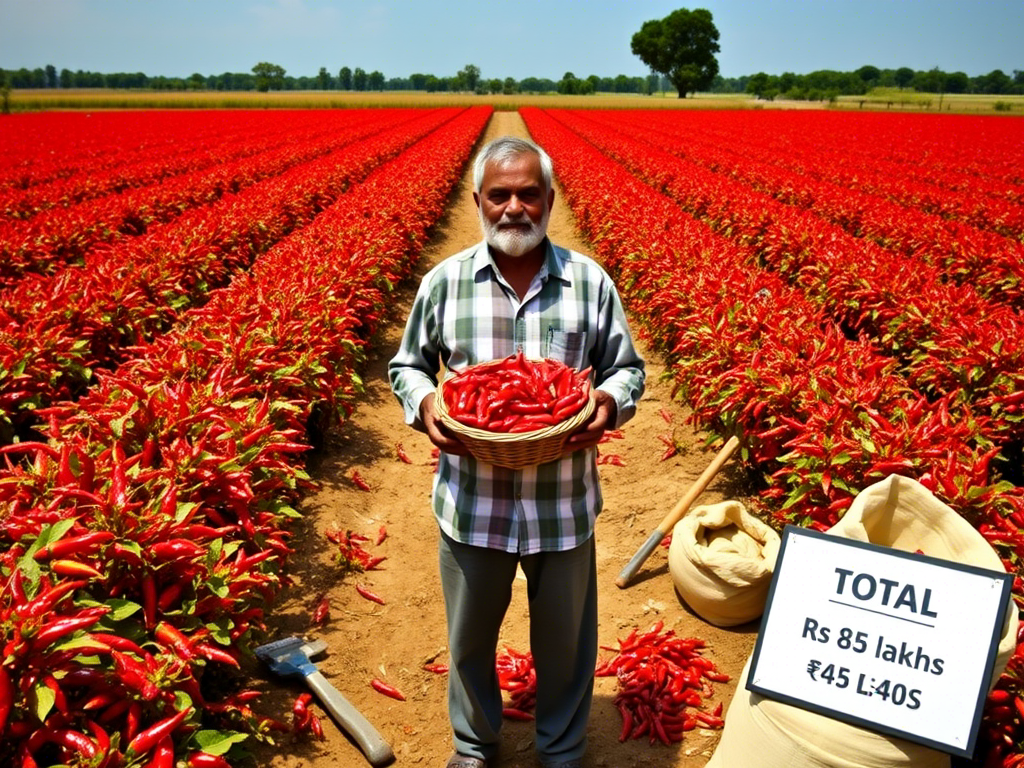
In the heart of India’s agricultural landscape, a visionary farmer transformed 40 bighas (approx. 13.2 acres) into a goldmine, earning Rs 85 lakhs through strategic chilli cultivation. This guide unravels the meticulous steps behind this success, offering a blueprint for aspiring farmers to replicate this triumph.
Step 1: Identifying the Opportunity – Why Chillies?
- Market Demand: India is the world’s largest chilli producer, with growing demand for spices, oleoresins, and dried variants globally.
- Profit Margins: High-value crops like Guntur Sannam or Byadgi chillies fetch Rs 150–300/kg, outperforming traditional crops.
- Climate Suitability: Thrives in warm, semi-arid regions (e.g., Andhra Pradesh, Telangana), requiring minimal rainfall.

Tip: Analyze local mandi prices and export trends via Agmarknet or NICRA portals.
Step 2: Selecting the Right Variety
- High-Yield Varieties: Bhut Jolokia (for extreme heat), Hybrid 3227 (high yield), or Teja (export preference).
- Disease Resistance: Choose varieties resistant to leaf curl virus and anthracnose.
- Market Preferences: Byadgi for color, Guntur for pungency.
Case Study: The farmer chose Hybrid 3227 for its 25–30 quintals/acre yield and drought tolerance.
Step 3: Land Preparation and Soil Management
- Soil Testing: Opt for loamy soil with pH 6.5–7.5. The farmer added 10 tonnes/acre of compost to enhance organic content.
- Bed Layout: Raised beds (4ft wide) with drainage trenches to prevent waterlogging.
- Solarization: Covered soil with plastic sheets for 15 days to eliminate pathogens.
Cost: Soil testing (~Rs 1,500) and composting (~Rs 8,000/acre).
Step 4: Sowing and Planting Techniques
- Nursery Setup: Sowed seeds in trays (October–November) using cocopeat, transplanting after 35 days.
- Spacing: 18–24 inches between rows, 12 inches between plants for airflow.
- Intercropping: Grew coriander as a short-term cash crop between chilli rows.
Yield Boost: Drip irrigation + mulching reduced transplant shock.
Step 5: Smart Irrigation and Water Management
- Drip Systems: Installed drip lines (Rs 50,000/acre subsidy available) to save 40% water.
- Schedule: Watered 30 mins/day post-transplanting, reduced during fruiting to enhance pungency.
Innovation: The farmer used IoT sensors to monitor soil moisture.
Step 6: Nutrient Management
- Fertigation: Applied 19:19:19 NPK weekly via drip, switching to potassium-rich formulas during fruiting.
- Organic Boost: Foliar sprays of neem oil and panchagavya every 15 days.
Cost: ~Rs 15,000/acre on fertilizers.
Step 7: Pest and Disease Control
- IPM Tactics:
- Yellow sticky traps for aphids.
- Neem oil (5ml/L) for thrips.
- Trichoderma against fungal wilt.
- Avoid Overuse: The farmer reduced pesticide costs by 30% through timely scouting.
Red Flag: Banned monocrotophos; opt for biopesticides.
Step 8: Harvesting for Maximum Returns
- Timing: First picking 75–80 days post-transplanting (green chillies), later harvests for red/dried variants.
- Labor: Hired 15 workers for selective picking, ensuring minimal damage.
Yield: 28 quintals/acre (dried) sold at Rs 220/kg.
Step 9: Post-Harvest Handling
- Drying: Solar dryers (3–5 days) retained bright color, avoiding monsoon spoilage.
- Grading: Machine-sorted chillies into Class A (export) and Class B (local).
- Storage: Cold storage (Rs 2/kg/month) to await price peaks.
Value Addition: The farmer sold 20% as powdered chilli for 50% higher margins.
Step 10: Strategic Marketing
- Direct Contracts: Partnered with Everest and MDH via FPOs (Farmer Producer Organizations).
- Export Channels: Utilized APEDA subsidies to ship to Bangladesh and the UAE.
- E-Commerce: Sold premium batches on BigBasket and Amazon.
Revenue: 60% income from exports, 30% from processors, 10% retail.
Financial Breakdown
- Investment: Rs 12 lakhs (includes seeds, labor, irrigation, fertilizers).
- Revenue: 40 bighas × 28 quintals × Rs 22,000/quintal = Rs 85.12 lakhs.
- Profit: Rs 73 lakhs (post-costs).
Subsidies: The farmer saved 30% via PMKSY (drip irrigation) and state horticulture schemes.
Step 11: Scaling Up and Sustainability
- Reinvestment: Upgraded to solar dryers and soil health drones.
- Crop Rotation: Post-chilli, planted maize to restore nitrogen.
Wisdom: “Start small, validate, then scale,” advises the farmer.
Conclusion
This journey from soil to Rs 85 lakhs underscores the power of agronomy, market savvy, and grit. With tailored varieties, precision farming, and strategic sales, chilli cultivation can be a goldmine. As the farmer quips, “Every seed holds a crorepati’s dream—if nurtured right.”!
Step-by-Step Guide: How a Farmer Harvested Rs 85 Lakhs from 40 Bighas of Chilli Farming
1. Research & Planning
- Crop Selection: Opt for high-yielding, disease-resistant hybrid varieties (e.g., Teja, Byadgi, or Bhut Jolokia) with strong market demand.
- Market Analysis: Target export-oriented buyers, processors, or direct contracts to avoid middlemen markups.
- Government Schemes: Utilize subsidies for seeds, drip irrigation, or organic farming to reduce costs.
2. Land Preparation
- Soil Testing: Ensure pH 6.5–7.5 and well-drained loamy soil. Amend with compost or FYM (10–15 tons/acre) for fertility.
- Layout: Create raised beds with 45–60 cm spacing between plants for airflow and pest control.
3. Seed Selection & Sowing
- Nursery Setup: Start seeds in trays 6–8 weeks before transplanting. Use treated seeds to prevent fungal diseases.
- Transplanting: Shift seedlings to the main field at 4–5 leaf stages (spacing: 60 cm x 45 cm).
4. Irrigation Management
- Drip Irrigation: Install systems for water efficiency (saves 30–40% water) and consistent moisture, critical during flowering/fruiting.
5. Nutrient Management
- Balanced Fertilization: Apply NPK (100:50:50 kg/acre) in split doses. Supplement with micronutrients (zinc, boron) and organic foliar sprays.
6. Pest & Disease Control
- IPM Strategies: Use neem oil, pheromone traps, and biocontrol agents (e.g., Trichogramma wasps) for pests like aphids and fruit borers.
- Disease Prevention: Apply copper-based fungicides for anthracnose and avoid waterlogging.
7. Weed Control
- Mulching: Use organic mulch (straw/plastic) to suppress weeds and retain soil moisture.
8. Harvesting
- Timing: Pick chillies at maturity (90–120 days) when 70–80% turn red. Use gloves to avoid skin irritation.
- Frequency: Harvest every 7–10 days for 2–3 months.
9. Post-Harvest Handling
- Drying: Sun-dry on clean surfaces or use solar dryers to achieve 10–12% moisture content.
- Grading & Packaging: Sort by size/color. Use airtight bags for storage or export.
10. Marketing & Sales
- Direct Contracts: Partner with exporters, spice brands, or e-commerce platforms.
- Premium Pricing: Sell dried chillies at ₹200–300/kg (organic/export quality) to maximize revenue.
Revenue Calculation (40 Bighas ≈ 10 Acres)
- Yield: 25–30 quintals/acre (250–300 quintals total).
- Price: ₹25,000–30,000/quintal (premium quality).
- Revenue: 300 quintals x ₹28,000 ≈ ₹84 lakhs (excluding value-added products).
FAQs
Q1: Which chilli variety is most profitable?
A: Hybrids like Teja, Byadgi, or Guntur Sannam (high demand in export markets).
Q2: How much investment is needed?
A: ₹3–4 lakhs/acre (includes seeds, drip irrigation, labor). Net profit can exceed 60% with good yields.
Q3: How to control pests organically?
A: Use neem oil, trap crops, and biocontrol agents. Avoid excessive chemical pesticides.
Q4: What’s the ideal irrigation method?
A: Drip irrigation ensures water efficiency and prevents fungal diseases.
Q5: Can I grow chillies without a nursery?
A: Direct sowing is possible but less efficient. Nursery-raised seedlings ensure uniformity.
Q6: How to improve drying efficiency?
A: Use raised mesh trays or solar dryers to reduce spoilage and contamination.
Q7: Are subsidies available for chilli farming?
A: Yes, state governments often subsidize seeds, drip systems, and organic certifications.
Q8: What’s the best market for chillies?
A: Target export hubs (Guntur, Byadgi) or online agri-platforms like Ninjacart.
