
The global exotic fruit market is booming, projected to grow from $18.03 billion in 2024 to $25.09 billion by 2029, driven by health-conscious consumers, organic demand, and innovative farming practices .
In India, farmers are capitalizing on this trend by shifting from traditional crops to exotic varieties like dragon fruit, rambutan, and avocado, which yield 50–100% higher returns compared to staples like apples or mangoes . This article explores the stories of pioneering farmers running highly profitable exotic fruit farms, the market forces enabling their success, and the future of this dynamic sector.
Top Exotic Fruit Farmers Revolutionizing Agriculture
1. Chethan Shetty: The Engineer-Turned-Rambutan Pioneer
Based in Karnataka’s Bellare village, Chethan Shetty transitioned from engineering to farming in 2017, defying family opposition. His organic farm specializes in rambutan, mangosteen, and avocado. Each rambutan tree produces 25–30 kg annually, sold wholesale at ₹300/kg and retail at ₹350–400/kg, generating ₹8,000–9,500 per tree yearly. Mangosteen fetches up to ₹750/kg during peak demand . Shetty’s success highlights the profitability of organic practices and direct-to-consumer sales
.
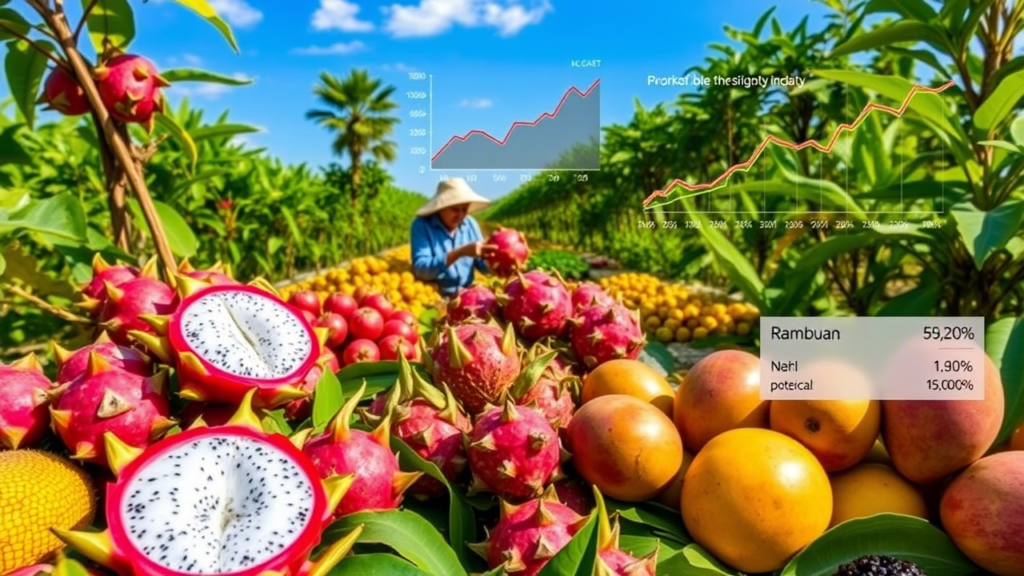
2. Mahesh Asabe: Dragon Fruit King of Solapur
In Maharashtra’s drought-prone Solapur district, Mahesh Asabe cultivates dragon fruit across 20 acres, earning ₹2 crore annually. Using drip irrigation and hybrid varieties (Jumbo Red, Siam Red), his farm yields 10 tonnes/acre post two years, sold at ₹100/kg. After deducting ₹1 lakh/acre in maintenance costs, net profits reach ₹9 lakh/acre . His model proves that arid regions can thrive with climate-resilient crops.
3. Biju Narayanan: High-Density Durian and Rambutan Farming
Kannur-based Biju Narayanan employs high-density planting for durian and rambutan, achieving yields of 6,000 kg/acre. Rambutan sells at ₹250–300/kg, contributing ₹15 lakh/acre annually. By intercropping coconut trees, he maximizes land use, while agritourism and nursery services add revenue streams .
4. Merlin Moothedan: Kerala’s Mangosteen Dynasty
Merlin Moothedan and his sons manage a five-acre organic farm in Thrissur with 1,000 mangosteen trees. Older trees yield 300 kg annually, with prices ranging from ₹250–500/kg. They also sell saplings sourced from Malaysian mother plants, tapping into both domestic and export markets .
5. Diwakar Channappa: Karnataka’s Date Innovator
A former ISRO scientist, Diwakar Channappa pioneered date farming in Karnataka. His 102 Barhi date palms yield 45–50 kg/plant, sold at ₹310–350/kg. With ₹8.1 lakh/acre revenue and ₹6 lakh profit, his success underscores the potential of non-traditional regions for exotic crops .
6. Lohith Shetty: Intercropping Master in Dakshin Kannada
Lohith Shetty’s 8-acre farm combines rambutan (2,700 plants) and mangosteen (800 plants) with areca nut. Mature trees yield 80–100 kg/season, sold at ₹300–700/kg. His intercropping strategy ensures year-round income and resource efficiency .
7. Chennakeshava M: Biodiversity Champion in Tumkur
Chennakeshava’s farm in Karnataka’s dryland region grows 70 fruit varieties, including water apple, mangosteen, and avocado. By staggering harvests, he earns ₹350–400/kg year-round, proving biodiversity’s role in risk mitigation .
8. Harmanpreet Singh Jhand: Punjab’s Avocado Trailblazer
After farming avocados in Africa, Jhand introduced hybrid varieties to Punjab. His nursery produces 10,000 plants/year, sold at ₹500–1,500 each. Mature trees yield 80 kg annually, generating ₹40,000–96,000/tree .
9. Gursimran Singh: Scaling Avocado in Malerkotla
Gursimran Singh’s Dhanoa Natural Farm grows avocados, logan, and pecan. Despite initial challenges, his 50 trees now yield 10–12 kg each, with plans to expand to 4 acres. His consultancy, Naturepath Plantation, helps farmers set up orchards for ₹2.5 lakh/acre .
Key Drivers of Profitability in Exotic Fruit Farming
1. Premium Pricing and Export Potential
Exotic fruits command 2–3x higher prices than traditional crops. For instance, dragon fruit sells at ₹100–500/kg in India , while global avocado prices reach $3–7/fruit . Export markets in the UAE, Europe, and Canada further boost margins, with India’s kiwi exports surging from 0.35 tonnes (2017) to 528 tonnes (2023) .
2. Government Support and Subsidies
India’s Ministry of Agriculture promotes 10 exotic fruits, including dragon fruit and avocado, under schemes like MIDH, targeting 50,000 hectares for dragon fruit by 2028 . Subsidies for organic certification, drip irrigation, and processing units reduce initial costs .
3. Climate Resilience and Low Input Costs
Dragon fruit and avocado require 75–80% less water than wheat or rice, ideal for drought-prone areas . Rambutan and mangosteen trees have 40–200-year lifespans, ensuring long-term yields with minimal replanting .
4. Organic and Sustainable Practices
Organic exotic fruits fetch 20–30% premiums, with global organic produce sales hitting $22 billion in 2022 . Farmers like Chethan Shetty and Merlin Moothedan leverage this trend through chemical-free cultivation and eco-friendly packaging .
5. Technology and Innovation
- Hydroponics and Vertical Farming: Urban farms use hydroponics for saffron and strawberries, reducing land dependency .
- Blockchain Traceability: Enhances supply chain transparency, appealing to ethically conscious buyers .
- Hybrid Varieties: Heat-tolerant avocados (e.g., ‘Fuerte’) enable cultivation in North India .
Challenges and Future Outlook
1. Market Volatility
Prices fluctuate seasonally; for example, mangosteen drops from ₹500/kg (April) to ₹250/kg (July) . Diversification, as seen in Chennakeshava’s multi-crop farm, mitigates this risk.
2. High Initial Investment
Dragon fruit setup costs ₹5–6 lakh/acre , while avocado nurseries require ₹2.5 lakh/acre . Government loans and cooperatives can ease financial barriers.
3. Consumer Education
Expanding domestic demand relies on awareness campaigns. Retailers like Frieda’s Branded Produce use vibrant packaging to attract buyers .
4. Global Competition
Vietnam and Thailand dominate dragon fruit exports, but India’s focus on quality and organic certification could carve a niche .
Conclusion: A Paradigm Shift in Agriculture
The success of these farmers underscores a broader shift toward high-value, sustainable agriculture. With the exotic fruit market growing at 6.8% CAGR , opportunities abound for farmers to adopt innovative techniques, leverage government schemes, and tap into global demand. As Biju Narayanan notes, “Exotic fruits are not just a crop—they’re a lifestyle revolution.” For those willing to embrace change, the future is ripe with potential.
FAQs: The Rise of Exotic Fruit Farming, Super-Profitable Farms, and Market Trends
- What defines “exotic fruit farming”?
Exotic fruit farming involves cultivating non-native, tropical, or rare fruits not traditionally grown in a region. Examples include dragon fruit, passion fruit, mangosteen, and durian. These crops often thrive in specific climates or controlled environments. - Why is exotic fruit farming gaining popularity?
Rising consumer demand for unique flavors, health benefits (e.g., antioxidants), and Instagram-worthy produce drives growth. Farmers also pivot to exotic crops for higher profit margins compared to traditional staples. - Which exotic fruits are most profitable?
Dragon fruit, passion fruit, golden berries, mangosteen, and Asian persimmons top the list. Dragon fruit, for instance, can yield $10,000–$20,000 per acre due to high retail prices ($5–$10 per fruit). - How do exotic fruit farms achieve super-profits?
Premium pricing, low competition, and niche markets (e.g., wellness brands). Farms like Miami Dragon Fruit use value-added products (jams, smoothie packs) to boost revenue. - What are current market trends?
- Surge in “superfood” labeling (e.g., açai, pitaya).
- Exotic flavors in beverages and snacks.
- Direct-to-consumer sales via online platforms.
- What fuels consumer demand for exotic fruits?
Health trends (vitamin-rich diets), multicultural demographics, and social media influence. Millennials and Gen Z prioritize novel culinary experiences. - Key challenges in exotic fruit farming?
Climate sensitivity, pest management, high initial costs (e.g., greenhouses), and limited agronomic knowledge. Supply chain gaps also hinder distribution. - How does climate impact exotic fruit farming?
Most require tropical/subtropical conditions. However, hydroponics and greenhouse tech enable farming in temperate regions (e.g., Canadian dragon fruit greenhouses). - What technologies boost productivity?
Drip irrigation, vertical farming, AI-driven climate control, and pollination drones. Costa Rica’s EcoFarm uses solar-powered hydroponics to grow passion fruit year-round. - Steps to start an exotic fruit farm?
- Research viable crops for your climate.
- Invest in infrastructure (e.g., polytunnels).
- Partner with distributors/restaurants.
- Leverage agritourism for added income.
- Certifications/regulations required?
Organic, Fair Trade, or GlobalG.A.P. certifications enhance marketability. Import/export permits are critical for international sales. - Success stories in exotic farming?
- Thailand’s Mangosteen Magic: Exports $15M annually to the U.S. and EU.
- California Tropicals: Profits surged 300% by supplying dragon fruit to Whole Foods.
- Risks involved?
Market volatility, crop failure from disease, and regulatory hurdles. Diversification (e.g., mixed cropping) mitigates risks. - Marketing strategies for exotic fruits?
Target health stores, chefs, and influencers. Kenya’s Kakuzi PLC markets avocados to Europe via TikTok campaigns. - Sustainable practices in exotic farming?
Agroforestry, organic pest control, and water recycling. Philippines’ Durian Delight uses composted waste to reduce costs by 30%. - Emerging exotic fruits to watch?
Jabuticaba (Brazilian grape), soursop, and black sapote. Açai demand is projected to grow 12% annually through 2030. - Competition vs. traditional farming?
Exotic farms face less competition but require specialized knowledge. Traditional crops (e.g., corn) have stable markets but lower margins. - Global market influences?
Trade policies (e.g., USDA grants for tropical crops) and rising Asian middle classes shape demand. Shipping costs impact export viability. - Best regions for exotic farming?
- Tropical: Southeast Asia, Latin America.
- Controlled environments: Dutch greenhouses, U.S. Sun Belt states.
- ROI expectations?
High-risk, high-reward: 3–5 years to breakeven, with 20–40% annual returns for established farms. Dragon fruit farms often recoup costs in 2–3 years.
