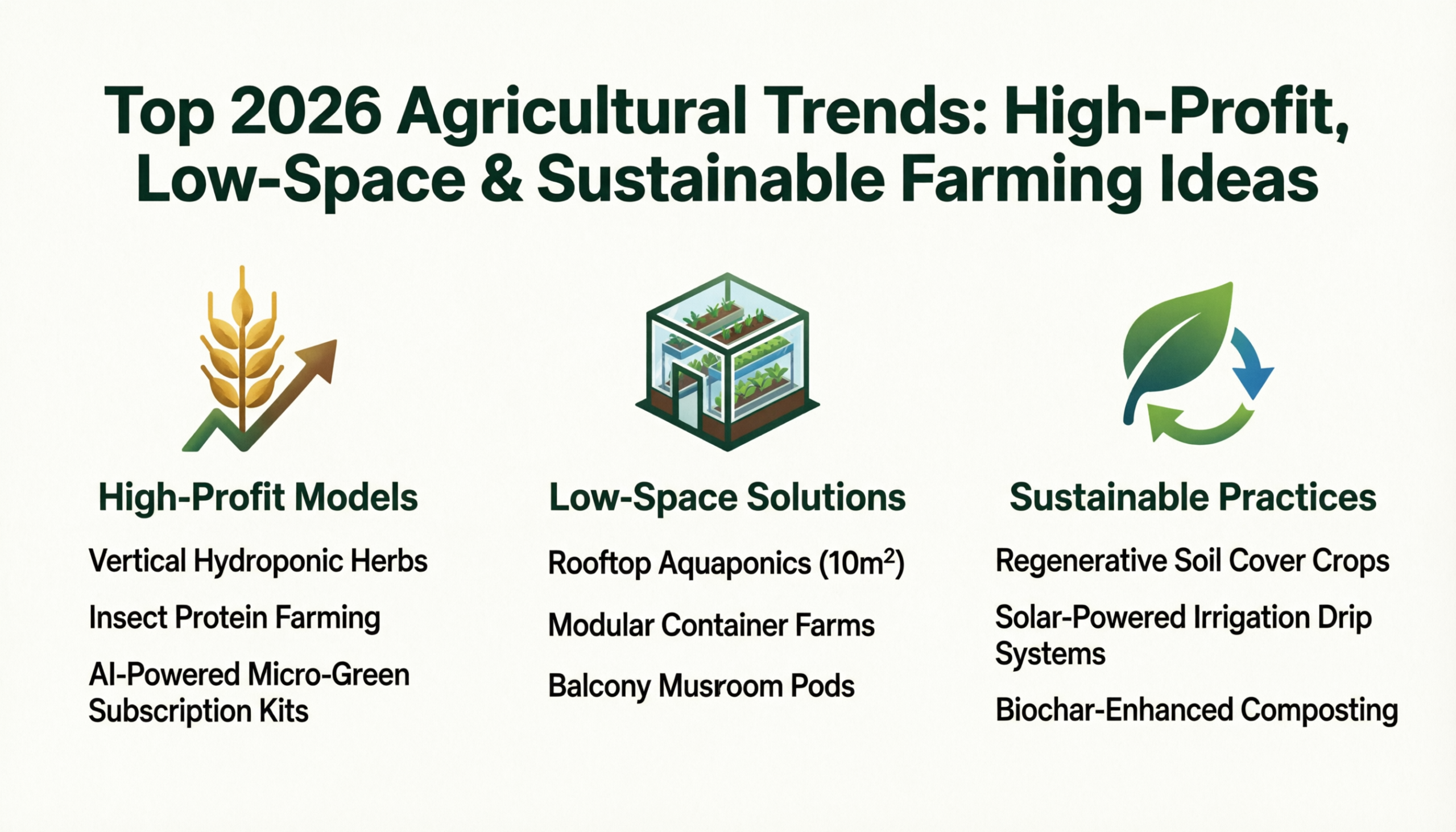
1. Introduction: The Future of Farming in 2026
Agriculture is evolving faster than ever. Rising population, shrinking farmland, climate change, and increasing food demand are forcing farmers and agribusiness entrepreneurs to rethink traditional farming methods.
By 2050, the global population is expected to reach nearly 10 billion people, and food production must increase dramatically to feed everyone. At the same time, urbanization is reducing arable land and natural resources such as water and fertile soil.
This challenge has sparked a wave of innovation in agriculture.
The year 2026 marks a major shift toward smart, sustainable, and space-efficient farming systems. Modern agriculture is no longer limited to large rural fields. Today, farming can happen on rooftops, inside warehouses, or even in small urban apartments.
New technologies such as:
Artificial intelligence
Internet of Things (IoT)
Vertical farming
Hydroponics
Smart irrigation systems
are transforming the agricultural landscape.
These innovations allow farmers to produce more food using less land, less water, and fewer chemicals.
For new farmers, investors, and agripreneurs, this transformation creates exciting opportunities. Many modern farming models require very little land but generate high profits.
In this article, we will explore the Top Agricultural Trends of 2026, focusing on profitable, sustainable, and low-space farming ideas that are shaping the future of food production.
2. Why Agriculture is Changing Rapidly
Several global factors are driving innovation in agriculture.
Understanding these forces helps explain why new farming methods are becoming essential.
2.1 Population Growth
The global population continues to grow rapidly. With billions more people expected in the coming decades, global food demand is increasing at an unprecedented rate.
Farmers must produce more food while using fewer natural resources.
This means agriculture must become more efficient and technologically advanced.
2.2 Climate Change
Climate change is one of the biggest threats to traditional agriculture.
Extreme weather events such as droughts, floods, heatwaves, and unpredictable rainfall are damaging crops worldwide.
Modern farming technologies like controlled environment agriculture help farmers produce crops independent of climate conditions.
2.3 Decreasing Agricultural Land
Urban expansion and industrial development are reducing farmland availability.
In many countries, farmland is being converted into residential areas, highways, and industrial zones.
Because of this, agriculture must adapt to low-space farming models.
Vertical farming and urban agriculture provide powerful solutions.
2.4 Water Scarcity
Agriculture uses nearly 70% of global freshwater resources.
However, water scarcity is increasing worldwide.
New farming techniques such as hydroponics and aeroponics use dramatically less water than traditional farming systems.
For example, hydroponic farming can reduce water usage by up to 90% compared to traditional agriculture.
2.5 Technology Revolution in Agriculture
Agriculture is entering the era of AgriTech.
Technologies like:
AI-based crop monitoring
Drone surveillance
Smart irrigation systems
Automated greenhouses
IoT soil sensors
are helping farmers make better decisions and increase productivity.
These technologies allow farmers to monitor crops in real time, detect diseases early, and optimize irrigation and fertilizers.
3. What Defines Modern Agriculture in 2026
The agriculture of the future is defined by three major principles.
These principles guide most new agricultural innovations.
3.1 High Profitability
Modern farmers are focusing on crops and systems that deliver high financial returns.
Examples include:
Microgreens
Exotic vegetables
Organic produce
Medicinal plants
Urban farming crops
These high-value crops can generate significant profits even on small land areas.
3.2 Low Space Requirements
Traditional farming requires large land areas.
However, modern farming methods maximize productivity in small spaces.
Some examples include:
Vertical farming
Container farming
Rooftop farming
Indoor farming
Hydroponic systems
These techniques allow farmers to grow crops in urban areas, warehouses, and even shipping containers.
3.3 Sustainability
Sustainability is a key focus in modern agriculture.
Consumers increasingly demand food that is:
Organic
Environmentally friendly
Locally produced
Chemical-free
Sustainable farming methods reduce environmental impact while maintaining high crop productivity.
4. Trend #1: Vertical Farming
Vertical farming is one of the most revolutionary agricultural innovations of the modern era.
Instead of growing crops on flat land, vertical farming grows plants in stacked layers inside controlled indoor environments.
This allows farmers to produce large quantities of food in very small spaces.
4.1 Why Vertical Farming is Growing Rapidly
Vertical farming is gaining global attention because it solves many agricultural challenges.
Benefits include:
Space efficiency
Water conservation
Year-round crop production
Reduced pesticide use
Urban farming opportunities
The global vertical farming market is growing rapidly. It is expected to grow from about $12.35 billion in 2026 to over $107 billion by 2035, reflecting massive global demand for controlled environment agriculture.
4.2 Higher Productivity
One of the biggest advantages of vertical farming is its productivity.
Vertical farms can produce 50–100 times more crops per square foot compared to traditional farming methods.
This makes it ideal for urban agriculture where land is expensive and limited.
4.3 Popular Crops for Vertical Farming
Several crops grow extremely well in vertical farming systems.
These include:
Lettuce
Spinach
Microgreens
Herbs
Strawberries
Kale
Arugula
Leafy greens dominate vertical farming because they grow quickly and require less space.
4.4 Vertical Farming Business Opportunities
Vertical farming opens many business opportunities.
These include:
Urban vegetable production
Supplying restaurants with fresh herbs
Local grocery store partnerships
Premium organic vegetable brands
Export-quality leafy greens
Entrepreneurs are also launching container farms, which are compact farms inside shipping containers.
These mobile farms can operate in cities, deserts, or remote areas.
5. Trend #2: Hydroponic Farming
Hydroponics is another major trend transforming agriculture.
Hydroponics is a soil-less farming technique where plants grow in nutrient-rich water solutions instead of soil.
This system allows precise control over nutrients, water, and environmental conditions.
5.1 How Hydroponics Works
Hydroponic systems deliver nutrients directly to plant roots through water.
Because nutrients are precisely controlled, plants grow faster and healthier.
Hydroponic systems usually include:
Water reservoirs
Nutrient solutions
Grow trays
LED lighting
Climate control systems
5.2 Advantages of Hydroponic Farming
Hydroponic farming provides several major benefits.
These include:
90% less water usage
Faster crop growth
Higher crop yields
Reduced pest problems
Year-round production
Hydroponics is also the most widely used method in vertical farming systems.
It holds the largest share of the vertical farming market due to its efficiency and scalability.
5.3 Profitable Hydroponic Crops
Some crops are especially profitable in hydroponic systems.
These include:
Lettuce
Basil
Mint
Cherry tomatoes
Cucumbers
Strawberries
Microgreens
These crops grow quickly and have strong market demand.
5.4 Hydroponics as a Startup Business
Hydroponic farming is becoming a popular startup opportunity for young farmers.
Small hydroponic farms can be started with limited land and moderate investment.
Many urban farmers operate hydroponic farms inside:
Greenhouses
Warehouses
Rooftops
Shipping containers
6. Trend #3: Smart Precision Farming
Smart farming is another major agricultural trend shaping the future.
Precision agriculture uses technology to monitor and manage crops more efficiently.
Sensors, satellites, and artificial intelligence help farmers optimize farming operations.
6.1 Technologies Used in Smart Farming
Modern smart farming systems use various technologies such as:
IoT sensors
GPS technology
Agricultural drones
Artificial intelligence
Satellite imagery
These tools collect real-time data about soil, weather, and crop health.
Farmers can then make better decisions about irrigation, fertilizers, and pest control.
6.2 Benefits of Precision Agriculture
Precision farming offers several advantages.
These include:
Higher crop yields
Reduced fertilizer use
Lower production costs
Improved environmental sustainability
Better disease detection
Smart farming also reduces labor requirements, which is important as agricultural labor shortages increase worldwide.
7. Trend #4: Urban Farming
Urban farming is rapidly becoming one of the most exciting agricultural trends.
Urban agriculture involves growing food inside cities.
This can include:
Rooftop farms
Community gardens
Indoor farms
Balcony gardens
Vertical farms
Urban farming reduces food transportation costs and provides fresh produce directly to city residents.
7.1 Why Urban Farming is Growing
Urban populations are increasing rapidly.
Cities need local food production systems to improve food security.
Urban farming helps provide fresh vegetables while reducing environmental impact.
7.2 Urban Farming Business Models
Some profitable urban farming business models include:
Rooftop vegetable farms
Restaurant herb supply
Community-supported agriculture
Hydroponic indoor farms
Organic vegetable subscription services
Many startups are building hyper-local food systems where vegetables travel only a few kilometers from farm to consumer.
8. Trend #5: Microgreens Farming – One of the Most Profitable Small-Space Farming Ideas
Microgreens farming has become one of the fastest-growing agricultural business opportunities in recent years. These tiny, nutrient-packed greens are harvested at an early growth stage, typically within 7–21 days after germination.
Despite their small size, microgreens contain concentrated nutrients and intense flavors, making them highly popular among restaurants, health-conscious consumers, and premium grocery stores.
Because microgreens grow quickly and require minimal space, they are considered one of the most profitable small-scale farming ideas for 2026.
8.1 What Are Microgreens?
Microgreens are young vegetable greens harvested shortly after the first leaves appear.
They are usually grown indoors in shallow trays and require very little space.
Common microgreens include:
Broccoli microgreens
Radish microgreens
Sunflower microgreens
Pea shoots
Mustard greens
Beet microgreens
Basil microgreens
Arugula microgreens
These crops grow quickly and can be harvested multiple times per month.
8.2 Why Microgreens Are Highly Profitable
Microgreens have one of the highest profit margins in agriculture.
Key reasons include:
Short growth cycle (7–21 days)
Minimal space requirement
Low water usage
High market demand
Premium selling price
In many urban markets, microgreens can sell for $20 to $50 per kilogram, depending on the variety and quality.
Restaurants and gourmet chefs are the biggest buyers because microgreens enhance food presentation and flavor.
8.3 Starting a Microgreens Business
One of the biggest advantages of microgreens farming is its low startup cost.
A small indoor microgreens farm can be started with:
Shelving racks
LED grow lights
Growing trays
Organic seeds
Soil or coco coir growing medium
Even a small room or garage can produce large quantities of microgreens.
Many entrepreneurs start microgreens farms inside apartments or small warehouses.
9. Trend #6: Regenerative Agriculture
Regenerative agriculture is gaining global attention as farmers seek ways to restore soil health and reduce environmental damage.
Unlike conventional farming, regenerative agriculture focuses on improving the ecosystem while producing food.
It aims to rebuild soil organic matter, increase biodiversity, and improve water retention.
9.1 Key Principles of Regenerative Farming
Regenerative agriculture follows several important principles.
These include:
Minimal soil disturbance
Crop rotation
Cover cropping
Reduced chemical inputs
Livestock integration
Organic matter restoration
These practices improve soil fertility naturally and reduce dependence on synthetic fertilizers.
9.2 Benefits of Regenerative Agriculture
Regenerative farming offers many long-term benefits.
Some of the most important include:
Improved soil health
Higher water retention
Reduced soil erosion
Greater biodiversity
Carbon sequestration
Healthy soils can capture large amounts of carbon from the atmosphere, helping combat climate change.
9.3 Economic Benefits for Farmers
Although regenerative farming may require initial adjustments, it can significantly improve farm profitability over time.
Healthy soil leads to:
Higher crop yields
Lower fertilizer costs
Better drought resistance
Higher organic product prices
Consumers increasingly prefer sustainably grown food, which can command premium prices in the market.
10. Trend #7: Artificial Intelligence and Robotics in Agriculture
Artificial intelligence and robotics are transforming agriculture into a high-tech industry.
Modern farms now use advanced technologies to monitor crops, automate tasks, and improve decision-making.
These innovations help farmers increase productivity while reducing labor costs.
10.1 AI-Powered Crop Monitoring
Artificial intelligence systems analyze data from sensors, drones, and satellites to monitor crop health.
These systems can detect problems such as:
Crop diseases
Nutrient deficiencies
Water stress
Pest infestations
Early detection allows farmers to take action before problems spread.
10.2 Agricultural Robots
Robotics is also becoming an important part of modern agriculture.
Farm robots can perform tasks such as:
Planting seeds
Harvesting crops
Removing weeds
Monitoring plant health
Automated harvesting robots are especially useful for crops like strawberries, tomatoes, and lettuce.
These machines work faster and more consistently than human labor.
10.3 Smart Greenhouses
Smart greenhouses use sensors and automated systems to control growing conditions.
These systems regulate:
Temperature
Humidity
Light levels
Water supply
Nutrient delivery
By optimizing these conditions, farmers can produce high-quality crops throughout the year.
11. Trend #8: Aquaponics Farming
Aquaponics combines two systems: aquaculture (fish farming) and hydroponics (soil-less plant farming).
In this system, fish waste provides nutrients for plants, while plants help filter and clean the water for the fish.
This creates a natural, closed-loop ecosystem.
11.1 How Aquaponics Works
Aquaponics systems work through a simple natural process.
Fish produce waste in the water.
Beneficial bacteria convert this waste into nutrients.
Plants absorb these nutrients to grow.
The cleaned water then returns to the fish tank.
This cycle continues continuously.
11.2 Benefits of Aquaponics
Aquaponics offers several unique advantages.
These include:
Dual income from fish and plants
Minimal water waste
No chemical fertilizers
Environmentally friendly system
Efficient use of space
Aquaponics systems are commonly used to grow vegetables like lettuce, herbs, tomatoes, and peppers while raising fish such as tilapia or catfish.
12. Trend #9: Climate-Smart Agriculture
Climate-smart agriculture is designed to address the challenges of climate change.
It focuses on farming methods that increase productivity while reducing environmental impact.
12.1 Core Goals of Climate-Smart Farming
Climate-smart agriculture aims to achieve three main objectives.
These include:
Increasing agricultural productivity
Improving climate resilience
Reducing greenhouse gas emissions
Farmers adopt new techniques to protect crops from extreme weather conditions.
12.2 Climate-Smart Techniques
Some common climate-smart practices include:
Drought-resistant crops
Efficient irrigation systems
Agroforestry
Water harvesting
Precision farming technologies
These methods help farmers adapt to changing environmental conditions.
13. Profitable Crops for Small Land Farmers
For farmers with limited land, choosing the right crops is essential for profitability.
Some crops generate significantly higher income per acre compared to traditional grains.
Here are some high-profit crop options.
13.1 Medicinal Plants
Medicinal plants are increasingly popular due to growing demand in herbal medicine and natural health products.
Examples include:
Ashwagandha
Aloe vera
Tulsi (holy basil)
Stevia
Lemongrass
These plants require relatively small space but can generate strong market demand.
13.2 Exotic Vegetables
Exotic vegetables are highly demanded in hotels and urban markets.
Examples include:
Zucchini
Bell peppers
Cherry tomatoes
Broccoli
Baby corn
These vegetables can deliver higher profits than traditional crops.
13.3 Mushroom Farming
Mushroom cultivation is another profitable low-space farming opportunity.
Popular varieties include:
Oyster mushrooms
Button mushrooms
Shiitake mushrooms
Mushrooms grow quickly and require very little land.
Many farmers grow mushrooms inside small rooms or controlled environments.
14. Future of Agriculture Beyond 2030
Agriculture will continue to evolve rapidly in the coming decades.
Technologies such as AI, robotics, biotechnology, and controlled environment farming will reshape how food is produced.
Some expected developments include:
Fully automated farms
AI-based crop management systems
Genetically optimized crops
Large-scale indoor food production
Urban vertical farming skyscrapers
These innovations will allow agriculture to feed billions of people sustainably.
15. Conclusion
The future of agriculture is innovative, technology-driven, and sustainable.
The trends emerging in 2026 show that farming no longer requires vast land areas or traditional methods.
Modern agricultural systems focus on high productivity, efficient resource use, and environmental sustainability.
Technologies such as vertical farming, hydroponics, artificial intelligence, and smart agriculture are creating new opportunities for farmers and entrepreneurs.
At the same time, sustainable practices like regenerative agriculture and climate-smart farming are helping protect the planet.
For new farmers and agribusiness investors, the future holds tremendous opportunities.
By adopting modern farming techniques and focusing on high-value crops, even small-scale farms can become highly profitable.
The agricultural revolution is already underway — and those who embrace these innovations will lead the future of food production.
