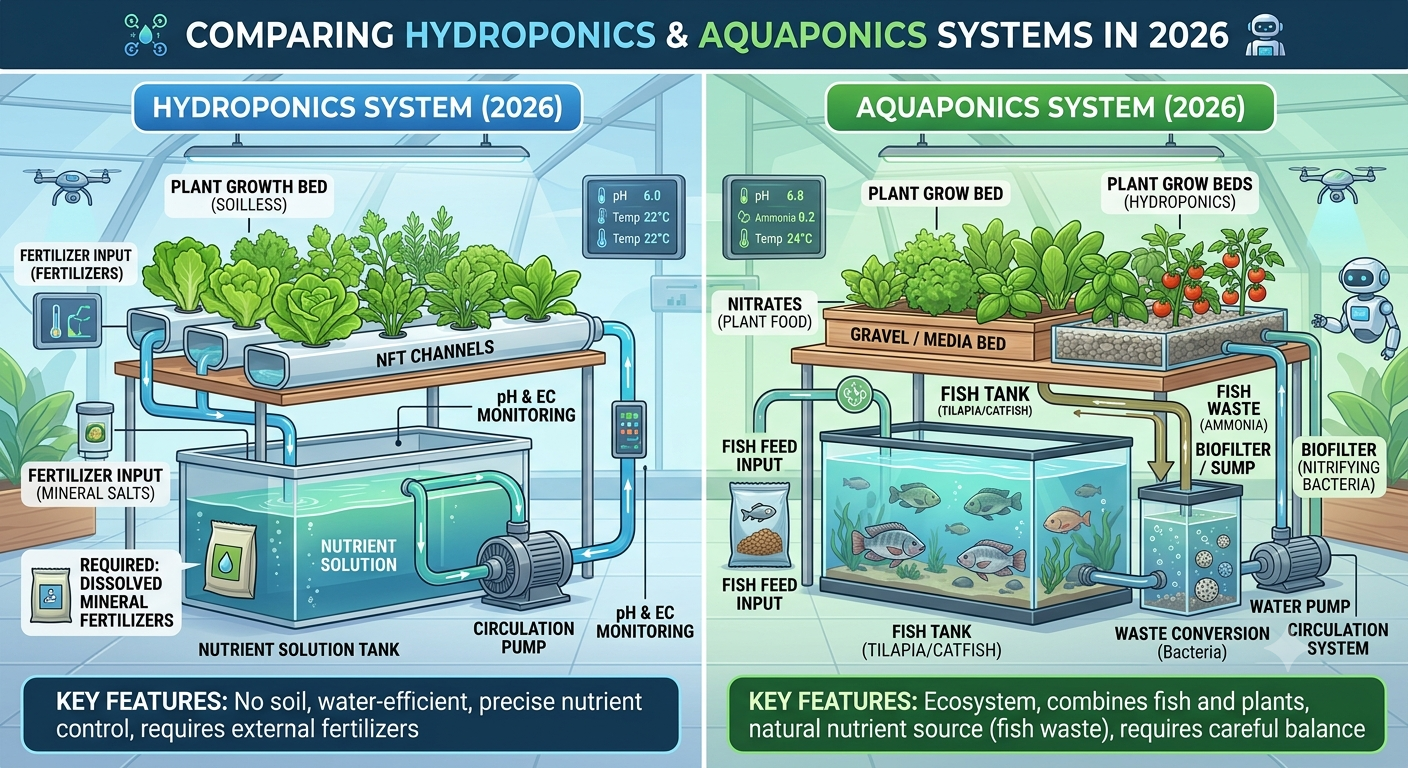
Hydroponics and aquaponics are both soilless growing methods, but they operate on fundamentally different principles. Hydroponics is a plant-focused system where you directly control nutrient delivery. Aquaponics is a closed-loop ecosystem where fish waste feeds plants, and plants clean water for fish.
🔬 Key Differences: Hydroponics vs. Aquaponics
The core distinction lies in how nutrients are supplied and what you are managing.
Hydroponics
· Nutrient Source: Synthetic fertilizers you mix into water.
· System Focus: Plant growth optimization. You manage pH, EC, and nutrient ratios directly.
· What You Grow: Plants only (vegetables, herbs, fruits).
· Complexity: Moderate. Requires monitoring and dosing nutrients. Fast plant response to errors.
Aquaponics
· Nutrient Source: Fish waste converted by beneficial bacteria into plant food.
· System Focus: Balance between fish, bacteria, and plants. You manage the ecosystem, not just plant food.
· What You Grow: Plants and fish (dual production).
· Complexity: High. Requires knowledge of fish care, biofiltration, and bacterial health. Mistakes can harm fish and plants.
📊 Performance & Efficiency: What the Research Says
Recent 2026 studies offer valuable insights into how these systems perform in practice:
· Crop Yield: Hydroponics typically achieves higher yields for a single crop because you can feed plants at optimal concentrations. In a tomato study, hydroponic yield was highest.
· Water Use: Aquaponics is the more water-efficient system. A Life Cycle Assessment found aquaponics reduces environmental impacts (including water consumption) by 40–49% compared to hydroponics. This is because water is recirculated for both fish and plants.
· Nutrient Efficiency: Aquaponics has significantly higher nutrient use efficiency because it recycles fish waste that would otherwise be discarded.
· Economic Performance: While aquaponics has higher operating costs (mainly electricity for pumps), the combined production of fish and crops resulted in the highest net profit among evaluated systems in a 2026 bioeconomic study. Sensitivity analysis shows energy consumption is the dominant factor influencing performance.
🎯 Which System Is “Best” for You?
There is no universal “best”—it depends entirely on your goals, resources, and constraints.
Choose Hydroponics if:
· You want maximum crop yield and precise control over plant nutrition.
· You are focused on commercial crop production where speed and consistency are priorities.
· You prefer a simpler system without the complexities of fish care and bacterial cycling.
· You have reliable access to synthetic fertilizers.
Choose Aquaponics if:
· You want dual production of both fish and vegetables.
· Sustainability and water conservation are top priorities for you.
· You are interested in education, small-scale farming, or sustainability projects.
· You are willing to accept higher system complexity and energy costs in exchange for resource efficiency and organic nutrient recycling.
In short, hydroponics is a precision tool for growing plants, while aquaponics is a miniature ecosystem that produces two crops. Your choice depends on whether you want to manage nutrients directly or nurture a balanced, integrated system.
