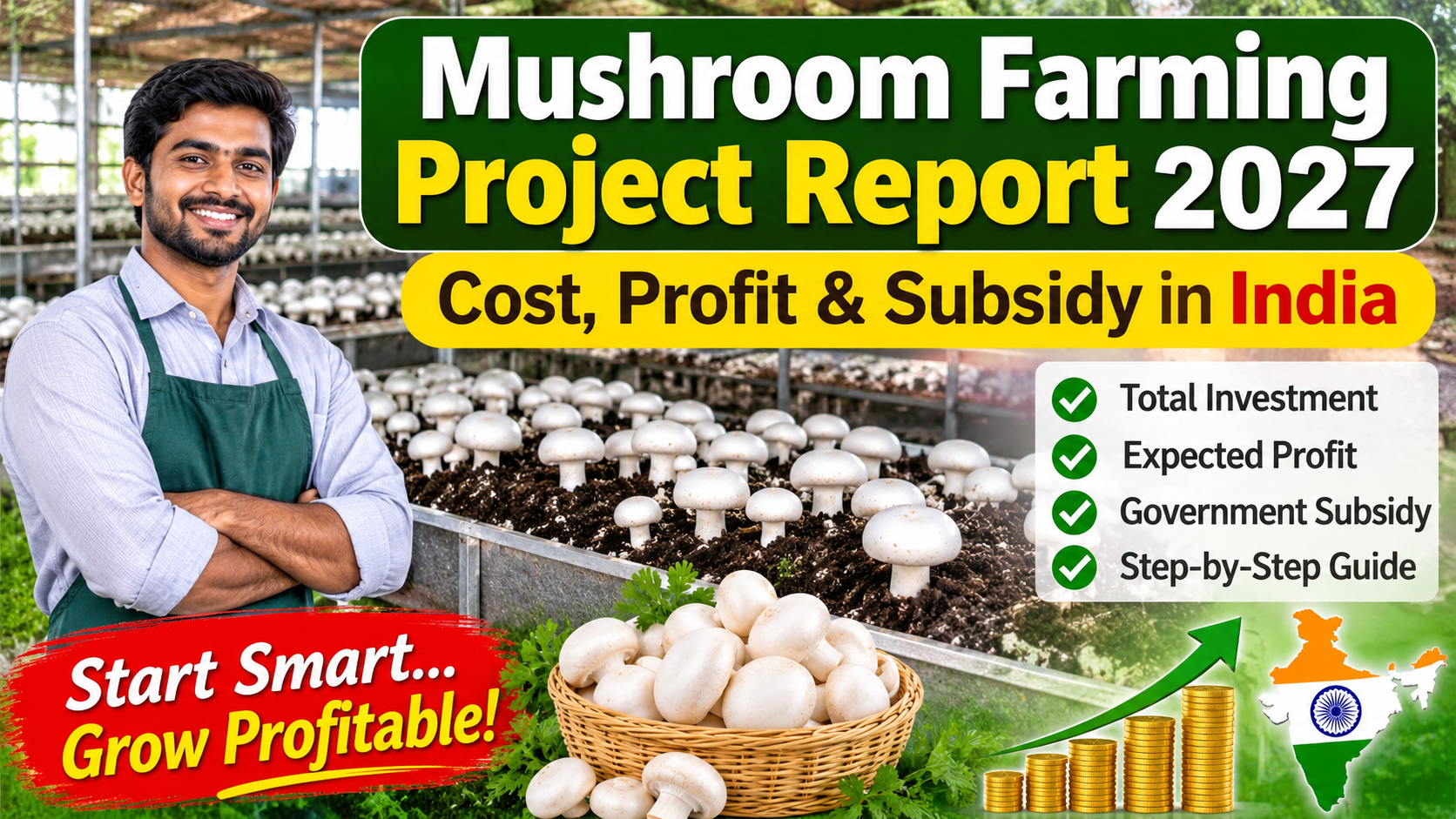
2027 Mushroom Farming Project Report: Cost and Profit Analysis in India


Mushroom farming is becoming an attractive agricultural business opportunity in India because it requires comparatively less land than traditional farming, can be started in a small indoor space, and offers opportunities to earn income throughout the year with proper temperature and humidity management.
In 2027, farmers, rural entrepreneurs, unemployed youth, self-help groups and small business owners can explore mushroom cultivation as a source of additional or full-time income.
However, mushroom farming is not automatically profitable. Success depends on mushroom variety, production capacity, climate control, raw material costs, labour, contamination management, market demand and selling prices.
This project report explains the investment, machinery, raw materials, production process, expected income, operating expenses, profit calculations, government support possibilities and marketing strategies for starting a mushroom farming business in India.
Important note about financial data: The financial figures below are planning estimates for 2027, not guaranteed market prices or official government-approved project costs. Actual costs vary by state, district, construction quality, electricity rates, production technology and local mushroom prices. The calculations will clearly distinguish assumptions from estimated results.:
- Mushroom farming cost in India 2027
- Mushroom farming profit per month
- Mushroom cultivation business plan
- Mushroom farming investment in India
- Mushroom farming subsidy in India
- Oyster mushroom farming project report
- Button mushroom farming cost
- Mushroom production per kg
- Mushroom farming loan
- Mushroom farming business for beginners
1. What Is Mushroom Farming?
Mushroom farming is the agricultural process of cultivating edible fungi under controlled environmental conditions for commercial consumption and sale.
Unlike conventional crops, mushrooms do not require large agricultural fields or direct sunlight for their growth. They are generally cultivated in specially designed rooms, sheds or growing houses.
Mushrooms grow on suitable organic substrates such as:
- Wheat straw
- Paddy straw
- Cotton waste
- Sawdust (for suitable species)
- Other agricultural residues
These materials provide nutrients and a growing medium for mushroom development.
Mushroom farming can convert agricultural waste into a valuable food product while creating opportunities for rural employment and small-scale entrepreneurship.
2. Why Start Mushroom Farming in 2027?
There are several reasons why mushroom cultivation deserves consideration as a small agricultural business in India.
2.1 Low Land Requirement
Traditional farming often requires several acres of land. Mushroom cultivation can be conducted in a relatively small indoor area.
A beginner can start with a properly ventilated room or a small growing shed, depending on the selected mushroom variety and production target.
2.2 Utilisation of Agricultural Waste
Mushroom cultivation can utilise agricultural residues that might otherwise have limited economic value.
For example, paddy straw and wheat straw can be used as substrates for suitable mushroom varieties.
This creates an additional income opportunity for farmers.
2.3 Short Production Cycles
Some mushroom varieties have relatively short cultivation cycles.
Oyster mushrooms, for example, can begin producing harvestable mushrooms within a few weeks after spawning, depending on the strain and growing conditions.
2.4 Employment Opportunities
Mushroom farming creates work in several activities:
- Raw material collection
- Substrate preparation
- Pasteurisation
- Spawning
- Bag filling
- Growing room management
- Harvesting
- Packaging
- Transportation
- Marketing
2.5 Multiple Business Opportunities
Entrepreneurs can earn revenue through different mushroom-related products:
- Fresh mushrooms
- Dried mushrooms
- Mushroom powder
- Mushroom pickles
- Mushroom soup mixes
- Packaged mushroom products
- Mushroom cultivation training and spawn distribution, where properly qualified and equipped
The best approach for a beginner is usually to establish reliable fresh-mushroom production and sales before investing in value-added processing.
3. Is Mushroom Farming Profitable in India?
Yes, mushroom farming can be profitable when production costs are controlled and a reliable market is available.
However, profitability is not the same for every mushroom grower.
Consider three different situations:
| Business type | Investment level | Business approach |
|---|---|---|
| Small-scale | Low | Home-based or small shed production |
| Medium-scale | Moderate | Commercial growing room |
| Large-scale | High | Multiple growing rooms and controlled production |
A small grower may sell mushrooms to local vegetable shops, hotels, restaurants and households.
A medium or large grower may supply supermarkets, wholesalers, food processors and institutional buyers.
The most important business principle is to identify customers before increasing production.
4. Real Mushroom Production Data in India
India’s mushroom industry has expanded considerably over the past decade.
A review published in CABI Agriculture and Bioscience reported that Indian mushroom production reached approximately 0.33 million tonnes during 2023–24. Button mushrooms accounted for the largest share, followed by oyster mushrooms. CABI Agriculture and Bioscience +1

4.1 Mushroom Production by Major Varieties
The following figures are approximate species-wise estimates reported in the 2025 review for 2023–24.
| Mushroom variety | Estimated production | Approximate share |
|---|---|---|
| Button mushroom | 235,200 tonnes | 70% |
| Oyster mushroom | 57,120 tonnes | 17% |
| Paddy straw mushroom | 30,240 tonnes | 9% |
| Milky mushroom | 10,080 tonnes | 3% |
| Other varieties | 3,360 tonnes | 1% |
| Total | 336,000 tonnes | 100% |
These are reported estimates, not a guarantee of the production mix in 2027. CABI Agriculture and Bioscience
4.2 Mushroom Production Opportunities in Different Indian States
Mushroom farming can be established in different parts of India, but the most suitable variety depends on the local climate and available infrastructure.
| State | Business opportunity |
|---|---|
| Bihar | Oyster and button mushroom |
| Uttar Pradesh | Button and oyster mushroom |
| Odisha | Paddy straw and oyster mushroom |
| Maharashtra | Oyster and button mushroom |
| Gujarat | Milky and oyster mushroom |
| Haryana | Button mushroom |
| Punjab | Button mushroom |
| Himachal Pradesh | Button and specialty mushrooms |
| Uttarakhand | Button and oyster mushroom |
| Jharkhand | Oyster mushroom |
| West Bengal | Oyster and paddy straw mushroom |
| Tamil Nadu | Milky and oyster mushroom |
| Karnataka | Oyster and milky mushroom |
| Kerala | Oyster mushroom |
This is a practical list of potential cultivation areas, not an official state-wise ranking.
4.3 Why Is Demand Increasing?
The mushroom market has opportunities in:
- Hotels and restaurants.
- Supermarkets.
- Vegetable retailers.
- Online grocery platforms.
- Food processing industries.
- Catering businesses.
- Frozen food manufacturers.
- Dried food product manufacturers.
Mushrooms are used in soups, pizza, pasta, curries, noodles and several other food products.
For entrepreneurs, the opportunity is not simply growing mushrooms. It is producing a consistent-quality product and building a dependable supply chain.
5. Types of Mushrooms Suitable for Commercial Farming in India
Before preparing a project report, it is important to select the right mushroom variety.


5.1 Button Mushroom Farming
Scientific name: Agaricus bisporus
Button mushrooms are among the most popular edible mushrooms in India.
They are commonly sold in supermarkets, hotels, restaurants and vegetable markets.
Growing conditions:
- Compost-based cultivation.
- Controlled temperature.
- High humidity.
- Proper ventilation.
- Casing soil management.
Temperature: Generally around 14–18°C during fruiting, depending on the strain.
Business advantages:
- Established consumer market.
- High recognition among customers.
- Opportunities for bulk supply.
- Suitable for commercial growing systems.
Business disadvantages:
- Compost preparation is technical.
- Temperature control can be expensive.
- Infrastructure investment is higher.
- Contamination can cause substantial losses.
Button mushroom farming is particularly attractive where cooling infrastructure and experienced technical support are available.
5.2 Oyster Mushroom Farming
Scientific name: Pleurotus species

Oyster mushroom farming is one of the more accessible options for beginners.
It can be cultivated using agricultural waste such as paddy straw and wheat straw.
Growing conditions:
- Suitable pasteurised substrate.
- Good ventilation.
- High relative humidity.
- Diffused light.
- Variety-specific temperature management.
Typical temperature: Approximately 20–30°C for many commonly cultivated strains, although the ideal temperature varies by species and strain.
Business advantages:
- Comparatively low initial investment.
- Short production cycle.
- Agricultural waste utilisation.
- Suitable for small growing rooms.
- Relatively simple cultivation process.
Business disadvantages:
- Fresh mushrooms have a short shelf life.
- Temperature variations affect production.
- Contamination must be controlled.
- Selling prices fluctuate.
My recommendation: Oyster mushroom farming is a sensible starting point for many first-time growers because the production system can be established on a relatively small scale.
5.3 Milky Mushroom Farming
Scientific name: Calocybe indica
Milky mushroom is a tropical mushroom that is particularly relevant to warm regions of India.

Growing conditions:
- Warm temperatures.
- High humidity.
- Suitable pasteurised substrate.
- Casing layer.
- Proper ventilation.
Typical temperature: Approximately 25–35°C, depending on the strain and cultivation stage.
Business advantages:
- Suitable for many warm-climate regions.
- Attractive white appearance.
- Potential for local retail sales.
- Alternative to seasonal button mushroom production.
5.4 Paddy Straw Mushroom Farming
Scientific name: Volvariella volvacea
Paddy straw mushroom is suitable for warm and humid conditions.
It can be grown using paddy straw, making it interesting for farmers in rice-producing areas.
Typical temperature: Approximately 28–35°C, depending on the cultivation method and strain.
Business advantages:
- Uses locally available paddy straw.
- Fast-growing mushroom.
- Suitable for tropical conditions.
- Can be started on a relatively small scale.
5.5 Which Mushroom Is Best for Beginners?
| Mushroom variety | Investment requirement | Climate suitability | Beginner suitability |
|---|---|---|---|
| Oyster | Low to moderate | Depends on strain | Very good |
| Button | Moderate to high | Cooler conditions | Moderate |
| Milky | Low to moderate | Warm conditions | Good |
| Paddy straw | Low to moderate | Warm and humid | Good |
The best variety is the one that can grow successfully in your local climate and can be sold reliably in your nearby market.
6. Mushroom Farming Business Models in India
A mushroom business can be started at different investment levels.
The following models are illustrative planning options for 2027.

6.1 Small-Scale Mushroom Farming
Suitable for: Beginners, farmers, homemakers and rural entrepreneurs.
Suggested infrastructure:
- One growing room.
- Basic racks or hanging arrangements.
- Substrate preparation equipment.
- Water sprayer.
- Thermometer and hygrometer.
- Clean packaging area.
Indicative startup budget: ₹50,000–₹1,50,000, excluding land purchase.
This model is useful for learning the cultivation process and testing local demand.
6.2 Medium-Scale Mushroom Farming
Suitable for: Entrepreneurs who want regular commercial production.
Suggested infrastructure:
- Two or more growing rooms.
- Substrate preparation area.
- Pasteurisation equipment.
- Commercial racks.
- Humidity management.
- Ventilation system.
- Packaging and storage facilities.
Indicative startup budget: ₹3 lakh–₹8 lakh, depending on existing buildings and equipment.
6.3 Large-Scale Mushroom Farming
Suitable for: Established agricultural entrepreneurs, FPOs and food-processing businesses.
Suggested infrastructure:
- Multiple production rooms.
- Temperature-controlled systems.
- Commercial pasteurisation facilities.
- Separate preparation and packing areas.
- Cold storage or pre-cooling arrangements.
- Delivery vehicles or transport contracts.
- Skilled workers.
Indicative startup budget: ₹15 lakh–₹40 lakh or more.
A large commercial unit should be established only after conducting a detailed market feasibility study.
7. Complete Mushroom Farming Project Report: Basic Details
Here is an illustrative commercial project model for an entrepreneur planning to establish an oyster mushroom farming business in India.
Project overview
₹5,00,000
Illustrative initial project investment
Business type
Oyster mushroom
Country
India
Project scale
Small commercial
Growing area
Approximately 500 sq. ft.
Production model
Staggered batches
Target market
Local and wholesale
Planning example only. The budget is not an official bank appraisal or approved project quotation.
7.1 Project Objectives
The primary objectives are:
- Establish a commercial mushroom production unit.
- Utilise agricultural waste as a cultivation substrate.
- Generate employment.
- Produce fresh edible mushrooms.
- Supply local retailers and restaurants.
- Develop a sustainable agricultural enterprise.
- Explore value-added mushroom products after production becomes stable.
7.2 Land and Building Requirements
Mushroom cultivation does not necessarily require agricultural land.
A suitable indoor building can be used if it provides:
- Clean surroundings.
- Proper drainage.
- Water availability.
- Ventilation.
- Temperature management.
- Protection against insects and rodents.
- Easy access for workers and transportation.
For a 500 sq. ft. unit, an illustrative layout could be:
| Section | Approximate area |
|---|---|
| Growing room 1 | 200 sq. ft. |
| Growing room 2 | 150 sq. ft. |
| Substrate preparation | 75 sq. ft. |
| Packing and storage | 50 sq. ft. |
| Utility and movement space | 25 sq. ft. |
| Total | 500 sq. ft. |
This is a suggested layout rather than a prescribed engineering design. Actual dimensions depend on racks, working space and production capacity.
7.3 Machinery and Equipment Required

| Equipment | Estimated cost |
|---|---|
| Growing room preparation | ₹1,00,000 |
| Metal or bamboo racks | ₹55,000 |
| Pasteurisation equipment | ₹45,000 |
| Water spraying system | ₹15,000 |
| Exhaust fans and ventilation | ₹25,000 |
| Humidity management equipment | ₹25,000 |
| Thermometer and hygrometer | ₹5,000 |
| Plastic cultivation bags and tools | ₹10,000 |
| Packing and weighing equipment | ₹15,000 |
| Electrical installation | ₹10,000 |
| Miscellaneous equipment | ₹10,000 |
| Total | ₹3,15,000 |
These are indicative budgeting allowances, not verified supplier quotations. A farmer who already has a suitable building may spend considerably less.
7.4 Initial Investment Calculation
| Investment component | Estimated amount |
|---|---|
| Room preparation and equipment | ₹3,15,000 |
| Initial raw materials | ₹35,000 |
| Working capital reserve | ₹1,00,000 |
| Training, transport and setup | ₹20,000 |
| Contingency | ₹30,000 |
| Total project investment | ₹5,00,000 |
The working capital reserve is important because the business must pay for inputs, labour, packaging and electricity before all harvested mushrooms are sold.
PART 2: Mushroom Farming Production Process and Raw Material Requirements
8. Raw Materials Required for Mushroom Farming
Raw materials are an important part of mushroom cultivation because the quality of the substrate directly affects production and contamination risk.
For oyster mushroom farming, the most commonly used raw materials include:

8.1 Main Raw Materials
| Raw material | Purpose |
|---|---|
| Paddy straw | Main growing substrate |
| Wheat straw | Alternative substrate |
| Mushroom spawn | Mushroom-growing inoculum |
| PP cultivation bags | Holding the substrate |
| Clean water | Substrate preparation and humidity |
| Rubber bands or cotton plugs | Closing cultivation bags |
| Disinfectants | Hygiene and sanitation |
| Packaging materials | Selling fresh mushrooms |
8.2 Mushroom Spawn Cost
Spawn is the planting material used to introduce mushroom mycelium into the prepared substrate.
It should be purchased from a reliable laboratory, agricultural university or recognised spawn producer.
An ICAR-Indian Institute of Horticultural Research price list published in June 2023 listed several oyster and milky mushroom spawn varieties at ₹90 per kg. This is a historical institutional price, not a guaranteed 2027 selling price. IIHR
Before purchasing spawn, check:
- Production date.
- Variety and strain.
- Cleanliness.
- Proper mycelial growth.
- Absence of contamination.
- Storage and transportation conditions.
Do not purchase spawn only because it is cheap.
9. Step-by-Step Oyster Mushroom Cultivation Process


9.1 Step 1: Selection of Quality Straw
Select clean and dry paddy or wheat straw.
Avoid:
- Rotten straw.
- Mouldy straw.
- Chemically contaminated material.
- Straw containing excessive soil.
- Material with unpleasant odours.
Good-quality straw helps establish a healthy growing environment.
9.2 Step 2: Straw Cutting
Cut the straw into smaller pieces, generally around 3–5 cm.
This makes handling, soaking and bag filling easier.
9.3 Step 3: Straw Soaking
Soak the chopped straw in clean water to increase its moisture content.
The duration depends on the substrate and preparation method.
9.4 Step 4: Substrate Pasteurisation
Pasteurisation reduces unwanted microorganisms and competing organisms.
Common methods include:
- Hot-water pasteurisation.
- Steam pasteurisation.
- Other validated substrate-treatment methods.
The correct temperature and treatment duration depend on the selected method and mushroom strain.
Never assume that ordinary soaking is equivalent to pasteurisation.
9.5 Step 5: Cooling and Draining
After treatment, drain excess water and allow the substrate to cool.
The substrate should be moist but not waterlogged.
Excessive moisture may create anaerobic conditions and increase contamination problems.
9.6 Step 6: Mushroom Spawning
Mix the spawn with the prepared substrate or layer it appropriately according to the selected cultivation method.
Use clean gloves and sanitised tools.
Follow the recommended spawn rate supplied by your training institution or spawn producer.
9.7 Step 7: Filling Cultivation Bags
Fill the prepared substrate into clean cultivation bags.
Make suitable holes or openings according to the production method.
Label bags with:
- Date of preparation.
- Mushroom variety.
- Spawn batch.
- Production batch number.
Batch records are particularly useful when contamination or poor yields occur.
9.8 Step 8: Incubation
During incubation, the mushroom mycelium spreads throughout the substrate.
The incubation room should maintain the temperature and ventilation requirements of the selected strain.
Keep bags away from direct sunlight.
Inspect the bags regularly for contamination.
9.9 Step 9: Fruiting Management
Once the substrate is sufficiently colonised, provide the conditions required for fruiting.
Important factors include:
- Suitable temperature.
- High relative humidity.
- Fresh air exchange.
- Appropriate light.
- Proper spacing between bags.
- Hygienic growing conditions.
For many oyster varieties, relative humidity around 85–95% is maintained during fruiting, with adjustments according to the strain and growing stage.
9.10 Step 10: Mushroom Harvesting
Harvest mushrooms when the caps are developed but before they become excessively mature.
Use clean hands or suitable harvesting tools.
Avoid pulling contaminated or damaged mushrooms into the saleable harvest.
9.11 Step 11: Grading and Packaging
Separate mushrooms according to:
- Size.
- Colour.
- Freshness.
- Appearance.
- Damage.
- Quality.
Use clean, food-grade packaging.
Fresh mushrooms should be cooled promptly and transported under suitable temperature conditions.
9.12 Step 12: Spent Mushroom Substrate Management
The leftover substrate after production is called spent mushroom substrate.
It may be used for suitable composting and vermicomposting applications after appropriate management.
This can create an additional benefit for farmers by recycling agricultural waste.
10. Mushroom Production Capacity: 1,000 Bag Project
Let’s understand production using a practical commercial calculation.
Suppose a farmer prepares 1,000 oyster mushroom bags.
Planning assumptions:
- Number of bags: 1,000
- Dry substrate per bag: 1 kg
- Expected saleable yield: 0.80 kg per bag
- Expected selling price: ₹150 per kg
These are illustrative assumptions. Actual biological efficiency, contamination losses and saleable yield depend on the mushroom strain and cultivation practices.
10.1 Total Mushroom Production
Formula:
Total production = Number of bags × Saleable yield per bag
Calculation:
1,000 × 0.80 kg = 800 kg
Estimated production per 1,000-bag batch
800 kg
Assuming 0.80 kg saleable mushrooms per bag
10.2 Gross Sales Calculation
Formula:
Gross revenue = Total saleable production × Selling price
800 kg × ₹150 = ₹1,20,000
The expected gross sales from this example batch are ₹1.20 lakh.
10.3 Alternative Production Scenarios
| Yield per bag | Total production | Gross sales at ₹150/kg |
|---|---|---|
| 0.50 kg | 500 kg | ₹75,000 |
| 0.60 kg | 600 kg | ₹90,000 |
| 0.70 kg | 700 kg | ₹1,05,000 |
| 0.80 kg | 800 kg | ₹1,20,000 |
| 0.90 kg | 900 kg | ₹1,35,000 |
| 1.00 kg | 1,000 kg | ₹1,50,000 |
These figures demonstrate why monitoring yield per bag is important for mushroom farmers.
PART 3: Mushroom Farming Cost and Profit Analysis in India 2027
11. Mushroom Farming Cost Per 1,000 Bags
The following is an illustrative operating budget for one 1,000-bag oyster mushroom batch.
| Expense | Estimated cost |
|---|---|
| Paddy or wheat straw | ₹8,000 |
| Mushroom spawn | ₹9,000 |
| Cultivation bags | ₹3,000 |
| Water and substrate treatment | ₹2,500 |
| Labour | ₹10,000 |
| Electricity | ₹3,000 |
| Cleaning and sanitation | ₹1,500 |
| Packaging | ₹5,000 |
| Transportation | ₹3,000 |
| Miscellaneous expenses | ₹2,000 |
| Total operating cost | ₹47,000 |
These are illustrative budget allowances, not observed national average prices. Local quotations should replace them before preparing a bank loan application.
11.1 Cost Per Kilogram
Formula:
Cost per kg = Total operating cost ÷ Total saleable production
₹47,000 ÷ 800 kg = ₹58.75 per kg.
Estimated operating cost per kg
₹58.75
Excludes fixed asset depreciation, loan interest, rent and any unlisted costs
12. Mushroom Farming Profit Per 1,000 Bags
Assume the farmer sells all 800 kg of mushrooms at ₹150 per kg.
| Particulars | Amount |
|---|---|
| Total production | 800 kg |
| Selling price | ₹150/kg |
| Gross revenue | ₹1,20,000 |
| Operating expenses | ₹47,000 |
| Operating surplus | ₹73,000 |
Formula:
Operating surplus = Gross revenue − Operating expenses
₹1,20,000 − ₹47,000 = ₹73,000.
This is a model result, not a guaranteed net profit. The final business profit will be lower after accounting for fixed costs, depreciation, financing, rent and taxes where applicable.
13. Mushroom Selling Price and Profit Sensitivity
The selling price is one of the most important factors affecting mushroom farming profitability.
Consider the same production and operating cost.
| Selling price per kg | Gross revenue | Operating surplus |
|---|---|---|
| ₹80 | ₹64,000 | ₹17,000 |
| ₹100 | ₹80,000 | ₹33,000 |
| ₹120 | ₹96,000 | ₹49,000 |
| ₹150 | ₹1,20,000 | ₹73,000 |
| ₹180 | ₹1,44,000 | ₹97,000 |
| ₹200 | ₹1,60,000 | ₹1,13,000 |
Important: Higher selling prices do not automatically mean higher profits. Unsold stock, retailer commissions, spoilage and additional transportation expenses can reduce actual earnings.
14. Mushroom Farming Monthly Income Calculation
A farmer who wants to earn regular monthly income should use staggered production.
Instead of preparing all cultivation bags on the same day, the farmer can prepare new batches at regular intervals.
For illustration, assume:
- 500 bags are prepared each month.
- Each bag produces 0.80 kg of saleable mushrooms.
- Monthly production is 400 kg.
- Average selling price is ₹150/kg.
- Operating costs are ₹23,500 per monthly batch.
| Particulars | Monthly amount |
|---|---|
| Monthly production | 400 kg |
| Selling price | ₹150/kg |
| Gross revenue | ₹60,000 |
| Operating costs | ₹23,500 |
| Operating surplus | ₹36,500 |
This is a simplified steady-state model. The actual cash flow during the first months will be different because mushroom production takes time to begin and different batches may overlap.
14.1 Annual Income Estimate
Assuming the same production and sales continue for 12 months:
| Particulars | Annual amount |
|---|---|
| Total production | 4,800 kg |
| Average selling price | ₹150/kg |
| Gross revenue | ₹7,20,000 |
| Operating costs | ₹2,82,000 |
| Operating surplus | ₹4,38,000 |
The above is not the final accounting profit. Add annual rent, equipment depreciation, interest, insurance and other fixed expenses to calculate the actual business profit.
14.2 What Happens if the Selling Price Falls?
For the same 400 kg monthly production and ₹23,500 operating cost:
| Selling price | Monthly revenue | Monthly operating surplus |
|---|---|---|
| ₹80/kg | ₹32,000 | ₹8,500 |
| ₹100/kg | ₹40,000 | ₹16,500 |
| ₹120/kg | ₹48,000 | ₹24,500 |
| ₹150/kg | ₹60,000 | ₹36,500 |
| ₹180/kg | ₹72,000 | ₹48,500 |
This sensitivity analysis shows why a farmer should develop more than one sales channel.
15. Break-Even Analysis of Mushroom Farming
Break-even analysis helps identify the minimum selling price or production level required to cover the operating costs.
For the 1,000-bag example:
- Operating expenses: ₹47,000
- Saleable production: 800 kg
Break-even operating selling price:
₹47,000 ÷ 800 = ₹58.75 per kg.
Therefore, ₹58.75/kg is the simplified operating break-even price before fixed and financing expenses.
For a more complete business break-even calculation, fixed costs must also be included.
15.1 Break-Even Formula
Break-even quantity:
Fixed costs ÷ (Selling price per kg − Variable cost per kg)
This calculation is useful when comparing different production capacities.
PART 4: Government Subsidies, Loans and Financial Support
16. Mushroom Farming Subsidy in India 2027
The Government of India supports horticulture development through schemes that may include mushroom cultivation infrastructure.
One important programme is the Mission for Integrated Development of Horticulture (MIDH).
The published MIDH Operational Guidelines 2025 specify the following mushroom infrastructure cost norms and assistance rates. National Horticulture Board
16.1 Mushroom Subsidy Details
| Component | Published cost norm | Assistance for eligible private projects |
|---|---|---|
| Mushroom production unit | ₹30 lakh | 40% |
| Spawn-making unit | ₹20 lakh | 40% |
| Compost-making unit | ₹30 lakh | 40% |
| Low-cost small-scale production unit (200 sq. ft.) | ₹2 lakh | 50% |
For the specified special areas, including eligible North-Eastern and Himalayan states and other notified categories, higher assistance rates may apply.
For the low-cost unit, the guideline specifies assistance for up to five units per beneficiary, subject to scheme conditions.
Example of low-cost unit assistance:
- Published unit cost norm: ₹2,00,000
- Assistance rate: 50%
- Illustrative assistance: ₹1,00,000
This is a scheme cost norm, not an automatic payment. Actual approval depends on state allocation, eligibility, technical specifications, inspection and sanction.
For production, spawn and compost units, the assistance is structured as credit-linked, back-ended subsidy. It should not be treated as an upfront cash grant.
16.2 Important Note for Gujarat Farmers
Farmers in Gujarat should check the current state horticulture department notifications and the relevant MIDH implementation rules before investing.
The subsidy availability, application window, documentation and eligible unit specifications can change.
Useful starting points:
- National Horticulture Board
- Mission for Integrated Development of Horticulture
- Gujarat iKhedut Portal
Do not begin construction assuming that subsidy approval is guaranteed.
17. Mushroom Farming Loan in India
A farmer or entrepreneur can explore agricultural and small-business financing through eligible banks and financial institutions.
Possible funding routes include:
- Commercial bank term loans.
- Working capital facilities.
- Agriculture and allied activity financing, where eligible.
- MUDRA loans for eligible micro enterprises.
- NABARD-linked financing arrangements through participating institutions.
- Other state-specific entrepreneurship support programmes.
Loan approval depends on the applicant’s repayment capacity, business feasibility, documents, bank policy and applicable scheme rules.
17.1 Documents Required for a Mushroom Farming Loan
Commonly requested documents include:
- Aadhaar or other accepted identity proof.
- PAN card.
- Address proof.
- Bank statements.
- Project report.
- Machinery quotations.
- Building ownership or rental documents.
- Training certificate, where required.
- Business registration, where applicable.
- Estimated income and expenditure statement.
- Relevant subsidy eligibility documents.
17.2 Sample Loan Structure
Suppose an entrepreneur starts a project costing ₹5 lakh.
| Particulars | Amount |
|---|---|
| Total project cost | ₹5,00,000 |
| Promoter contribution (example 25%) | ₹1,25,000 |
| Proposed bank finance | ₹3,75,000 |
| Total | ₹5,00,000 |
This is only an example of project financing. The bank may require a different promoter contribution, margin, security or loan structure.
Do not deduct an unapproved subsidy from the loan requirement.
PART 5: Market Research, Selling Strategies and Business Management
18. Where Can You Sell Mushrooms in India?
A successful mushroom farming business needs a strong marketing strategy.
Growing mushrooms is only one part of the business. Finding customers who purchase fresh mushrooms regularly is equally important.

18.1 Local Vegetable Markets
Local vegetable markets are one of the easiest starting points.
Farmers can approach:
- Vegetable wholesalers.
- Retail vegetable shops.
- Fruit and vegetable distributors.
- Local market traders.
- Weekly farmers’ markets.
The advantage is that you can establish relationships with buyers close to the production unit.
18.2 Hotels and Restaurants
Hotels and restaurants use mushrooms in several dishes.
Potential customers include:
- Pizza restaurants.
- Chinese restaurants.
- South Indian restaurants.
- Multi-cuisine restaurants.
- Hotels.
- Catering companies.
- Cloud kitchens.
Restaurants may prefer regular deliveries and consistent product quality.
18.3 Supermarkets and Grocery Stores
Supermarkets can provide access to retail customers.
However, suppliers may need to fulfil specific requirements involving:
- Packaging.
- Product grading.
- Weight accuracy.
- Labelling.
- Food safety.
- Delivery schedules.
- Invoicing.
18.4 Online Mushroom Selling
Farmers can explore direct-to-consumer sales through:
- WhatsApp Business.
- Local delivery groups.
- Instagram business pages.
- Their own website.
- Local online grocery services.
Online sales can help reduce dependence on a single wholesale buyer.
18.5 Food Processing Companies
Food processors may purchase mushrooms for:
- Frozen mushroom products.
- Dried mushrooms.
- Mushroom powder.
- Ready-to-cook food products.
- Canned mushrooms.
- Soup mixes.
Processing can help utilise mushrooms that cannot be sold immediately as fresh produce, provided the products are processed and stored safely.
19. Mushroom Marketing Strategy for New Farmers
A beginner should avoid producing a large quantity before establishing a customer base.
A practical marketing strategy is:
First month:
- Identify local mushroom buyers.
- Visit 10–15 vegetable shops.
- Contact nearby restaurants.
- Collect local selling-price information.
- Understand packaging requirements.
Second month:
- Start small production.
- Offer samples to interested buyers.
- Obtain feedback on size and quality.
- Record daily sales.
Third month:
- Establish repeat orders.
- Develop a delivery schedule.
- Increase production according to confirmed demand.
19.1 Suggested Marketing Channels
| Marketing channel | Main advantage |
|---|---|
| Local retailers | Regular small orders |
| Restaurants | Repeat business |
| Wholesale markets | Larger quantities |
| Direct household sales | Potentially better realisation |
| Supermarkets | Wider customer reach |
| Food processors | Potential bulk purchasing |
19.2 Branding and Packaging
A professional brand can help a small mushroom business compete in the local market.
Include the following on appropriate retail packaging:
- Brand name.
- Product name.
- Net weight.
- Batch or lot identification.
- Packing date.
- Use-by or best-before information, as appropriate.
- Storage instructions.
- Required food-business and regulatory details.
Ensure that packaging and labels comply with applicable FSSAI and Legal Metrology requirements.
20. Food Safety Requirements for Mushroom Businesses
Food safety is important because mushrooms are perishable food products.
Farmers who sell packaged mushrooms or operate processing businesses should understand applicable food safety requirements.
20.1 FSSAI Registration and Licensing
The Food Safety and Standards Authority of India regulates food businesses under India’s food safety framework.
Depending on the nature and scale of operations, appropriate registration or licensing may be required.
Official website: FSSAI FoSCoS Portal
20.2 Hygiene Requirements
Follow these basic practices:
- Use clean drinking-quality water where required.
- Maintain clean growing and packing areas.
- Wash hands before handling mushrooms.
- Keep pests away from cultivation rooms.
- Use clean harvesting tools.
- Separate contaminated produce.
- Avoid dirty packaging materials.
- Maintain proper storage temperatures.
- Keep records of production batches.
- Use suitable transport containers.
20.3 Fresh Mushroom Storage
Fresh mushrooms have a relatively short shelf life.
To reduce quality deterioration:
- Harvest carefully.
- Remove damaged material.
- Avoid unnecessary washing before storage.
- Use appropriate breathable packaging.
- Pre-cool when suitable.
- Maintain the recommended cold chain.
- Minimise the time between harvest and delivery.
Never assume that all mushroom varieties have the same shelf life.
21. Major Risks in Mushroom Farming
Mushroom cultivation has good business potential, but entrepreneurs must understand its risks.

21.1 Contamination Risk
Contamination is one of the most common production problems.
It can occur because of:
- Poor-quality spawn.
- Inadequate substrate treatment.
- Dirty cultivation rooms.
- Contaminated water.
- Poor hygiene.
- Improper handling.
Solution: Purchase quality spawn, maintain sanitation and follow a scientifically recommended substrate-treatment process.
21.2 Temperature Problems
Temperature outside the suitable range may slow mycelial growth or reduce fruiting.
Solution: Choose a mushroom variety suitable for the local climate and install appropriate temperature-monitoring equipment.
21.3 High Humidity Without Ventilation
Excess humidity combined with inadequate ventilation can increase disease and contamination risks.
Solution: Maintain humidity and fresh-air exchange according to the selected variety.
21.4 Market Price Fluctuations
The price of mushrooms may decrease when several growers harvest at the same time.
Solution: Develop multiple sales channels and use staggered production.
21.5 Short Shelf Life
Unsold mushrooms can lose quality quickly.
Solution: Develop buyer relationships, organise fast delivery and investigate suitable processing methods.
21.6 Electricity Expenses
Commercial production may require fans, humidifiers, pumps and cooling systems.
Solution: Use energy-efficient equipment and calculate electricity costs before expanding.
PART 6: Real-World Mushroom Farming Economics and Five-Year Business Plan
22. Real ICAR Mushroom Farming Case Study
A useful way to understand mushroom farming economics is to examine actual Indian farmer experiences.
An ICAR article published in October 2025 reported the economics of oyster mushroom cultivation by Smt. Sukarmani Kharkhusa under the Farmer FIRST Programme.
The report recorded the following results: ICAR
| Year | Bags | Mushroom production | Selling price/kg | Reported net income |
|---|---|---|---|---|
| 2020–21 | 150 | 133 kg | ₹150 | ₹15,000 |
| 2021–22 | 1,500 | 1,335 kg | ₹160 | ₹1.60 lakh |
| 2022–23 | 2,100 | 1,869 kg | ₹180 | ₹2.40 lakh |
| 2023–24 | 3,000 | 2,670 kg | ₹180 | ₹3.60 lakh |
| 2024–25 | 3,100 | 2,950 kg | ₹180 | ₹4.00 lakh |
22.1 What Can We Learn from This Case Study?
This example demonstrates several important business lessons.
First: A farmer can increase production capacity gradually.
The farmer expanded from 150 bags to 3,100 bags over the reported period.
Second: Technical support is important.
The Farmer FIRST Programme provided inputs and regular monitoring.
Third: Market development matters.
The farmer sold the produce in local markets and expanded the enterprise.
Fourth: Value addition creates opportunities.
The ICAR report also describes diversification into mushroom-based products such as badi and pickles.
Fifth: Waste recycling is beneficial.
Spent mushroom substrate was utilised for vermicomposting.
Important: This is a documented individual enterprise, not an average profitability benchmark for all Indian mushroom farmers. Its results should not be directly applied to a new commercial project without considering location, labour, costs and market access.
23. Five-Year Mushroom Farming Business Projection
The following is an illustrative business projection for a small commercial oyster mushroom enterprise.
It assumes gradual growth in production and sales.
Illustrative projection — not an official industry forecast
| Financial year | Saleable production | Average selling price | Gross revenue |
|---|---|---|---|
| 2027–28 | 3,000 kg | ₹140/kg | ₹4,20,000 |
| 2028–29 | 3,600 kg | ₹145/kg | ₹5,22,000 |
| 2029–30 | 4,200 kg | ₹150/kg | ₹6,30,000 |
| 2030–31 | 4,800 kg | ₹155/kg | ₹7,44,000 |
| 2031–32 | 5,400 kg | ₹160/kg | ₹8,64,000 |
These quantities require corresponding production capacity, customer demand and operating resources. They are not guaranteed output from a fixed 500 sq. ft. unit.
23.1 Projected Operating Expenses and Surplus
For illustration, assume operating costs equal ₹85 per saleable kg in the first year, increasing by ₹3 per kg each subsequent year.
| Year | Revenue | Operating cost | Operating surplus |
|---|---|---|---|
| 2027–28 | ₹4,20,000 | ₹2,55,000 | ₹1,65,000 |
| 2028–29 | ₹5,22,000 | ₹3,16,800 | ₹2,05,200 |
| 2029–30 | ₹6,30,000 | ₹3,69,600 | ₹2,60,400 |
| 2030–31 | ₹7,44,000 | ₹4,22,400 | ₹3,21,600 |
| 2031–32 | ₹8,64,000 | ₹4,86,000 | ₹3,78,000 |
Operating surplus is before depreciation, interest, rent, taxes and other excluded fixed expenses.
23.2 Five-Year Revenue Growth
24. How Much Investment Is Required for Different Mushroom Farming Capacities?
The following ranges are indicative planning budgets, not official subsidy norms or market quotations.
| Business capacity | Suggested investment |
|---|---|
| Home-based mushroom unit | ₹30,000–₹75,000 |
| Small commercial unit | ₹1–₹2.5 lakh |
| Medium commercial unit | ₹3–₹8 lakh |
| Advanced commercial unit | ₹10–₹20 lakh |
| Large integrated project | ₹25–₹50 lakh or more |
Actual investment depends on whether you own the building, the cooling requirements and whether you purchase new or used equipment.
24.1 Which Investment Model Is Best?
- Beginners: Start with a small oyster mushroom unit.
- Farmers: Use existing buildings wherever technically suitable.
- Entrepreneurs: Develop a medium-scale unit after validating demand.
- Established businesses: Consider controlled-environment production and processing.
A gradual expansion strategy can reduce financial risk.
PART 7: Advanced Mushroom Farming Business Opportunities in 2027
25. Mushroom Processing Business
Fresh mushroom production is only one business opportunity. Entrepreneurs can also explore processing and packaging.


25.1 Dried Mushroom Business
Dried mushrooms can be sold to:
- Grocery stores.
- Hotels.
- Restaurants.
- Food processors.
- Online customers.
Drying reduces moisture and can improve storage stability when performed and packaged correctly.
25.2 Mushroom Powder Business
Mushroom powder is produced by drying and grinding suitable edible mushrooms.
Potential applications include:
- Soup mixes.
- Seasoning mixes.
- Ready-to-cook products.
- Food formulations.
25.3 Mushroom Pickle Business
Mushroom pickles are another value-added product.
The business requires:
- Food-grade ingredients.
- A validated preparation process.
- Hygienic production.
- Appropriate packaging.
- Shelf-life and food safety controls.
25.4 Mushroom Snacks
Entrepreneurs can investigate:
- Mushroom chips.
- Dried mushroom snacks.
- Mushroom crackers.
- Mushroom-based ready-to-eat products.
These products require product development and proper food processing facilities.
26. Mushroom Farming Technology in 2027
Technology can improve production management and reduce unnecessary operating expenses.

26.1 Automatic Humidity Control
Humidity controllers can automatically operate humidifiers when the humidity falls below a selected level.
26.2 Temperature Monitoring
Digital temperature sensors help growers monitor growing-room conditions.
26.3 IoT-Based Mushroom Farming
Internet-connected sensors can provide information about:
- Temperature.
- Relative humidity.
- Air quality.
- Carbon dioxide levels.
- Equipment operation.
26.4 Automatic Ventilation
Automated fans can help maintain suitable fresh-air exchange.
26.5 Digital Production Records
Farmers can maintain digital records of:
- Spawn purchases.
- Substrate preparation.
- Bag production.
- Contamination.
- Harvest quantity.
- Selling price.
- Customer details.
- Electricity consumption.
- Labour expenses.
- Monthly profit.
Technology should be introduced according to business requirements. A beginner does not need an expensive automated system immediately.
PART 8: Practical Business Planning and Implementation
27. How to Start a Mushroom Farming Business in India: Step-by-Step

Follow these steps before investing money.
Step 1: Conduct market research
Find out how many customers purchase mushrooms in your area.
Step 2: Select the mushroom variety
Choose oyster, milky, button or paddy straw mushrooms according to local climatic conditions.
Step 3: Attend mushroom cultivation training
Contact your nearest Krishi Vigyan Kendra (KVK), agricultural university or ICAR mushroom research institution.
Step 4: Prepare a detailed project report
Calculate the building cost, equipment investment, working capital, expected production and selling price.
Step 5: Arrange the growing space
Select a clean building with appropriate ventilation, water and drainage.
Step 6: Purchase equipment
Purchase the necessary racks, bags, spraying equipment, pasteurisation equipment and monitoring instruments.
Step 7: Purchase quality spawn
Buy spawn from a reliable supplier.
Step 8: Begin small-scale production
Test a small number of bags before increasing production.
Step 9: Develop marketing channels
Contact restaurants, retailers, wholesalers and households.
Step 10: Expand gradually
Increase production only when cultivation results and market demand justify expansion.
28. Mushroom Farming Training in India
Training is especially important for beginners.
Useful institutions include:
- ICAR-Directorate of Mushroom Research.
- ICAR-Indian Institute of Horticultural Research.
- Krishi Vigyan Kendras.
- State agricultural universities.
- State horticulture departments.
Useful websites:
- ICAR Directorate of Mushroom Research.
- ICAR Indian Institute of Horticultural Research.
- Indian Council of Agricultural Research.
Training should cover substrate preparation, pasteurisation, spawning, incubation, fruiting, harvesting, contamination control and marketing.
29. Sample Mushroom Farming Project Report Summary for Bank Applications
The following table provides a simplified format that can be adapted for a bank project report.
| Particulars | Details |
|---|---|
| Project name | Commercial Oyster Mushroom Farming |
| Location | India |
| Business activity | Mushroom cultivation |
| Project scale | Small commercial |
| Proposed growing area | 500 sq. ft. |
| Initial investment | ₹5,00,000 |
| Proposed crop | Oyster mushroom |
| Cultivation method | Bag cultivation |
| Marketing | Retail, wholesale and restaurants |
| Expected revenue | Based on local market quotations |
| Proposed financing | Promoter contribution and bank loan |
| Employment | Owner-operated with additional labour as required |
29.1 Financial Information Required by Banks
A detailed bankable report should include:
- Detailed project cost.
- Machinery quotations.
- Building estimates.
- Working capital requirements.
- Production capacity.
- Expected yield.
- Market price evidence.
- Projected profit and loss account.
- Cash flow statement.
- Balance sheet projections.
- Debt repayment schedule.
- Break-even analysis.
- Promoter contribution.
The ₹5 lakh illustration in this article is not a substitute for a professionally prepared bank appraisal.
PART 9: Frequently Asked Questions About Mushroom Farming in India 2027
30. Is Mushroom Farming Profitable in India in 2027?
Mushroom farming can be profitable if farmers select a suitable variety, maintain production quality and establish a reliable market.
However, profit depends on selling prices, yield, operating expenses, infrastructure and wastage.
31. How Much Investment Is Required to Start Mushroom Farming?
A small home-based oyster mushroom unit may be started with approximately ₹30,000–₹75,000 under suitable conditions.
A medium commercial project may require ₹3 lakh–₹8 lakh or more.
These are indicative planning ranges.
32. How Much Profit Can I Earn from 1,000 Mushroom Bags?
In the illustrative calculation in this report:
- Bags: 1,000.
- Production: 800 kg.
- Selling price: ₹150/kg.
- Revenue: ₹1,20,000.
- Operating expenses: ₹47,000.
- Operating surplus: ₹73,000.
Actual results may be substantially different.
33. Which Mushroom Is Best for Beginners?
Oyster mushrooms are often a good starting option because they can be cultivated on agricultural residues using comparatively simple infrastructure.
However, milky mushrooms may be more suitable in some warm regions.
34. Can I Start Mushroom Farming at Home?
Yes. A clean, properly ventilated room can be used for small-scale mushroom cultivation if the necessary growing conditions are maintained.
35. How Many Days Does Mushroom Farming Take?
Oyster mushrooms can often begin producing harvestable mushrooms within approximately 3–4 weeks after spawning, depending on the strain and growing conditions.
Other varieties may require different production schedules.
36. Is Mushroom Farming Possible Without Land?
Yes. Commercial mushroom cultivation can be conducted in suitable indoor buildings without owning agricultural land.
37. Can Farmers Get Mushroom Farming Subsidies?
Eligible farmers and entrepreneurs may receive assistance under applicable horticulture development programmes, including MIDH.
The published 2025 guidelines contain mushroom infrastructure cost norms and assistance rates. Availability and eligibility must be confirmed with the state horticulture department.
38. Which Mushroom Has the Highest Market Demand in India?
Button mushrooms have a strong established market in India. Oyster and milky mushrooms also have commercial opportunities in suitable regions.
Demand differs by location and customer preferences.
39. How Much Space Is Required for Mushroom Farming?
A small unit may operate in a 100–200 sq. ft. area. Larger commercial units require additional growing, preparation and packing space.
40. Can Mushroom Farming Be Done Throughout the Year?
Yes, with appropriate variety selection and environmental management.
However, maintaining year-round production may require additional infrastructure and energy expenses.
41. How Can I Sell Mushrooms Directly to Customers?
You can sell through local vegetable shops, restaurants, supermarkets, WhatsApp Business, online grocery channels and direct household delivery.
42. What Is the Main Disadvantage of Mushroom Farming?
The major challenges include contamination, temperature management, short shelf life, market price fluctuations and the need for regular marketing.
43. Is Mushroom Farming Suitable for Gujarat?
Yes. Mushroom cultivation can be undertaken in Gujarat using suitable varieties and properly managed growing rooms.
Oyster and milky mushrooms are potential options, but local climate, especially summer temperatures, must be considered.
44. Can Mushroom Farming Be Started with ₹50,000?
A small experimental or home-based unit may be possible with ₹50,000 if an existing suitable room is available and expensive infrastructure is not required.
A commercial climate-controlled operation may require considerably more capital.
45. Can I Get a Bank Loan for Mushroom Farming?
You can approach banks with a technically sound project report, cost quotations, financial projections and other required documents.
Approval depends on the bank’s lending criteria.
PART 10: Final Conclusion – Is Mushroom Farming a Good Business in 2027?
Mushroom farming offers an interesting opportunity for Indian farmers and entrepreneurs who want to establish an agricultural business with relatively limited land requirements.
The availability of agricultural residues, opportunities for indoor production, growing consumer awareness and government horticulture development programmes create a favourable environment for exploring mushroom cultivation.
However, starting a profitable mushroom business requires more than purchasing spawn and preparing cultivation bags.
A successful entrepreneur must understand:
- Mushroom variety selection.
- Suitable growing conditions.
- Quality spawn procurement.
- Substrate preparation.
- Contamination management.
- Production planning.
- Labour management.
- Harvesting and packaging.
- Customer development.
- Financial management.
For beginners, starting with oyster mushroom cultivation is a reasonable approach in many regions.
Instead of immediately investing ₹10 lakh or ₹20 lakh, consider testing a smaller production unit, learning the cultivation process and developing a customer base.
Once production and sales become consistent, gradually increase the number of cultivation bags and explore value-added products.
The most important lesson is that mushroom farming profitability depends on the combination of good cultivation practices, controlled costs and reliable marketing.
A farmer who manages all three areas has a better chance of developing a sustainable mushroom farming business in India in 2027.
References and Sources for This Article
The following sources provide research, agricultural information, government guidelines and documented examples.
1. ICAR – Indian Council of Agricultural Research – Farmer FIRST mushroom cultivation economics. ICAR
2. Mission for Integrated Development of Horticulture – MIDH Operational Guidelines 2025 and mushroom subsidy norms. nhb.gov.in +1
3. National Horticulture Board – Oyster mushroom cultivation and historical economics. National Horticulture Board
4. ICAR-Indian Institute of Horticultural Research – Mushroom spawn and fresh mushroom institutional rates, June 2023. IIHR
5. CABI Agriculture and Bioscience – Current status and future prospects of mushroom cultivation and research in India: A review. CABI Agriculture and Bioscience
6. ICAR – Documented oyster mushroom cultivation success and farmer economics in Jharkhand. ICAR
7. Principal Scientific Adviser, Government of India – Low-cost ready-to-fruit mushroom bag technology. Principal Scientific Adviser
Additional SEO Recommendations for Your Website
Recommended featured image

Image ALT text: Mushroom Farming Project Report 2027 Cost and Profit Analysis in India
Image caption: Commercial mushroom farming in India with investment, production and profit opportunities in 2027.
Suggested Internal Links
Add internal links to relevant articles on your agriculture website:
- Mushroom Farming Business Plan in India.
- Oyster Mushroom Farming Complete Guide.
- Organic Farming Business Ideas in India.
- Agricultural Business Ideas for 2027.
- Government Agriculture Subsidy Schemes in India.
- Mushroom Farming Loan and Project Report.
- Food Processing Business Ideas in India.
AdSense-Friendly Publishing Checklist
- Add an original featured image.
- Include author information.
- Add a last-updated date.
- Include reliable references.
- Explain that financial estimates are illustrative.
- Avoid guaranteed-profit claims.
- Add relevant internal links.
- Use descriptive image ALT text.
- Add a table of contents.
- Check spelling and factual accuracy.
- Ensure the article is mobile-friendly.
- Provide About Us, Contact, Privacy Policy and Disclaimer pages.
