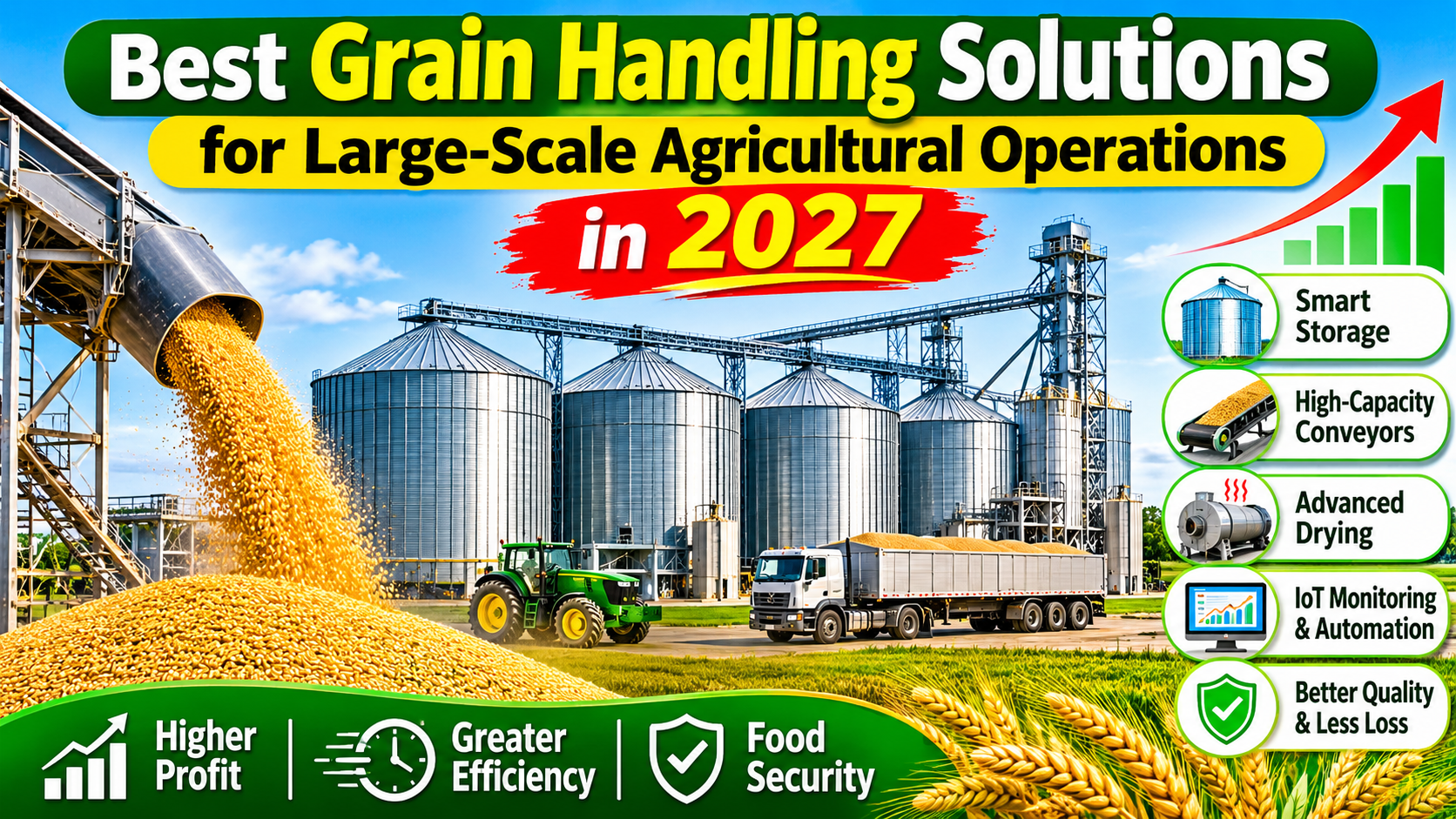
Large-scale agricultural operations in 2027 will increasingly depend on automated grain handling systems, smart storage facilities, high-capacity grain conveyors, advanced drying technology, and AI-powered grain monitoring.
The goal is to move grain efficiently from harvesting to transportation and storage while reducing labour costs, grain losses, moisture damage, pest infestation, and operational expenses.
For large farms, grain elevators, commercial farming companies, cooperatives, and grain processing businesses, the best approach is to build an integrated grain handling system rather than relying on individual machines.


1. Top 10 Grain Handling Solutions for 2027

1. Automated grain receiving systems
Automatically unload grain from trucks and trailers using hydraulic tipping platforms, receiving pits, intake hoppers, and high-capacity conveyors.
- Faster truck unloading
- Reduced manual labour
- Better harvest-season logistics

2. High-capacity grain conveyor systems
Use belt conveyors, chain conveyors, screw conveyors, and bucket elevators to transport grains between different processing and storage areas.
- Continuous grain movement
- Reduced handling time
- Suitable for large warehouses and grain terminals

3. Industrial grain drying systems
Continuous-flow and batch grain dryers remove excess moisture using controlled heated air.
- Prevents mould development
- Improves storage stability
- Helps maintain grain quality
Choose dryer capacity according to peak harvest intake, not just average daily production.

4. Large-capacity grain storage silos
Install steel or concrete silos with suitable foundations, ventilation, aeration, discharge systems, and inspection access.
- Bulk grain storage
- Better inventory management
- Protection from rain and external contamination

5. IoT-based grain monitoring
Smart sensors monitor grain temperature, relative humidity, and other storage conditions.
- Real-time monitoring
- Early warning of heating and spoilage
- Remote monitoring through mobile applications
Advanced systems can automate aeration based on sensor readings and weather conditions.

6. Automated grain cleaning and separation
Use vibrating screens, aspirators, magnetic separators, destoners, and optical sorters.
- Removes dust and foreign materials
- Separates stones and unwanted particles
- Improves grain quality and market value

7. AI-powered grain grading
Optical cameras and computer vision identify discoloured, damaged, broken, and defective grains.
- Consistent grading
- Better quality control
- Reduced manual inspection

8. Automated grain aeration
Fans and perforated ducts circulate air through stored grain to manage temperature and moisture migration.
- Reduces hot spots
- Helps control insect activity
- Maintains storage quality
Remember: aeration is primarily for cooling and conditioning, not a substitute for proper grain drying.

9. Automated warehouse handling
Use robotic palletizers, automated stacking systems, forklifts, and conveyor-based bag handling.
- Faster loading and unloading
- Better warehouse space utilization
- Reduced manual lifting

10. Automated grain loading and transportation
Integrate bulk loading conveyors, truck-loading spouts, weighbridges, and automated dispatch systems.
- Accurate weighing
- Faster dispatch
- Improved supply-chain efficiency
2. Comparison of Grain Handling Technologies
| Technology | Main purpose | Best application |
|---|---|---|
| Bucket elevator | Vertical movement | Grain terminals |
| Belt conveyor | Horizontal movement | Large farms |
| Screw conveyor | Short-distance transfer | Processing plants |
| Continuous-flow dryer | Moisture removal | Commercial grain facilities |
| Grain silo | Bulk storage | Large-scale farms |
| IoT sensors | Monitoring | Smart storage |
| Optical sorter | Quality grading | Processing facilities |
| Aeration fans | Cooling grain | Long-term storage |
| Robotic palletizer | Bag stacking | Warehouses |
| Automated weighbridge | Weight measurement | Grain collection centres |
3. Best Grain Storage Solutions for 2027


Storage selection depends on grain type, storage duration, available land, climate, and investment capacity.
| Storage solution | Main advantage | Suitable use |
|---|---|---|
| Steel silos | High-capacity bulk storage | Wheat, maize, rice |
| Concrete silos | Permanent infrastructure | Large grain terminals |
| Flat-bottom bins | Large storage volumes | Commercial farms |
| Hopper-bottom bins | Easy grain discharge | Frequent grain movement |
| Hermetic storage | Limits exchange with outside air | Selected grains and seeds |
| Modern warehouses | Flexible storage | Bagged food grains |
Important: Hermetic storage must be properly sealed and designed for the intended grain and moisture conditions. It is not a substitute for drying wet grain.
According to grain storage guidance from agricultural authorities, controlling temperature, moisture, and airflow is essential to preventing spoilage. Canada +2
4. Smart Grain Handling: Technologies to Watch in 2027

The next generation of grain handling facilities will increasingly integrate:
- Artificial intelligence: Predict grain spoilage risks and identify operational problems.
- Internet of Things: Connect temperature, humidity, and environmental sensors.
- Cloud-based monitoring: Allow managers to monitor several storage facilities remotely.
- Computer vision: Automatically identify grain defects.
- Predictive maintenance: Detect conveyor, motor, and bearing problems before major failures.
- Automated inventory management: Track grain quantities entering and leaving storage.
- Digital traceability: Record grain origin, quality, processing, and transportation history.
- Renewable energy: Use solar power where technically and economically suitable for auxiliary equipment.
A 2025 research review of Indian food-grain processing and storage highlights IoT, AI, blockchain, mechanized grading, and improved drying as important innovation areas. ScienceDirect
5. Recommended Grain Handling System for Large Farms
For large-scale operations, the most effective solution is an integrated grain handling line.

Recommended operational workflow:
01
Grain harvesting
Combine harvesters and grain collection
02
Truck receiving
Receiving pits and automatic unloading
03
Pre-cleaning
Remove dust, straw and foreign materials
04
Moisture testing
Measure moisture before storage or drying
05
Grain drying
Reduce moisture to the crop-specific safe target
06
Final cleaning and grading
Separate damaged and unwanted grain
07
Conveyor transportation
Move grain through the facility
08
Silo storage
Store with aeration and sensor monitoring
09
Quality inspection
Check temperature, moisture and pests
10
Dispatch and transportation
Load, weigh and transport grain
This workflow reduces unnecessary grain movement and creates a more organized operation.
6. Grain Handling Equipment for Different Farm Sizes
The following are planning categories, not fixed engineering capacity standards.
| Operation size | Suggested infrastructure |
|---|---|
| 100–500 tonnes | Small silos, mobile conveyors, grain cleaners |
| 500–2,000 tonnes | Multiple silos, mechanical dryer, bucket elevators |
| 2,000–10,000 tonnes | Automated receiving, industrial dryers, central control |
| 10,000–50,000 tonnes | Commercial grain terminal, bulk conveyors, automated storage |
| 50,000+ tonnes | Integrated grain terminal, high-capacity automation and logistics |
Actual machinery capacity should be calculated from peak tonnes per hour, daily harvest intake, operating hours, crop characteristics, and storage turnover.
7. Best Grain Handling Solutions for Indian Agriculture


For agricultural operations in India, particularly Gujarat, Punjab, Haryana, Rajasthan, Maharashtra, and Madhya Pradesh, equipment should be selected according to the local climate and major crops.
| Crop | Recommended solutions |
|---|---|
| Wheat | Grain cleaners, bucket elevators, steel silos |
| Rice | Paddy dryers, destoners, rice grading systems |
| Maize | Mechanical dryers, aeration silos, conveyors |
| Soybean | Pre-cleaners, moisture monitoring, bulk storage |
| Pearl millet (Bajra) | Grain cleaners, dry storage, moisture testing |
| Mustard | Screening systems, cleaning equipment, dry storage |
| Pulses | Destoners, optical sorting, grading machines |
Important considerations for Indian conditions
- Use moisture testing before accepting grain into storage.
- Protect storage infrastructure from monsoon water leakage.
- Provide adequate ventilation and suitable aeration.
- Maintain pest-control and sanitation programmes.
- Use dust collection systems around grain transfer points.
- Consider solar-assisted drying where local conditions permit.
- Maintain separate storage and traceability for different crop varieties and quality grades.
India is also moving towards more mechanized food-grain warehousing. The Central Warehousing Corporation’s 2025 mechanization initiative explored conveyor-based handling, automated stacking and de-stacking, and smart warehouse equipment. CEWACOR
8. How to Choose the Right Grain Handling Equipment
Before purchasing equipment, evaluate these eight factors:
- Capacity: How many tonnes must be handled per hour?
- Grain type: Wheat, rice, maize, soybean, or mixed crops?
- Moisture: What drying capacity is required?
- Storage duration: A few weeks, several months, or longer?
- Automation: Manual, semi-automatic, or fully automated?
- Energy consumption: Electricity, diesel, biomass, or solar-assisted systems?
- Maintenance: Availability of spare parts and technical support.
- Total cost: Purchase, installation, electricity, labour, maintenance, and depreciation.
Essential safety requirements
Large grain facilities need more than efficient machinery. They also need:
- Dust extraction and explosion-risk management.
- Guarding around conveyors, elevators, and rotating equipment.
- Lockout/tagout procedures during maintenance.
- Confined-space entry procedures for silos.
- Grain engulfment prevention.
- Fire detection and emergency response plans.
- Worker training and appropriate protective equipment.
Never enter a grain silo or bin containing flowing or unstable grain. Grain engulfment can be fatal.
9. Biggest Grain Handling Trends in 2027
| Trend | Expected operational benefit |
|---|---|
| AI monitoring | Early identification of storage risks |
| Automated conveyors | Reduced manual handling |
| Smart grain dryers | Better drying control |
| Wireless sensors | Remote monitoring |
| Robotic stacking | Faster warehouse operations |
| Solar-assisted drying | Potential energy savings |
| Digital grain tracking | Better supply-chain transparency |
| Predictive maintenance | Reduced unplanned downtime |
These are emerging technology directions, not guarantees that every facility will achieve the same savings or performance.
10. Final Recommendation: Best Integrated Solution

For a large agricultural operation in 2027, I recommend combining these six core systems:
- Automated grain receiving and unloading.
- High-capacity belt conveyors and bucket elevators.
- Industrial grain cleaning and grading.
- Energy-efficient mechanical grain dryers.
- Smart grain silos with automated aeration and monitoring.
- Digital inventory, weighing, and dispatch management.
The most important investment priority should be grain drying, proper storage, and real-time monitoring. These systems protect the value of harvested grain, while conveyors and automation improve operational efficiency.
11. Frequently Asked Questions (FAQs)
Q1. What is the best grain handling system for large farms?
An integrated system containing automated receiving, grain cleaning, mechanical drying, conveyors, storage silos, and smart monitoring is generally the best option.
Q2. Which conveyor is best for bulk grain transportation?
Belt conveyors are suitable for many long-distance horizontal applications, while bucket elevators are used for vertical transportation. Screw conveyors are useful for shorter transfer distances.
Q3. How can farmers prevent grain spoilage during storage?
Maintain appropriate grain moisture, control temperature through aeration, inspect grain regularly, and implement pest-management procedures.
Q4. What is smart grain storage?
Smart grain storage uses sensors, automation, and digital monitoring to track storage conditions and identify potential spoilage problems.
Q5. Is automated grain handling profitable?
It can improve profitability through reduced labour requirements, faster grain movement, lower handling losses, and improved grain quality. However, profitability depends on utilization, capital cost, energy prices, and maintenance.
Q6. Which grain storage technology is best for India?
Properly engineered steel silos with suitable aeration, moisture monitoring, cleaning, and mechanical drying are strong options for large commercial operations.
12. Useful Technical References
- Government of Canada – Monitoring Grain Temperature and Aerating Grain
- Research review – Food Grain Processing and Storage Innovations in India
- Central Warehousing Corporation – Food Grain Mechanization
- U.S. Grains Council – Grain Storage Solutions Manual
- University of Georgia – Aerating Grain in Storage
13. Plan a Grain Handling Facility for Your Operation
I can help develop a practical equipment and infrastructure plan based on your actual grain volume.
Grain handling facility requirements
1. Total grain storage capacity
500–2,000 tonnes
2,000–10,000 tonnes
10,000–50,000 tonnes
50,000+ tonnes
2. Main grain types
Wheat and maize
Rice and paddy
Soybean and pulses
Multiple grain types
3. Preferred automation
Manual
Semi-automated
Fully automated
4. Country of operation
Create my grain handling plan
