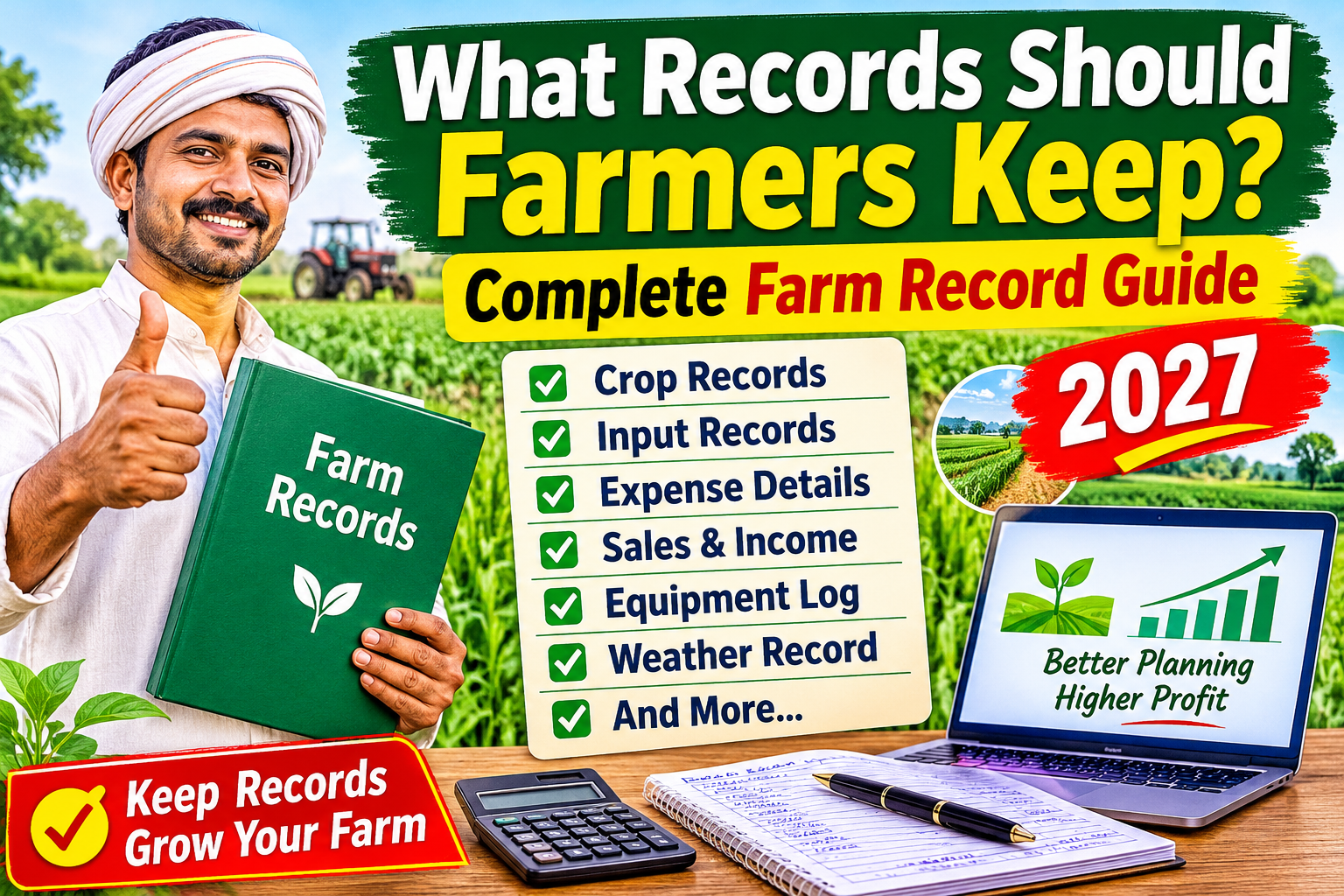
1. Introduction: Why Farm Record Keeping Matters in 2027
Farming has changed significantly over the years. Agriculture is no longer limited to planting seeds, watering crops, harvesting produce, and selling it in the market. Modern farming is becoming a business that depends on planning, technology, financial management, production efficiency, and accurate information.
Whether a farmer manages a small vegetable farm, a large crop operation, a dairy farm, a poultry unit, or a mixed agricultural business, keeping proper records is one of the most important habits for long-term success.
Many farmers work hard throughout the year but do not maintain complete information about their farming activities. They may remember how much fertilizer they purchased, how many workers helped during harvesting, or how much money they received from selling crops. However, memory alone is not a reliable way to manage a farm business.
Without proper records, it can be difficult to answer important questions:
- How much money did the farm earn this season?
- What was the total cost of producing one acre of crop?
- Which crop variety produced the best yield?
- How much fertilizer was used?
- Which field experienced the most pest problems?
- How much feed was consumed by livestock?
- Which farm machine required the most maintenance?
- How much money is still owed by customers?
- What should be changed in the next farming season?
Farm records help farmers answer these questions using actual information instead of guesswork.
According to the Internal Revenue Service’s Farmer’s Tax Guide, farm records can help farmers monitor business progress, prepare financial statements, identify income sources, track expenses, prepare tax returns, and support financial information. The guide also explains that farmers should maintain records that clearly show their income and expenses.
Record keeping is not only useful for large agricultural companies. Small farmers, family farms, independent growers, and new agricultural entrepreneurs can also benefit from maintaining simple and organized records.
In 2027, farmers who combine traditional agricultural knowledge with reliable record keeping can make more informed decisions about their land, crops, animals, equipment, and finances.
The goal of this guide is to explain what records modern farms should keep, why each record matters, and how farmers can create a practical recordkeeping system without making farm management unnecessarily complicated.
2. What Are Farm Records?
Farm records are written or digital documents that contain information about the activities, resources, production, expenses, income, and performance of a farming business.
These records may be maintained in a notebook, register, spreadsheet, mobile application, accounting software, or farm management system.
A farm record can contain information about:
- Land and field details
- Crop planting and harvesting
- Seed and fertilizer purchases
- Irrigation activities
- Pesticide and pest management applications
- Livestock identification and production
- Farm labor and wages
- Machinery and equipment
- Farm inventory
- Agricultural sales
- Income and expenses
- Loans and payments
- Weather and field observations
Farm records should be accurate, understandable, and updated regularly. A record that is incomplete or entered incorrectly may create confusion when the farmer needs to make an important decision.
The University of Wisconsin–Madison Extension explains that farm record keeping involves collecting and organizing both production information and financial information. These records support risk management and help farmers make decisions that can improve the long-term performance of their farm business.
In simple terms, farm records tell the story of what happened on the farm.
They show what the farmer produced, what resources were used, what the farm earned, what it spent, and what changes may be needed in the future.
3. Why Every Modern Farm Should Maintain Records
Keeping farm records requires time and effort. However, the information collected can be useful throughout the farming year.
3.1 Understanding Farm Profitability
A farmer may sell a large quantity of produce and assume that the season was profitable. However, sales revenue alone does not show the actual financial result.
The farmer must also consider expenses such as:
- Seeds and planting materials
- Fertilizers and soil amendments
- Irrigation and electricity
- Fuel and machinery
- Labor
- Packaging and transportation
- Land rent
- Repairs and maintenance
- Interest and other business costs
Farm financial records help farmers compare their income with their expenses.
For example, imagine that a farmer earns ₹2,00,000 from selling a crop during one season.
If the recorded production and operating expenses total ₹1,45,000, the difference is ₹55,000 before any additional costs that have not yet been included.
This example is for illustration only. Actual farm profitability depends on the crop, location, production system, market price, and cost structure.
Without expense records, the farmer may incorrectly assume that the entire ₹2,00,000 is profit.
3.2 Improving Crop Production
Crop production records help farmers understand how different fields and crop varieties perform.
A farmer can record:
- Crop variety
- Planting date
- Field location
- Seed quantity
- Fertilizer applications
- Irrigation dates
- Pest observations
- Harvest quantity
After several seasons, these records may reveal useful patterns.
For example, one field may consistently produce lower yields than another field. By reviewing field records, the farmer may discover differences in soil conditions, irrigation, planting dates, or crop management.
The records do not automatically identify the cause, but they provide useful information for further investigation.
3.3 Planning the Next Farming Season
Farmers often need to make important decisions before the next season begins.
They must estimate how much seed to purchase, how much fertilizer may be required, how many workers may be needed, and what expenses should be included in the budget.
Previous farm records provide a starting point for these estimates.
Instead of creating a budget entirely from memory, a farmer can review the previous season’s actual expenses and production results.
This makes future planning more realistic.
3.4 Managing Agricultural Risks
Farming is affected by weather, pests, diseases, input prices, market changes, and other factors.
Records can help farmers understand how these risks affect their operations.
For example, rainfall records may help explain why planting was delayed. Pest monitoring records may help identify when a particular problem usually appears. Sales records may show how different market channels performed.
Record keeping cannot eliminate agricultural risk, but it can help farmers prepare for future challenges.
3.5 Supporting Loans and Financial Decisions
Farmers may need financial assistance to purchase machinery, improve irrigation, expand production, or develop agricultural infrastructure.
Lenders and financial institutions may request information about farm income, expenses, assets, liabilities, and production.
Organized farm records make it easier to prepare this information.
A farmer who maintains clear financial statements and supporting documents can explain the farm’s financial position more effectively than someone who relies only on verbal estimates.
3.6 Keeping Farm and Personal Finances Separate
Many small farms operate as family businesses. Farm money may be used for household expenses, while personal money may sometimes be used to purchase agricultural inputs.
This can make it difficult to understand the actual financial performance of the farm.
A useful practice is to maintain separate farm accounts and record any money transferred between the farm and the household.
For example, if a farmer withdraws ₹10,000 from the farm account for a personal purpose, the transaction should be recorded appropriately.
The withdrawal should not automatically be treated as a production expense.
Separating business and personal transactions helps create clearer financial reports.
4. The Main Types of Farm Records Every Farmer Should Keep
There is no single recordkeeping system that is suitable for every agricultural operation. A dairy farm requires different records from a vegetable farm, while a poultry business may need detailed bird production and feed information.
However, most modern farms benefit from maintaining the following major categories of records.
4.1 Land and Field Records
Land and field records contain information about the agricultural land used by the farm.
These records may include:
- Field identification number
- Total field area
- Land ownership or lease information
- Soil type
- Soil test results
- Irrigation source
- Drainage conditions
- Previous crops
- Field boundaries
- Land improvement activities
A farmer managing several fields should give each field a unique identification number.
For example:
Field A — 1.5 acres
Field B — 2.0 acres
Field C — 1.0 acre
The farmer can then connect crop production, fertilizer use, irrigation, labor, and harvesting records to the correct field.
This is especially useful when different crops are grown on different areas of the farm.
4.2 Crop Production Records
Crop production records show what was planted, how the crop was managed, and what was harvested.
These records are among the most useful documents for crop farmers.
Important information includes:
- Crop name
- Crop variety
- Seed source
- Planting date
- Field identification
- Area planted
- Seed quantity
- Germination observations
- Fertilizer applications
- Irrigation dates
- Pest and disease observations
- Harvest date
- Total production
- Crop quality
For example, a farmer growing cotton on two fields may use different varieties or planting dates.
By maintaining separate production records, the farmer can compare the results without mixing the information from both fields.
Crop records can also help farmers identify which varieties perform better under their local growing conditions.
4.3 Seed and Planting Material Records
Seeds and planting materials represent an important part of crop establishment.
Farmers should record the quantity and type of seeds purchased or used.
A seed record may contain:
- Purchase date
- Seed variety
- Supplier name
- Quantity purchased
- Purchase price
- Seed lot or batch number
- Expiry or validity information, where applicable
- Quantity used
- Remaining stock
These records help farmers plan seed purchases and manage inventory.
They may also be useful when investigating poor germination or unexpected crop performance.
4.4 Fertilizer and Soil Amendment Records
Fertilizer records help farmers understand how nutrients are being applied to different crops and fields.
A useful fertilizer register should include:
- Application date
- Field identification
- Crop name
- Fertilizer product
- Quantity applied
- Application method
- Area treated
- Reason for application
- Relevant soil test recommendation
Farmers should record actual applications rather than relying only on planned quantities.
Soil amendment records may also include compost, manure, lime, or other materials used to improve soil conditions.
These records can support better nutrient management and help reduce unnecessary input use.
4.5 Irrigation and Water Management Records
Water is an important resource in agriculture.
Irrigation records help farmers monitor when water was applied and how irrigation was managed.
Useful information includes:
- Irrigation date
- Field or crop
- Irrigation method
- Duration of irrigation
- Estimated water quantity, if available
- Pump operating hours
- Energy consumption
- Water source
- Irrigation-related problems
Farmers using drip irrigation may also record filter cleaning, pipe maintenance, and system inspections.
For farms using pumps, recording operating hours and electricity or fuel consumption can help monitor irrigation costs.
4.6 Pest and Disease Management Records
Pest and disease records help farmers monitor crop health.
A pest management register may include:
- Date of observation
- Field identification
- Crop stage
- Pest or disease observed
- Level of infestation
- Weather conditions
- Management action
- Product or treatment used, if applicable
- Application date
- Follow-up observation
For pesticide applications, farmers should follow the product label and applicable local requirements. Records should accurately identify the product, application details, and any required safety or harvest-interval information.
These records can help farmers understand recurring crop health problems and review the effectiveness of management practices.
4.7 Harvest and Yield Records
Harvest records show how much produce was collected from each field or crop.
Important details include:
- Crop name
- Field identification
- Harvest date
- Harvest quantity
- Grade or quality
- Quantity rejected
- Quantity stored
- Quantity sold
- Quantity used for seed or other purposes
Yield records are particularly valuable because they allow farmers to compare production across fields and seasons.
For example, if a farmer harvests 4,000 kilograms of produce from a field measuring 2 acres, the recorded yield is:
4,000 kilograms ÷ 2 acres = 2,000 kilograms per acre.
This is a simple example of how production records can be converted into useful management information.
4.8 Farm Sales and Marketing Records
Sales records show how much produce was sold, who purchased it, and what price was received.
Farmers should record:
- Sale date
- Crop or product
- Buyer name
- Quantity sold
- Selling price
- Total sale value
- Market or sales channel
- Transportation cost
- Payment status
Sales may take place through a wholesale market, local trader, direct customer, cooperative, processor, or online agricultural marketplace.
Keeping separate records for each sales channel helps farmers compare prices and related costs.
A market offering a higher price may not always provide the highest net return if transportation, packaging, commission, or handling costs are also higher.
4.9 Farm Expense Records
Expense records show where farm money is being spent.
Farm expenses may include:
- Seeds
- Fertilizers
- Crop protection products
- Irrigation
- Fuel
- Electricity
- Labor
- Machinery repairs
- Packaging
- Transportation
- Rent
- Insurance
- Professional services
Every expense should have a date, amount, purpose, and supporting document where available.
Farmers should keep invoices, bills, receipts, and payment records in an organized manner.
A clear expense register makes it easier to prepare financial summaries and calculate production costs.
5. Financial Records Every Farm Should Maintain
Financial records help farmers understand the money moving through their agricultural business.
A farm may have several sources of income and many different expenses. Keeping these transactions organized is essential for understanding the financial position of the operation.
5.1 Farm Income Register
A farm income register records money received from agricultural activities.
Income may come from:
- Crop sales
- Milk sales
- Egg sales
- Livestock sales
- Fruit and vegetable sales
- Agricultural services
- Sale of farm by-products
- Other farm-related activities
Each transaction should include the date, source, amount, payment method, and supporting document.
Farmers should distinguish between money earned and money actually received when preparing financial reports. For example, a buyer may purchase produce today but pay the farmer several days later.
Recording the sale and the payment status helps prevent confusion.
5.2 Farm Expense Register
A farm expense register records money spent on agricultural operations.
A simple expense register can contain the following columns:
Date | Expense Category | Description | Amount | Payment Method | Receipt Number
Farmers can classify expenses into different categories to make monthly and yearly summaries easier.
5.3 Cash Book
A cash book records cash received and cash paid.
It is useful for farmers who frequently make small purchases or receive payments in cash.
The cash book should show:
- Opening cash balance
- Cash received
- Cash paid
- Closing cash balance
The recorded balance should be compared with the actual cash available.
5.4 Bank Transaction Records
Farmers should keep bank statements and record important transactions connected with the farm business.
These records may include:
- Deposits from crop sales
- Payments to suppliers
- Loan installments
- Interest payments
- Machinery purchases
- Electronic transfers
- Bank charges
A monthly review of bank transactions helps identify missing entries and payment mistakes.
5.5 Farm Loan and Credit Records
Many agricultural businesses use loans or credit facilities to purchase inputs, machinery, land, or infrastructure.
A loan register should contain:
- Lender name
- Loan account reference
- Loan purpose
- Original loan amount
- Interest terms
- Repayment schedule
- Installments paid
- Outstanding balance
- Relevant documents
Farmers should also record money owed to suppliers and money owed by customers.
This information helps them understand their financial commitments and expected cash flow.
5.6 Profit and Loss Statement
A profit and loss statement summarizes farm income and expenses over a particular period.
It can be prepared monthly, seasonally, or annually.
The basic calculation is:
Total farm income − Total farm expenses = Net operating result
The result may be a profit or a loss.
Farmers should understand that a simple cash summary may not include every accounting adjustment. For example, machinery depreciation and changes in inventory may affect a more complete financial statement.
5.7 Farm Balance Sheet
A balance sheet provides a picture of the farm’s financial position on a specific date.
It generally includes:
Assets: What the farm owns or controls.
Examples:
- Cash
- Bank balances
- Farm inventory
- Livestock
- Machinery
- Buildings
- Land
Liabilities: What the farm owes.
Examples:
- Loans
- Supplier payments due
- Outstanding bills
- Other financial obligations
Farm equity: The difference between assets and liabilities.
Assets − Liabilities = Farm equity
A balance sheet can help farmers understand whether their financial position is improving over time.
6. Livestock and Dairy Farm Records
Livestock farms require production records that are different from those used in crop farming.
Animal identification and regular record updates are important for managing health, feeding, reproduction, production, and farm inventory.
6.1 Animal Identification Records
Each animal should have a reliable identification method appropriate for the farm and applicable regulations.
The identification register may include:
- Animal identification number
- Species and breed
- Date of birth or estimated age
- Sex
- Purchase date
- Source
- Purchase price
- Parentage information, where available
A consistent identification system makes it easier to connect an animal with its health, breeding, and production history.
6.2 Animal Birth and Death Records
Farmers should record births, deaths, purchases, sales, and transfers.
These records help maintain an accurate livestock inventory.
For example, a dairy farm should be able to compare the number of animals recorded at the beginning of the month with the number at the end of the month.
6.3 Milk Production Records
Dairy farmers should record milk production by animal or group, depending on the scale of the operation.
Useful details include:
- Animal identification
- Date
- Morning milk quantity
- Evening milk quantity
- Total daily milk production
- Milk quality information, where available
- Sale quantity
- Milk retained for farm or household use
These records help farmers monitor production patterns and identify animals that may require closer management.
6.4 Animal Health and Veterinary Records
Health records should include information about veterinary visits, illness observations, treatments, vaccinations, and follow-up care.
A health register may contain:
- Animal identification
- Date of observation
- Health concern
- Veterinary advice
- Treatment details
- Treatment date
- Follow-up date
- Relevant withdrawal period, where applicable
Farmers should follow veterinary guidance and applicable animal health requirements.
6.5 Feed and Fodder Records
Feed is a major operating cost in many livestock businesses.
Farmers should record:
- Feed type
- Quantity purchased
- Purchase price
- Quantity issued
- Animal group
- Feeding date
- Remaining stock
- Fodder production
These records help farmers understand feed use and identify unusual changes in consumption.
6.6 Breeding and Reproduction Records
Breeding records help farmers monitor reproduction and maintain animal histories.
Useful information includes:
- Animal identification
- Service or insemination date
- Sire information, where available
- Pregnancy examination
- Expected calving date
- Actual calving date
- Birth outcome
These records support breeding management and future planning.
7. Poultry Farm Records
Poultry farming requires regular monitoring of bird numbers, feed consumption, egg production or meat production, health, and operating expenses.
7.1 Bird Stock Register
A poultry stock register records:
- Batch or flock identification
- Date of placement
- Number of birds received
- Supplier
- Bird type
- Daily or periodic mortality
- Transfers
- Birds sold or removed
- Final flock count
The register helps farmers maintain an accurate count of birds.
7.2 Feed Consumption Register
Feed records should include the type and quantity of feed supplied to each flock.
Farmers may record:
- Feed delivery date
- Feed type
- Quantity received
- Quantity consumed
- Remaining feed
- Feed cost
Feed consumption can be reviewed alongside bird growth or egg production.
7.3 Egg Production Records
For egg-producing operations, farmers should record:
- Date
- Number of birds
- Eggs collected
- Damaged or rejected eggs
- Eggs sold
- Eggs remaining in storage
These records help monitor production and sales.
7.4 Poultry Health Records
Poultry health records may include mortality, veterinary observations, vaccination information, biosecurity checks, and relevant treatment details.
Farmers should maintain these records according to veterinary advice and applicable regulations.
8. Farm Inventory Records
Inventory records show the quantity of materials and products available on the farm.
Inventory may include:
- Seeds
- Fertilizers
- Crop protection products
- Animal feed
- Fuel
- Packaging materials
- Spare parts
- Harvested produce
- Farm supplies
8.1 Stock Register
A stock register should record the opening quantity, purchases, usage, sales, losses, and closing quantity of each item.
The basic calculation is:
Opening stock + Stock received − Stock used or sold = Closing stock
The calculated closing stock should be compared with the physical quantity available.
8.2 Storage Records
Farmers should record where important materials are stored.
Storage information may include:
- Store or warehouse location
- Item name
- Quantity
- Batch number
- Purchase date
- Expiry date, where applicable
- Storage condition
- Inspection date
Materials should be stored safely and according to their labels and applicable requirements.
8.3 Harvest Storage Records
Farmers who store produce should record the quantity entering storage, quantity sold, quantity used, and quantity lost or rejected.
This helps identify storage losses and improve post-harvest planning.
9. Machinery and Equipment Records
Farm machinery is a valuable investment. Tractors, harvesters, pumps, sprayers, and other equipment require regular maintenance.
9.1 Machinery Register
A machinery register should include:
- Machine name
- Model
- Serial number
- Purchase date
- Purchase price
- Supplier
- Warranty information
- Current condition
- Location
9.2 Equipment Usage Log
Farmers should record how often equipment is used and which operations it performs.
Useful information includes:
- Date of use
- Machine identification
- Field or location
- Operating hours
- Activity performed
- Fuel used, where applicable
- Operator
These records help farmers understand equipment utilization.
9.3 Repair and Maintenance Register
Maintenance records should include:
- Service date
- Machine identification
- Problem reported
- Repair performed
- Parts replaced
- Service cost
- Next maintenance date
Regular maintenance records can help farmers plan repairs and avoid unnecessary downtime.
9.4 Machinery Purchase and Depreciation Records
Farmers should preserve documents related to machinery purchases, improvements, and disposal.
These documents may be needed for financial reporting, asset management, and tax purposes.
Depreciation treatment depends on the applicable accounting and tax rules. Farmers should consult a qualified accountant or tax professional for their circumstances.
10. Farm Labor and Worker Records
Labor records help farmers understand how much time and money are spent on agricultural activities.
A labor register may include:
- Worker or team identification
- Work date
- Field or activity
- Hours worked
- Work completed
- Payment rate
- Amount paid
- Payment date
Farmers should also record unpaid family labor when evaluating the true economic cost of production.
Even when family members do not receive wages, their time represents a resource used by the farm.
Worker records should be maintained respectfully and securely. Personal information should only be collected when necessary and handled according to applicable privacy and employment requirements.
11. Weather and Environmental Records
Weather conditions can influence planting, irrigation, crop growth, harvesting, and farm operations.
Farmers may record:
- Daily rainfall
- Temperature observations
- Strong winds
- Hail or storm events
- Flooding
- Dry periods
- Irrigation interruptions
Environmental records may also include soil test results, water quality observations, erosion concerns, and conservation activities.
These records can help explain changes in production and support future farm planning.
12. Digital Farm Records: The Future of Modern Farming
Digital technology is becoming an important part of agricultural management. Farmers can use computers, smartphones, spreadsheets, and farm management applications to organize their information.
Digital record keeping does not mean that every farmer needs expensive software. A small farm may manage its records using a simple spreadsheet, while a large agricultural business may require a more advanced system.
The most important factor is not the technology itself. It is whether the system helps the farmer maintain accurate, useful, and accessible information.
12.1 Spreadsheet-Based Farm Records
A spreadsheet is one of the simplest ways to begin digital farm management.
Farmers can create separate sheets for:
- Crop production
- Farm income
- Farm expenses
- Inventory
- Livestock
- Machinery
- Labor
- Sales
A spreadsheet can automatically calculate totals, averages, and other basic measurements.
For example, a farmer can enter the quantity of fertilizer purchased and the amount used in each field. The spreadsheet can calculate the remaining quantity.
Spreadsheets are particularly useful for farmers who want to begin digital record keeping without investing in a complex system.
12.2 Mobile Farm Record Applications
Mobile applications may allow farmers to record activities directly from the field.
Depending on the application, farmers may be able to:
- Record crop activities
- Add field observations
- Track expenses
- Monitor inventory
- Record livestock information
- Save photographs
- Review production summaries
Farmers should select applications based on their actual requirements, language preferences, connectivity, cost, and ability to export or back up information.
Before choosing an application, check whether the data can be downloaded if the farmer changes software in the future.
12.3 GPS and Field Mapping Records
GPS-based field mapping can help farmers identify field boundaries and connect records with specific agricultural areas.
A field map may include:
- Field name
- Field boundary
- Area
- Crop planted
- Soil information
- Irrigation infrastructure
- Field observations
Accurate field identification is especially useful for farms managing multiple plots.
12.4 Digital Photographs as Farm Records
Photographs can provide useful supporting information.
Farmers may photograph:
- Crop growth stages
- Pest or disease symptoms
- Soil conditions
- Irrigation problems
- Machinery damage
- Harvest quality
- Storage conditions
Photographs should include a date and, where practical, a field or activity identification.
A photograph without context may be difficult to use later. Adding a short note explaining what the photograph shows makes it more valuable.
12.5 Cloud Storage and Data Backup
Digital records should be backed up regularly.
Farmers may use secure cloud storage, external storage devices, or another suitable backup method.
A practical approach is to maintain:
- The main farm record file
- A backup copy
- A separate copy of important supporting documents
Farmers should protect their records with appropriate account security and avoid sharing private financial information unnecessarily.
13. How Often Should Farmers Update Their Records?
Farm records should be updated according to the type of information being collected.
Some records need to be updated immediately, while others can be reviewed weekly, monthly, or annually.
13.1 Daily Records
Daily records may include:
- Crop activities
- Irrigation
- Labor
- Livestock production
- Feed usage
- Sales
- Cash transactions
- Pest observations
Recording information on the same day helps reduce mistakes and missing details.
13.2 Weekly Records
Weekly reviews may include:
- Farm inventory
- Crop condition
- Machinery usage
- Outstanding customer payments
- Farm labor summaries
- Livestock performance
Weekly reviews help farmers identify problems before they become more difficult to manage.
13.3 Monthly Records
Monthly records may include:
- Income and expense summaries
- Bank reconciliation
- Loan payments
- Machinery maintenance
- Inventory valuation
- Production summaries
A monthly financial review can help farmers understand whether expenses are increasing faster than expected.
13.4 Seasonal Records
At the end of a crop season, farmers should review:
- Total area planted
- Total production
- Total sales
- Total production expenses
- Yield per acre or hectare
- Crop losses
- Market prices
- Lessons for the next season
Seasonal reviews are particularly valuable for farms growing different crops throughout the year.
13.5 Annual Records
At the end of the financial or farming year, farmers should prepare a complete review of the business.
This may include:
- Annual income statement
- Balance sheet
- Farm inventory
- Asset register
- Loan balance
- Annual production summary
- Tax-related documents
- Next year’s farm budget
The review should use a consistent date and accounting period whenever practical.
14. Simple Farm Record Templates
The following examples show how farmers can organize their records.
These are illustrative templates, not official government forms.
14.1 Crop Production Record
| Date | Field | Crop | Activity | Quantity | Notes |
|---|---|---|---|---|---|
| 10 June | Field A | Cotton | Sowing | 1.5 acres | Example entry |
| 18 June | Field A | Cotton | Irrigation | Recorded separately | Example entry |
| 25 June | Field A | Cotton | Field inspection | — | Example entry |
14.2 Farm Expense Record
| Date | Category | Description | Amount |
|---|---|---|---|
| 5 June | Seeds | Seed purchase | ₹5,000 |
| 12 June | Fertilizer | Fertilizer purchase | ₹8,000 |
| 20 June | Labor | Field work | ₹3,000 |
The amounts above are examples only and do not represent current market prices.
14.3 Farm Sales Record
| Date | Product | Quantity | Price | Total |
|---|---|---|---|---|
| 15 September | Vegetables | 100 kg | ₹20/kg | ₹2,000 |
| 18 September | Vegetables | 150 kg | ₹22/kg | ₹3,300 |
14.4 Livestock Record
| Animal ID | Date | Activity | Details |
|---|---|---|---|
| C-001 | 1 July | Health observation | Example entry |
| C-001 | 5 July | Milk production | Quantity recorded |
| C-002 | 8 July | Veterinary visit | Example entry |
14.5 Machinery Record
| Date | Machine | Activity | Cost |
|---|---|---|---|
| 10 August | Tractor | Routine service | ₹4,000 |
| 15 August | Water pump | Repair | ₹1,500 |
These example amounts are for demonstration and should not be used as actual farm cost estimates.
15. Common Farm Recordkeeping Mistakes to Avoid
Even farmers who maintain records may make mistakes that reduce their usefulness.
15.1 Recording Information Too Late
Waiting until the end of the month to enter daily activities can lead to forgotten transactions.
A better approach is to record important activities as soon as practical.
15.2 Mixing Personal and Farm Expenses
Personal purchases should not be mixed with farm operating expenses without proper classification.
Separate accounts and clear transaction descriptions help prevent confusion.
15.3 Keeping Receipts Without Organizing Them
Collecting receipts is useful, but receipts should be connected to the correct transaction.
Farmers can organize documents by year, category, and transaction date.
15.4 Maintaining Too Many Complicated Registers
A recordkeeping system that is too complicated may become difficult to maintain.
Farmers should begin with the essential records and add more detail when it becomes useful.
15.5 Ignoring Small Expenses
Small purchases can add up over a season.
Farmers should record minor expenses such as spare parts, transportation, packaging, and small farm supplies.
15.6 Failing to Review the Records
Recording information is only the first step.
Farmers should review their records regularly and use the information to make practical decisions.
15.7 Not Backing Up Digital Information
Digital records can be lost through device failure, accidental deletion, or other problems.
Regular backups help protect important farm information.
16. A Practical Farm Recordkeeping Plan for 2027
Farmers do not need to introduce every record at once.
A practical starting plan is to create a small system and improve it gradually.
Step 1: Identify the Main Farm Activities
List the crops, livestock, equipment, and other agricultural activities managed by the farm.
Step 2: Create Separate Record Categories
Create separate sections for production, finances, inventory, machinery, and livestock where applicable.
Step 3: Choose a Recordkeeping Method
Select a notebook, spreadsheet, mobile application, or suitable accounting system.
The system should be easy to use and affordable for the farm.
Step 4: Establish a Regular Recording Routine
Choose a specific time each day or week to update the records.
Step 5: Keep Supporting Documents
Save invoices, receipts, bills, bank statements, and other documents that support the recorded transactions.
Step 6: Review the Records Monthly
Check whether income, expenses, inventory, and production information are complete.
Step 7: Prepare a Seasonal Report
At the end of each farming season, compare production, expenses, and sales.
Step 8: Use the Information for Future Planning
Use the previous season’s information to prepare a more realistic budget and plan improvements.
17. What Farm Records Should Small Farmers Start With?
Small farmers do not need a large number of registers to begin.
A simple recordkeeping system can start with five essential records:
- Crop or livestock production register
- Farm income register
- Farm expense register
- Inventory register
- Farm asset and machinery register
These records provide a useful foundation for understanding the farm’s activities and financial performance.
As the business grows, farmers can add more detailed records for labor, irrigation, soil management, marketing, and other activities.
18. What Records Should Large Modern Farms Keep?
Large farms generally require more detailed information because they may manage several fields, workers, machines, crop varieties, and production units.
A larger farm may maintain:
- Field-wise production records
- Enterprise-wise financial accounts
- Machinery utilization reports
- Labor management records
- Inventory control systems
- Crop input application records
- Livestock performance reports
- Detailed financial statements
- Digital field maps
- Risk management documentation
- Quality and traceability records
The recordkeeping system should match the complexity of the farm.
A large farm may benefit from integrated software that connects production, inventory, machinery, and financial information.
19. Farm Recordkeeping and Agricultural Sustainability
Good farm records can also support more responsible resource management.
Farmers can use records to review:
- Water use
- Fertilizer use
- Soil conditions
- Crop rotation
- Energy consumption
- Waste management
- Input efficiency
- Soil conservation activities
For example, irrigation records may help a farmer identify fields where water management needs further attention.
Fertilizer records may help compare nutrient applications with soil test recommendations and crop performance.
These records support informed decisions, although they do not replace professional agronomic advice or local agricultural recommendations.
20. Farm Recordkeeping and Tax Compliance
Farmers should maintain financial records that support the income and expenses reported for their business.
Important supporting documents may include:
- Sales invoices
- Purchase receipts
- Bank statements
- Loan documents
- Payroll records
- Machinery purchase documents
- Tax returns
- Relevant business agreements
Record retention requirements differ by country and by type of document.
For example, the United States Internal Revenue Service’s Farmer’s Tax Guide generally discusses a three-year period for certain tax records, with exceptions. Employment tax records generally have a longer minimum retention period.
These are United States federal tax guidelines, not Indian tax rules.
Farmers in India should follow applicable Indian tax, accounting, employment, agricultural, and business requirements. A qualified local accountant can help determine which documents must be retained and for how long.
21. Frequently Asked Questions About Farm Records
21.1 What records should every farmer keep?
Most farmers should maintain production records, income records, expense records, inventory records, and asset records.
The exact records depend on the type and size of the farming business.
21.2 Why are farm records important?
Farm records help farmers understand production, expenses, income, inventory, and farm performance.
They also support planning, financial reporting, and better management decisions.
21.3 Can farmers maintain records in a notebook?
Yes. A notebook or register can be a practical starting point.
The important thing is to record information accurately, organize it clearly, and update it regularly.
21.4 Is digital farm record keeping necessary?
Digital record keeping is not necessary for every farm, but it can make information easier to organize, calculate, search, and back up.
Farmers should choose a system that matches their needs and resources.
21.5 How often should farm records be updated?
Daily activities should generally be recorded as soon as practical.
Financial summaries can be reviewed monthly, while production and profitability can be analyzed at the end of each season.
21.6 What is the most important farm record?
There is no single record that is most important for every farm.
For a crop farmer, field production and expense records may be particularly valuable.
For a dairy farmer, animal identification, milk production, feed, and health records may be essential.
For every farm business, accurate financial records are important.
21.7 How can farm records help increase income?
Records can help farmers identify unnecessary expenses, compare crop performance, monitor production costs, and evaluate selling prices.
They do not guarantee higher income, but they provide information that can support better decisions.
21.8 Should farmers keep old farm records?
Farmers should retain records according to applicable legal requirements and business needs.
Historical records can also be useful for comparing production, expenses, and farm performance across seasons.
22. Conclusion: Better Records for Better Farming in 2027
Farm record keeping is one of the foundations of modern agricultural management.
A successful farm requires more than hard work and good production techniques. Farmers also need reliable information about their land, crops, livestock, equipment, labor, inventory, income, and expenses.
Keeping accurate records helps farmers understand what is happening on their farms and prepare for future decisions.
A simple notebook, a well-organized spreadsheet, or a suitable digital farm management system can make a meaningful difference when it is used consistently.
Farmers should begin with the records that matter most to their operations, update them regularly, and review the information at the end of each month and farming season.
The most useful farm recordkeeping system is not necessarily the most expensive or complicated one. It is the system that provides accurate information, remains easy to maintain, and helps the farmer manage the business more effectively.
As agriculture continues to develop in 2027, combining traditional farming experience with organized records can help modern farms become more informed, efficient, and prepared for changing agricultural conditions.
Remember: Record what you do, organize what you collect, review what you learn, and use that information to plan your next farming season.
