

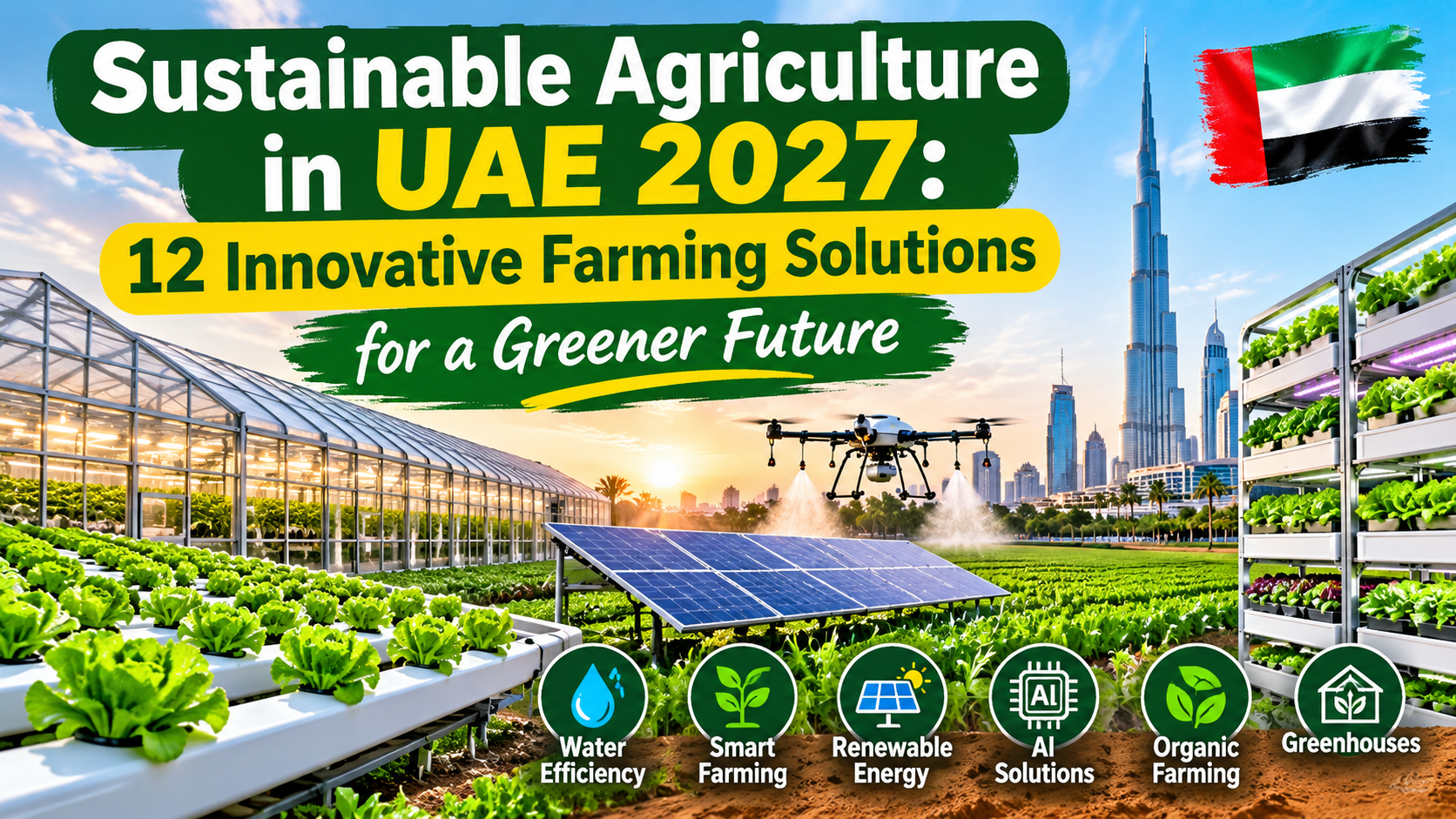
- Sustainable Agriculture in UAE 2027: 12 Innovative Farming Solutions.
- Tilapia Feeding Guide 2027: Daily Feed by Pond Size & Fish Weight.
- Mushroom Farming Project Report 2027: Cost, Profit & Subsidy in India
- From Farm to Carton in 2027: How Transparency Standards Became the New Competitive Edge for Organic Egg Brands
- Feed Cost Calculator: Calculate Livestock, Poultry, and Fish Feed Costs in 2027
2027 Sustainable Agriculture in the UAE: Innovative Solutions for a Greener Future
Sustainable agriculture in the UAE is becoming increasingly important as the country works to strengthen food security, conserve water, reduce dependence on food imports, and develop climate-resilient farming systems. With innovative technologies such as hydroponics, vertical farming, artificial intelligence, precision irrigation, and controlled-environment agriculture, the UAE is creating new opportunities for farmers, agricultural entrepreneurs, investors, and food producers.
This comprehensive guide explores the latest sustainable farming solutions, innovative agricultural technologies, investment opportunities, challenges, and future trends shaping UAE agriculture in 2027.
Meta Description: Explore sustainable agriculture in the UAE in 2027, including hydroponics, vertical farming, smart irrigation, AI farming, renewable energy, and food security innovations.
- Sustainable farming in UAE
- UAE agricultural technology 2027
- Vertical farming in Dubai
- Hydroponic farming in UAE
- Smart agriculture UAE
- Water-efficient farming
- Desert agriculture solutions
- UAE food security strategy
- Climate-smart agriculture
- Modern farming techniques in UAE
1. Introduction: Why Sustainable Agriculture Matters in the UAE
The United Arab Emirates is located in an arid region where agriculture faces several natural challenges, including limited freshwater resources, high temperatures, low rainfall, sandy soils, and increasing pressure on food production.
Traditional farming methods can consume substantial amounts of water and energy in such conditions. Therefore, sustainable agriculture is essential for developing a productive and environmentally responsible agricultural sector.
The UAE is increasingly investing in modern agricultural solutions that allow farmers to produce more food using fewer natural resources.
Some of the major priorities include:
- Reducing agricultural water consumption.
- Increasing domestic food production.
- Improving soil health and fertility.
- Promoting renewable energy in farming.
- Developing climate-resistant crops.
- Expanding hydroponic and vertical farming.
- Using artificial intelligence in agricultural management.
- Reducing food waste.
- Supporting agricultural entrepreneurs.
- Strengthening long-term food security.
Sustainable agriculture is not simply about growing crops without chemicals. It involves creating an entire agricultural system that balances economic profitability, environmental protection, and food security.
2. Understanding the UAE Agricultural Environment
Before understanding innovative farming solutions, it is important to examine the natural conditions affecting agriculture in the UAE.
2.1 Climate Conditions
The UAE has a predominantly arid desert climate.
Important characteristics include:
- Extremely hot summers.
- Mild winters.
- Limited annual rainfall.
- High evaporation rates.
- Saline groundwater in some agricultural areas.
- Occasional dust storms and strong winds.
These conditions make open-field agriculture challenging, particularly for crops that require regular irrigation and moderate temperatures.
2.2 Water Scarcity
Water availability is one of the most important factors affecting UAE agriculture.
Agricultural producers need efficient irrigation systems because excessive groundwater extraction can contribute to groundwater depletion and salinity problems.
Modern farming operations are increasingly exploring:
- Drip irrigation.
- Hydroponic growing systems.
- Treated wastewater reuse where permitted.
- Smart irrigation sensors.
- Desalinated water where economically and environmentally appropriate.
- Rainwater harvesting where feasible.
2.3 Soil Challenges
Desert soils often have low organic matter and limited natural fertility.
Some agricultural areas also experience soil salinity, which can reduce crop productivity.
Sustainable soil management includes composting, organic matter improvement, appropriate soil amendments, salt-tolerant crops, and careful irrigation management.
3. Top 12 Innovative Sustainable Agriculture Solutions in the UAE for 2027
The following technologies are expected to play an important role in the development of UAE agriculture.
3.1 Hydroponic Farming


Hydroponics is one of the most promising agricultural technologies for countries with limited fertile soil and water resources.
In this system, plants grow without traditional agricultural soil. Their roots receive water containing carefully balanced essential nutrients.
How hydroponic farming works:
- Seeds are planted in growing media.
- Nutrient-rich water is supplied to plant roots.
- Water circulation provides essential minerals.
- Sensors monitor pH and electrical conductivity.
- Farmers control temperature, humidity, and lighting.
- Crops are harvested when they reach maturity.
Suitable hydroponic crops in the UAE:
- Lettuce
- Spinach
- Basil
- Mint
- Coriander
- Kale
- Tomatoes
- Cucumbers
- Strawberries
Major advantages:
- Efficient water management.
- Reduced dependence on fertile soil.
- Controlled nutrient delivery.
- Year-round production possibilities.
- Potentially higher productivity per square metre.
Dubai’s official investment promotion information identifies hydroponics as an important part of its agricultural innovation ecosystem. It reports potential water savings of up to 70% compared with conventional growing methods, although actual savings depend on the system and comparison method. Invest in Dubai
3.2 Vertical Farming


Vertical farming involves growing crops in vertically stacked layers inside controlled indoor facilities.
It is especially useful in cities where agricultural land is expensive or limited.
In the UAE, vertical farming can help produce fresh vegetables close to consumers, reducing transportation distances and improving supply-chain efficiency.
Important technologies used:
- LED grow lights.
- Automated nutrient delivery.
- Temperature control.
- Humidity monitoring.
- Air circulation systems.
- Automated harvesting.
- Artificial intelligence monitoring.
Benefits of vertical farming:
- Requires relatively little land.
- Protects crops from extreme outdoor temperatures.
- Supports continuous production.
- Reduces exposure to certain outdoor pests.
- Enables urban food production.
One important example is Dubai’s FoodTech Valley initiative, which aims to create an integrated food and agricultural technology ecosystem using innovations such as vertical farming, hydroponics, and other advanced production methods. Invest in Dubai
However, vertical farming requires significant investment in electricity, cooling, lighting, and infrastructure. It is particularly suitable for high-value crops rather than every agricultural commodity.
3.3 Artificial Intelligence in Agriculture

Artificial intelligence (AI) is changing the way agricultural operations are managed.
AI-powered farming systems analyse information collected from sensors, cameras, weather stations, drones, and agricultural equipment.
Farmers can use this information to make better decisions.
Applications of AI in UAE agriculture:
- Detecting plant diseases.
- Monitoring crop growth.
- Predicting irrigation requirements.
- Identifying nutrient deficiencies.
- Forecasting crop yields.
- Detecting pest infestations.
- Automating greenhouse management.
For example, an AI-powered greenhouse system can identify when a crop is experiencing heat stress and notify the farmer before serious damage occurs.
AI can also analyse historical climate information and recommend suitable planting schedules.
The development of agricultural innovation facilities in Sharjah and Abu Dhabi is helping bring technologies such as AI, automation, and controlled-environment farming closer to commercial use. Gulf News +1
3.4 Smart Drip Irrigation

Water conservation is one of the most important priorities for sustainable agriculture in the UAE.
Smart drip irrigation delivers water directly to the root zone of plants instead of distributing it across the entire field.
Unlike conventional irrigation, smart irrigation systems can use sensors and automated controllers to adjust watering according to actual crop requirements.
Main components:
- Water storage tanks.
- Filtration units.
- Pressure regulators.
- Drip pipes.
- Emitters.
- Soil moisture sensors.
- Automated control valves.
Advantages:
- Reduces unnecessary water application.
- Helps maintain suitable soil moisture.
- Can reduce weed growth between crop rows.
- Supports fertigation.
- Improves irrigation management.
Farmers should regularly inspect filters, pipes, and emitters to prevent blockages caused by sediment or mineral deposits.
3.5 Climate-Smart Agriculture

Climate-smart agriculture focuses on improving agricultural productivity while helping farming systems adapt to changing environmental conditions.
This approach is particularly important in the UAE because of extreme heat, water scarcity, and changing weather patterns.
Some important practices include:
- Cultivating heat-tolerant crop varieties.
- Growing salt-tolerant crops.
- Improving irrigation efficiency.
- Using organic soil amendments.
- Reducing post-harvest losses.
- Diversifying agricultural production.
- Using weather information for farm planning.
Important 2026–2027 development: The UAE’s National Agricultural Initiative for the Adoption of Climate-Smart Crops is particularly relevant to this topic.
According to the International Center for Biosaline Agriculture (ICBA), the initiative’s first phase includes selected farms across the Emirates, farmer training, and agricultural extension support. Its second phase, planned for 2027, focuses on commercial expansion and private-sector partnerships. International Center for Biosaline Agriculture
This initiative could create opportunities for agricultural researchers, farmers, seed suppliers, and agritech companies.
3.6 Renewable Energy in Agriculture

Solar energy can help agricultural businesses reduce dependence on conventional electricity.
The UAE receives abundant sunlight, making solar-powered agricultural equipment an attractive option in suitable locations.
Applications include:
- Solar-powered irrigation pumps.
- Greenhouse ventilation systems.
- Agricultural lighting.
- Water pumping stations.
- Farm monitoring equipment.
- Cold-storage facilities.
- Automated agricultural machinery.
Solar energy can reduce operating costs over time, but the initial investment, battery requirements, maintenance, and seasonal energy demand must be considered.
For indoor farms, cooling and lighting can consume substantial electricity. Therefore, solar integration should be combined with energy-efficient equipment and proper building insulation.
3.7 Desert Agriculture and Salt-Tolerant Crops


Desert agriculture involves producing crops under conditions of limited rainfall, high temperatures, and challenging soil conditions.
The UAE has considerable experience with date palm cultivation and is also exploring other crops that can tolerate environmental stress.
Potential crops for desert and saline environments:
- Date palms.
- Quinoa.
- Barley.
- Certain salt-tolerant fodder crops.
- Selected halophyte species.
- Heat-tolerant vegetables.
The suitability of each crop depends on local soil conditions, water salinity, climate, market demand, and available agricultural infrastructure.
The ICBA plays an important role in research on biosaline agriculture and climate-resilient crops. International Center for Biosaline Agriculture
3.8 Controlled-Environment Agriculture

Controlled-environment agriculture (CEA) allows farmers to manage growing conditions inside greenhouses and indoor facilities.
Farmers can control:
- Temperature.
- Humidity.
- Light intensity.
- Carbon dioxide concentration.
- Irrigation.
- Nutrient availability.
- Air circulation.
CEA is especially useful for growing vegetables that cannot tolerate the UAE’s extreme outdoor summer temperatures.
It also allows farmers to plan production schedules more accurately.
However, successful CEA operations require reliable electricity, cooling infrastructure, skilled workers, and effective pest management.
3.9 Agricultural Drones

Agricultural drones are becoming useful tools for monitoring large farms.
They can collect aerial images and information that help farmers understand field conditions.
Common applications:
- Crop monitoring.
- Identifying irrigation problems.
- Detecting plant stress.
- Mapping agricultural land.
- Monitoring date palm plantations.
- Assessing crop damage.
- Supporting precision agricultural operations.
Drone spraying and other regulated operations must follow UAE aviation, agricultural, and pesticide-use requirements.
3.10 Organic Farming

Organic agriculture focuses on maintaining ecological balance and reducing dependence on certain synthetic agricultural inputs.
Important practices include:
- Compost application.
- Crop rotation.
- Biological pest management.
- Responsible soil management.
- Organic fertilisers.
- Biodiversity protection.
Organic farming can help create premium market opportunities, but producers must comply with the applicable UAE organic production and certification requirements before marketing products as certified organic.
The UAE’s food-security and agritech information highlights a policy objective of increasing organic farmland by 5% annually. This should be understood as a reported policy growth target, not a guarantee of individual farm profitability. Invest-Emirates.ae
3.11 Aquaponics

Aquaponics combines fish farming with hydroponic vegetable production.
In this system, fish produce waste containing nutrients. Beneficial bacteria convert ammonia into forms that plants can absorb. The plants take up nutrients, while treated water circulates back to the fish tanks.
Main components:
- Fish tanks.
- Biological filtration.
- Water pumps.
- Plant-growing beds.
- Aeration equipment.
- Water-quality sensors.
Potential fish species depend on local regulations, temperature control, water quality, and production objectives.
Aquaponics can provide two products from one integrated system, but it requires careful management of fish health, plant nutrients, oxygen, and water quality.
3.12 Agricultural Waste Recycling and Composting

Agricultural waste recycling is another important part of sustainable farming.
Crop residues, suitable plant waste, and certain organic materials can be processed into compost.
Benefits include:
- Reducing organic waste.
- Improving soil organic matter.
- Supporting soil structure.
- Recycling nutrients.
- Reducing dependence on some commercial fertilisers.
However, compost should be properly processed and tested for maturity, salinity, contaminants, and suitability before agricultural use.
4. UAE Government Initiatives Supporting Sustainable Agriculture
The development of sustainable agriculture is supported by government strategies, research organisations, agricultural authorities, and private-sector partnerships.
4.1 National Food Security Strategy 2051
The UAE National Food Security Strategy 2051 aims to strengthen the country’s food security and improve the resilience of its food supply.
Its major priorities include:
- Increasing sustainable local food production.
- Diversifying international food supply sources.
- Improving agricultural technology.
- Reducing food loss and waste.
- Supporting food supply-chain resilience.
- Improving access to safe and nutritious food.
The strategy also includes a national food basket covering 18 main food types and initiatives to diversify their supply sources. Invest-Emirates.ae
4.2 Dubai Food Security Strategy 2030
Dubai’s Food Security Strategy 2030, detailed in October 2026, focuses on five major pillars:
- Food availability.
- Affordability.
- Quality and safety.
- Sustainability and resilience.
- Industry empowerment.
The strategy also emphasises sustainable local production, resilient supply chains, food-waste reduction, and investment in agricultural technology. Emirates News Agency
4.3 Abu Dhabi Agricultural Sustainability Initiatives
The Abu Dhabi Agriculture and Food Safety Authority (ADAFSA) supports agricultural sustainability through farm guidance, irrigation management, agricultural development planning, and the Abu Dhabi Good Agricultural Practices programme.
Its published information reports that 1,530 farms have obtained AD.G.A.P. certification. The programme addresses food safety, environmental protection, worker well-being, and biodiversity. Agricultural Sustainability
4.4 Agricultural Research and Innovation
Research institutions are helping farmers identify technologies suitable for the UAE’s environmental conditions.
The October 2026 partnership between the Advanced Technology Research Council and ADAFSA aims to test and scale technologies in areas including:
- Water and soil health.
- Smart agriculture.
- Sustainable food systems.
- Biosecurity.
- Livestock management.
Its Agricultural Innovation Scale-Up Studio is intended to validate promising solutions through practical field trials. ATRC
5. Best Crops to Grow Using Sustainable Agriculture in the UAE
Choosing the right crop is one of the most important decisions for agricultural entrepreneurs.
The crop should match the local climate, water availability, production system, market demand, and operating costs.
| Crop | Suitable farming method | Market opportunity |
|---|---|---|
| Lettuce | Hydroponics | Restaurants and supermarkets |
| Basil | Vertical farming | Hotels and food businesses |
| Tomatoes | Greenhouse farming | Retail and wholesale |
| Cucumbers | Protected cultivation | Fresh vegetable markets |
| Strawberries | Controlled environment | Premium fresh produce |
| Dates | Traditional farming | Domestic and export markets |
| Quinoa | Experimental field cultivation | Specialty food markets |
| Microgreens | Indoor farming | Restaurants and premium retailers |
| Mint | Hydroponics | Retail and hospitality |
| Barley | Field cultivation | Fodder and livestock |
Important: These are potential crop opportunities, not guaranteed profitable crops. Conduct local market research and test production costs before investing.
6. Sustainable Agriculture Business Opportunities in the UAE


The development of agricultural technology creates opportunities for entrepreneurs and investors.
6.1 Commercial Hydroponic Farming
Entrepreneurs can establish hydroponic farms to supply fresh vegetables to:
- Supermarkets.
- Hotels.
- Restaurants.
- Catering companies.
- Grocery stores.
- Food distributors.
A successful business needs reliable buyers, consistent product quality, effective cooling, and controlled production costs.
6.2 Vertical Farming Business
Vertical farming is an opportunity for entrepreneurs interested in technology-based agriculture.
Potential business products include:
- Lettuce.
- Microgreens.
- Basil.
- Mint.
- Specialty herbs.
However, electricity and cooling costs must be carefully evaluated before establishing a commercial facility.
6.3 Organic Vegetable Production
Organic vegetable production can target consumers looking for certified organic products.
Entrepreneurs should understand certification requirements, production standards, packaging, distribution, and customer demand.
6.4 Agricultural Technology Services
Farmers increasingly need professional assistance with modern agricultural equipment.
Potential service businesses include:
- Smart irrigation installation.
- Greenhouse automation.
- Agricultural sensor installation.
- Drone-based crop monitoring.
- Hydroponic system maintenance.
- Agricultural data analysis.
- Soil and water testing.
6.5 Compost Production
Businesses can collect suitable organic materials and convert them into quality compost.
Potential customers include nurseries, landscaping companies, farms, and gardening businesses.
7. Estimated Investment for Sustainable Farming in the UAE
Agricultural investment costs depend on location, land arrangements, production capacity, technology, labour, electricity, water quality, and construction requirements.
The following figures are illustrative planning scenarios, not verified UAE market quotations.
| Farming business | Illustrative initial investment |
|---|---|
| Small hydroponic setup | AED 20,000–60,000 |
| Small greenhouse | AED 50,000–150,000 |
| Commercial hydroponic farm | AED 200,000–700,000 |
| Indoor vertical farm | AED 500,000–2,000,000+ |
| Small aquaponics system | AED 40,000–120,000 |
| Solar irrigation installation | AED 15,000–80,000 |
Actual quotations can differ substantially.
7.1 Example: Small Hydroponic Farm Budget
Consider a hypothetical small hydroponic vegetable business.
| Expense | Estimated cost |
|---|---|
| Growing structure | AED 15,000 |
| Hydroponic channels | AED 8,000 |
| Water tanks and pumps | AED 4,000 |
| Filtration system | AED 3,000 |
| Nutrient management | AED 2,000 |
| Sensors and monitoring | AED 3,000 |
| Seeds and growing materials | AED 1,500 |
| Other installation expenses | AED 3,500 |
| Total | AED 40,000 |
This is an illustrative equipment budget. It does not necessarily include land, commercial licensing, cooling, labour, packaging, distribution, or working capital.
7.2 How to Calculate Farm Profit
Farmers should calculate their profitability using actual sales and operating expenses.
Formula:
Net Profit = Total Revenue − Total Operating Expenses
For example:
- Monthly sales revenue: AED 12,000
- Monthly operating expenses: AED 8,000
- Monthly operating profit: AED 4,000
This example is hypothetical and does not represent an expected return.
Farmers should also account for depreciation, financing, taxes where applicable, and replacement of equipment.
8. Role of Water Conservation in UAE Agriculture

Water conservation is essential for the long-term sustainability of UAE agriculture.
Farmers can implement the following methods.
8.1 Drip Irrigation
Drip irrigation supplies water directly to the plant root zone.
It helps minimise unnecessary water application and can improve irrigation efficiency.
8.2 Water Recycling
Suitable agricultural operations can recycle and reuse treated water where regulations and water-quality standards permit.
8.3 Soil Moisture Monitoring
Soil sensors help farmers understand when crops need irrigation.
This reduces guesswork and supports more efficient water management.
8.4 Mulching
Mulching involves covering the soil surface with suitable organic or inorganic materials.
It can help reduce evaporation, regulate soil temperature, and suppress weeds.
8.5 Rainwater Harvesting
Although rainfall is limited, rainwater harvesting can provide an additional source of water for suitable agricultural applications.
Proper storage and water-quality management are necessary.
9. Challenges Facing Sustainable Agriculture in the UAE
Despite technological progress, sustainable agriculture still faces several challenges.
9.1 High Initial Investment
Advanced greenhouses, vertical farms, hydroponic equipment, and automated irrigation systems require considerable capital.
Small farmers may find it difficult to finance these technologies.
Possible solutions:
- Start with a small pilot project.
- Compare multiple equipment suppliers.
- Use modular agricultural systems.
- Develop partnerships.
- Prepare a detailed financial feasibility study.
9.2 High Electricity Consumption
Cooling, lighting, and ventilation can increase electricity expenses, especially in indoor farming.
Energy-efficient equipment, solar power, insulation, and intelligent climate control can help reduce operating costs.
9.3 Water Quality Problems
Salinity and mineral concentrations can affect plant growth and irrigation equipment.
Regular water testing, filtration, and appropriate treatment are essential.
9.4 Lack of Skilled Workers
Modern agricultural businesses require workers with knowledge of:
- Plant nutrition.
- Greenhouse management.
- Irrigation engineering.
- Agricultural automation.
- Pest management.
- Hydroponic systems.
Technical training and collaboration with agricultural research institutions can address this challenge.
9.5 Market Competition
Local producers compete with imported agricultural products.
Farmers need to maintain consistent quality, competitive pricing, reliable delivery, and strong customer relationships.
9.6 Climate Change
Rising temperatures and environmental changes can create additional pressure on agricultural production.
Heat-resistant varieties, climate-smart cultivation, and controlled-environment agriculture are important adaptation measures.
10. Role of Artificial Intelligence and IoT in Future Farming

The combination of artificial intelligence and the Internet of Things (IoT) can make farms more efficient.
IoT devices collect information from agricultural equipment and environmental sensors.
AI systems analyse this information and provide recommendations.
Example of a smart farming system:
- A soil sensor measures moisture.
- A temperature sensor measures greenhouse conditions.
- A nutrient sensor monitors water quality.
- The information is sent to a digital platform.
- Software analyses the collected data.
- The irrigation controller adjusts watering.
- The farmer receives notifications about unusual conditions.
In 2027, agricultural entrepreneurs should pay particular attention to affordable sensors, automated irrigation, and practical AI tools that solve measurable farming problems.
11. Sustainable Agriculture and Food Security in the UAE
Food security is one of the major reasons behind the UAE’s agricultural transformation.
The country depends on international trade for a substantial proportion of its food supply. Local agricultural production can help diversify food sources and strengthen supply-chain resilience.
Sustainable agriculture contributes to food security through:
- Increased domestic production.
- Better agricultural productivity.
- Reduced post-harvest losses.
- More resilient food supply chains.
- Efficient use of water and energy.
- Greater agricultural research.
- Diversification of crop production.
However, local production does not need to replace every imported food product. A balanced food-security strategy combines competitive domestic production, diversified imports, storage, logistics, and international partnerships.
12. Future of Sustainable Agriculture in the UAE: 2027–2030


The future of agriculture in the UAE will likely involve a combination of traditional farming knowledge and advanced technologies.
The following trends deserve attention.
12.1 Expansion of Climate-Smart Crops
The UAE’s climate-smart crop initiative plans commercial expansion and private-sector partnerships in its second phase in 2027.
This could help introduce additional climate-resilient crops and strengthen local agricultural value chains. International Center for Biosaline Agriculture
12.2 Growth of Vertical Farming
More investment in indoor farming may support the local production of leafy vegetables, herbs, and other high-value crops.
12.3 Agricultural Robotics
Robotic systems may increasingly support:
- Seed planting.
- Crop monitoring.
- Harvesting.
- Sorting and grading.
- Greenhouse operations.
12.4 Advanced Water Management
Smart irrigation, improved filtration, water recycling, and agricultural water monitoring will remain important areas of innovation.
12.5 Agricultural Research Partnerships
Partnerships between universities, research organisations, technology companies, and farmers can help bring agricultural innovations into commercial production.
12.6 Sustainable Food Supply Chains
Better packaging, cold storage, transport management, and food-waste reduction can improve the overall efficiency of the agricultural industry.
13. How Farmers Can Start Sustainable Agriculture in the UAE
Farmers and entrepreneurs interested in sustainable agriculture should follow a practical approach.
Step 1: Select a suitable agricultural business
Decide whether you want to establish a hydroponic farm, greenhouse, organic vegetable farm, or agricultural technology service.
Step 2: Conduct market research
Identify potential customers, competitor prices, crop demand, and distribution channels.
Step 3: Evaluate land and water availability
Check soil conditions, water quality, electricity supply, land-use permissions, and site suitability.
Step 4: Prepare a financial plan
Calculate equipment, installation, labour, energy, water, packaging, transport, and working-capital requirements.
Step 5: Select appropriate technology
Choose a farming system according to the crop, local climate, available resources, and expected sales.
Step 6: Obtain necessary approvals
Check the applicable agricultural, business, environmental, food-safety, and land-use requirements with the relevant UAE authorities.
Step 7: Start with a pilot project
Test crop performance, production expenses, water use, and customer demand before expanding.
Step 8: Monitor farm performance
Maintain records of production, sales, crop losses, water consumption, energy use, and operating costs.
14. Important Organisations Supporting Agricultural Development in the UAE
The following organisations are useful starting points for agricultural research, regulations, and sector information.
| Organisation | Main area |
|---|---|
| Ministry of Climate Change and Environment | Environmental and agricultural policy |
| International Center for Biosaline Agriculture | Climate-resilient and saline agriculture |
| Abu Dhabi Agriculture and Food Safety Authority | Agricultural guidance and food safety |
| Advanced Technology Research Council | Technology research and innovation |
| Dubai Environment and Climate Change Authority | Environmental and food-security initiatives |
Useful official resources:
- UAE Ministry of Climate Change and Environment
- International Center for Biosaline Agriculture
- Abu Dhabi Agriculture and Food Safety Authority
- Advanced Technology Research Council
- Invest in Dubai – Agritech opportunities
15. Frequently Asked Questions (FAQs)
1. What is sustainable agriculture in the UAE?
Sustainable agriculture in the UAE means producing food while conserving water, protecting soil, reducing waste, improving energy efficiency, and maintaining long-term agricultural productivity.
2. Which farming method is best for the UAE?
Hydroponics, greenhouse cultivation, vertical farming, precision irrigation, and climate-smart crop production are promising methods. The best choice depends on investment, crop selection, water availability, and market demand.
3. Is hydroponic farming profitable in the UAE?
Hydroponic farming can be profitable when farmers manage electricity, cooling, labour, nutrients, packaging, and distribution expenses effectively. Profitability is not guaranteed.
4. Which crops grow well in the UAE?
Date palms, tomatoes, cucumbers, leafy vegetables, herbs, and selected heat-tolerant or salt-tolerant crops can be cultivated under suitable conditions.
5. How does vertical farming help UAE agriculture?
Vertical farming enables crops to grow in stacked indoor layers, making efficient use of limited land and allowing farmers to control growing conditions.
6. How can farmers save water?
Farmers can use drip irrigation, soil moisture sensors, hydroponics, suitable mulching, filtration, and approved water-reuse systems.
7. What is climate-smart agriculture?
Climate-smart agriculture combines sustainable productivity, adaptation to climate change, and, where possible, reduced greenhouse gas emissions.
8. What is the UAE National Food Security Strategy 2051?
It is a national strategy designed to strengthen food security through diversified food supplies, sustainable domestic production, modern technology, and reduced food loss and waste.
9. Is organic farming suitable for the UAE?
Yes. Organic farming can be practised under suitable climatic and production conditions, but farmers must carefully manage water, soil fertility, pests, and certification requirements.
10. What is the future of agriculture in the UAE?
The future is likely to involve greater use of AI, hydroponics, vertical farming, renewable energy, climate-smart crops, automation, and advanced irrigation technologies.
11. Can small farmers adopt smart agriculture?
Yes. Small farmers can begin with affordable drip irrigation, moisture sensors, basic greenhouse automation, and digital farm records before investing in expensive technologies.
12. What is the biggest challenge for UAE agriculture?
Water scarcity, high temperatures, electricity consumption, limited suitable agricultural land, and production costs are among the major challenges.
16. Conclusion: Building a Greener Agricultural Future in the UAE
Sustainable agriculture is becoming an important part of the UAE’s long-term economic, environmental, and food-security development.
Innovations such as hydroponics, vertical farming, artificial intelligence, smart irrigation, climate-smart crops, solar-powered agricultural equipment, and controlled-environment farming can help overcome many of the challenges associated with desert agriculture.
The UAE’s National Food Security Strategy 2051, Dubai Food Security Strategy 2030, and agricultural research partnerships provide an important foundation for future development.
However, successful sustainable farming requires more than advanced technology. Farmers must select appropriate crops, manage water and energy consumption, understand customer demand, maintain production quality, and carefully evaluate financial risks.
The biggest opportunity for UAE agriculture in 2027 is to combine innovation, resource conservation, and commercially viable food production to build a greener and more resilient agricultural future.
17. References and Research Sources
For editorial credibility and further research, consult these sources:
- UAE National Food Security Strategy 2051 and Agritech overview.
- ICBA – Climate-Smart Crops Initiative, October 2026.
- Invest in Dubai – Innovation and Investment in Agritech.
- ATRC and ADAFSA – Agricultural Innovation Partnerships, October 2026.
- ADAFSA – Agricultural Sustainability.
- Emirates News Agency – Dubai Food Security Strategy 2030, October 2026.
Editorial note: The 2027 projections in this article describe potential developments, not confirmed future outcomes. Investment estimates are illustrative, and readers should verify current regulations, quotations, and programme eligibility before making financial decisions.
Suggested WordPress image SEO details
- Featured image filename:
sustainable-agriculture-uae-2027.jpg - Image alt text: Sustainable agriculture in the UAE featuring modern greenhouses, vertical farming, hydroponics and solar energy.
- Image title: Sustainable Agriculture in UAE 2027
- Image caption: Innovative agricultural technologies are helping the UAE develop a greener and more resilient food system.
Recommended internal links for FarmerIdea.com:
- Smart Agriculture Technology: AI and IoT in Modern Farming.
- Hydroponic Farming: Complete Beginner’s Guide.
- Vertical Farming: Benefits, Costs and Business Opportunities.
- Top Agricultural Technologies and Advanced Farming Methods.
- How to Start a Farm in 2027: Complete Guide for Beginners.
- Drip Irrigation: Benefits, Costs and Water-Saving Techniques.
These related articles can help build a strong UAE and international sustainable-agriculture topic cluster on FarmerIdea.com.

