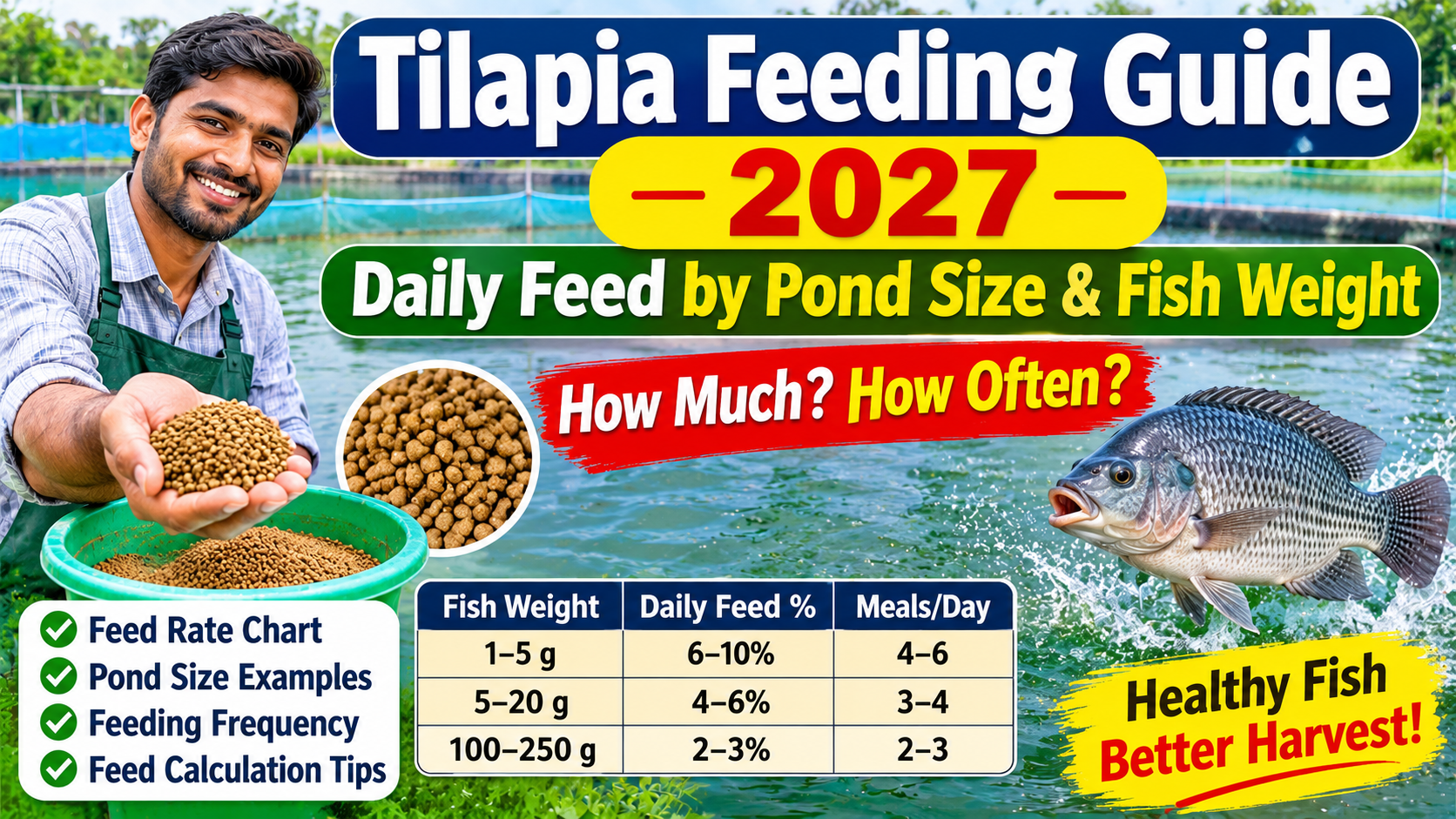
1. Introduction: Why Proper Tilapia Feeding Is Important
Tilapia is one of the most widely farmed freshwater fish groups in aquaculture. Farmers raise tilapia because the fish can adapt to different production systems, accept formulated feeds, and grow under suitable water and management conditions.
However, successful tilapia farming is not simply about putting fish into a pond and supplying feed every day. Feed management directly influences fish growth, feed expenses, water quality, survival, and the final harvest.
Feed is often one of the largest operating expenses in intensive fish farming. If a farmer gives too much feed, uneaten pellets may decompose and increase the organic load in the pond. If the farmer provides too little feed, fish may grow slowly and take longer to reach market size.
- Tilapia Feeding Guide 2027: Daily Feed by Pond Size & Fish Weight.
 1. Introduction: Why Proper Tilapia Feeding Is Important Tilapia is …
- Mushroom Farming Project Report 2027: Cost, Profit & Subsidy in India
 2027 Mushroom Farming Project Report: Cost and Profit Analysis in …
- From Farm to Carton in 2027: How Transparency Standards Became the New Competitive Edge for Organic Egg Brands
 2027 SEO Blog Article | Agriculture | Organic Farming | …
- Feed Cost Calculator: Calculate Livestock, Poultry, and Fish Feed Costs in 2027
 If you raise chickens, pigs, cattle, or fish, feed is …
- Best Grain Handling Solutions for Large-Scale Agricultural Operations in 2027.
 Large-scale agricultural operations in 2027 will increasingly depend on automated …
The best approach is to calculate feed according to the estimated total weight of the fish in the pond. This is known as biomass-based feeding.
For example:
- A pond containing 1,000 fish weighing 50 grams each has 50 kg of total fish biomass.
- A pond containing 1,000 fish weighing 300 grams each has 300 kg of total fish biomass.
Both ponds contain the same number of fish, but the second pond contains six times as much fish biomass. Therefore, it requires a much larger daily feed allowance.
A practical feeding programme should consider:
- Average fish weight.
- Number of live fish.
- Total fish biomass.
- Water temperature.
- Dissolved oxygen.
- Feed protein and pellet size.
- Fish appetite and feeding response.
- Natural food available in the pond.
- Stocking density and aeration.
- Fish growth during the production cycle.
FAO feeding tables and university aquaculture guidance also show that feeding rates generally decrease as tilapia become larger. FAOHome +2
2. How Much Feed Should Tilapia Eat Per Day?
The daily feed requirement depends mainly on the fish’s average body weight and the total biomass in the pond.
For a practical starting point, the following ranges can help farmers plan a feeding programme for formulated feed. These are indicative ranges, not fixed rules for every farm.
2.1 Tilapia daily feeding rate chart
| Average fish weight | Indicative daily feed rate | General feeding frequency |
|---|---|---|
| Below 1 g | 10–30% of biomass | 6–8 times |
| 1–5 g | 6–10% | 4–6 times |
| 5–20 g | 4–6% | 3–4 times |
| 20–100 g | 3–4% | 2–4 times |
| 100–250 g | 2–3% | 2–3 times |
| 250–500 g | 1.5–2.5% | 2–3 times |
| Above 500 g | 1–2% | 2 times |
These are planning ranges synthesized from published FAO and aquaculture extension feeding tables. Actual feeding allowances vary with water temperature, culture system, feed quality, fish appetite, and natural pond food. FAOHome +3
Important: The percentage means the percentage of the total live weight of the fish—not the percentage of pond water volume.
For example, if the total fish biomass is 100 kg and the feeding rate is 2%, the daily feed allowance is 2 kg.
2.2 Why do small tilapia need more feed relative to their body weight?
Small fish grow rapidly and have higher nutritional requirements relative to their body weight. They need frequent access to suitable small-sized feed.
As fish grow, their percentage feed requirement usually decreases. A 10-gram fingerling may need a daily ration equivalent to a much higher percentage of its weight than a 400-gram market-size fish.
This is why farmers should not continue using the same feeding percentage throughout the entire production cycle.
2.3 Example of feed requirements for different fish sizes
Consider a group of 1,000 tilapia. The following examples show how the feed requirement changes as the fish grow.
| Average weight per fish | Total biomass | Example feed rate | Daily feed |
|---|---|---|---|
| 10 g | 10 kg | 5% | 0.50 kg |
| 25 g | 25 kg | 4% | 1.00 kg |
| 50 g | 50 kg | 3.5% | 1.75 kg |
| 100 g | 100 kg | 2.5% | 2.50 kg |
| 200 g | 200 kg | 2% | 4.00 kg |
| 300 g | 300 kg | 1.8% | 5.40 kg |
| 500 g | 500 kg | 1.5% | 7.50 kg |
These figures are examples using selected rates within commonly published feeding ranges. The actual ration should be adjusted after sampling the fish and observing feeding behaviour.
3. How to Calculate Daily Tilapia Feed
The calculation is simple once you know the number of live fish, their average weight, and the selected feeding rate.
Formula 1: Total fish biomass
\text{Biomass (kg)} =
\frac{\text{Number of fish}\times\text{Average weight (g)}}{1000}
Formula 2: Daily feed requirement
\text{Daily feed (kg)} =
\text{Biomass (kg)}\times\frac{\text{Feed rate (\%)}}{100}
3.1 Example: 2,000 tilapia weighing 100 grams each
Suppose a farmer has:
- Number of live fish: 2,000
- Average fish weight: 100 grams
- Selected feeding rate: 2.5%
First, calculate biomass:
\frac{2,000\times100}{1,000}=200\text{ kg}
Next, calculate daily feed:
200\times\frac{2.5}{100}=5\text{ kg}Calculated example
The farmer’s starting daily feed allowance is 5 kg per day, subject to adjustment based on appetite and water conditions.
If the farmer feeds twice daily, the initial allocation could be:
- Morning: 2.5 kg
- Afternoon: 2.5 kg
If the fish are not consuming the feed properly, the farmer should investigate the cause rather than automatically increasing the ration.
3.2 Example: 5,000 tilapia weighing 250 grams each
Suppose the pond contains 5,000 live fish with an average weight of 250 grams.
Total biomass:
\frac{5,000\times250}{1,000}=1,250\text{ kg}
At an example feeding rate of 2%:
1,250\times0.02=25\text{ kg/day}
The estimated daily allowance is 25 kg.
If divided into three meals:
- Morning: approximately 8.3 kg
- Midday: approximately 8.3 kg
- Afternoon: approximately 8.4 kg
This is only an initial ration. The farmer should check consumption and water quality before maintaining it.
4. How Many Times Should You Feed Tilapia Per Day?
One of the most common questions from new fish farmers is: How many times should I feed tilapia per day?
The answer depends on the size of the fish and the production system.
Small fry need more frequent feeding because of their rapid growth and small body size. Larger grow-out fish can generally be managed with fewer meals.
4.1 Recommended feeding frequency
| Fish growth stage | General daily feeding frequency |
|---|---|
| Newly feeding fry | 6–8 times |
| 1–5 g fish | 4–6 times |
| 5–20 g fingerlings | 3–4 times |
| 20–100 g juveniles | 2–4 times |
| 100–250 g growers | 2–3 times |
| 250–500 g growers | 2 times |
| Market-size fish | Usually 2 times |
Published guidance differs between systems. For example, FAO pond feeding tables commonly show two daily feedings for several grow-out size classes, while other intensive-system references describe more frequent feeding. FAOHome +2
For many small and medium pond farms, two or three well-managed meals are a practical starting point for larger fish.
4.2 Best time to feed tilapia
A simple daily schedule for grow-out tilapia is:
| Time | Feeding activity |
|---|---|
| 7:00–8:00 AM | First feeding after checking fish activity and water conditions |
| 12:00–1:00 PM | Optional smaller meal if using three meals |
| 4:00–5:00 PM | Final feeding before evening |
The exact times can be changed according to local weather, water temperature, oxygen conditions, and farm routines.
Avoid feeding heavily when fish are showing signs of oxygen stress, such as gathering at the surface and gasping. Check aeration and water quality first.
4.3 Should you feed tilapia at night?
For ordinary outdoor pond farming, feeding during daylight is generally easier to manage because the farmer can observe fish behaviour and leftover feed.
Night feeding may be used in some controlled intensive systems, but it should not be adopted automatically. Dissolved oxygen can become a serious concern at night, particularly in heavily stocked ponds with high organic loads.
For small and medium farms, a consistent daytime feeding schedule is usually easier to monitor.
5. How Much Feed Per Day by Pond Size?
Pond size is important for understanding the production system, but it does not directly determine the daily feed quantity.
A 1-acre pond stocked with 2,000 fish may require much less feed than a 1-acre pond stocked with 10,000 fish at a larger average weight.
Therefore, pond-size calculations must include stocking numbers and average fish weight.
5.1 Example: 0.1-acre pond
Assume:
- Pond surface area: 0.1 acre
- Number of live fish: 500
- Average weight: 100 g
- Feeding rate: 2.5%
Biomass:
\frac{500\times100}{1000}=50\text{ kg}
Daily feed:
50\times0.025=1.25\text{ kg}
The example daily feed allowance is 1.25 kg.
5.2 Example: 0.25-acre pond
Assume:
- Pond surface area: 0.25 acre
- Number of live fish: 1,500
- Average weight: 100 g
- Feeding rate: 2.5%
Biomass:
\frac{1,500\times100}{1000}=150\text{ kg}
Daily feed:
150\times0.025=3.75\text{ kg}
The example daily feed allowance is 3.75 kg.
5.3 Example: 0.5-acre pond
Assume:
- Pond surface area: 0.5 acre
- Number of live fish: 3,000
- Average weight: 150 g
- Feeding rate: 2%
Biomass:
\frac{3,000\times150}{1000}=450\text{ kg}
Daily feed:
450\times0.02=9\text{ kg}
The example daily feed allowance is 9 kg.
5.4 Example: 1-acre pond
Assume:
- Pond surface area: 1 acre
- Number of live fish: 5,000
- Average weight: 200 g
- Feeding rate: 2%
Biomass:
\frac{5,000\times200}{1000}=1,000\text{ kg}
Daily feed:
1,000\times0.02=20\text{ kg}
The example daily feed allowance is 20 kg.
5.5 Pond-size comparison table
| Pond size | Assumed live fish | Average fish weight | Example daily feed |
|---|---|---|---|
| 0.1 acre | 500 | 100 g | 1.25 kg |
| 0.25 acre | 1,500 | 100 g | 3.75 kg |
| 0.5 acre | 3,000 | 150 g | 9 kg |
| 1 acre | 5,000 | 200 g | 20 kg |
| 2 acres | 10,000 | 200 g | 40 kg |
Please note: This is a mathematical illustration, not a recommended stocking-density chart. Actual stocking numbers must be selected according to pond depth, water exchange, aeration, seed quality, local regulations, and the farmer’s production system.
Part 2: Choosing the Right Tilapia Feed
6. Which Feed Is Best for Tilapia?
Tilapia can consume natural pond food and formulated commercial feed. However, in commercial farming, a nutritionally balanced formulated feed is important for achieving predictable growth.
Common feed options include:
- Commercial floating pellets.
- Commercial sinking pellets.
- Farm-made supplementary feed.
- Natural pond food.
- Agricultural by-products used in properly formulated diets.
The most suitable option depends on the fish size, production system, budget, and availability of quality feed.
6.1 Floating fish feed


Floating feed remains on the water surface for some time. It allows farmers to observe feeding activity and estimate whether fish are consuming the ration.
Advantages:
- Easier to observe fish appetite.
- Helps identify uneaten feed.
- Allows feeding adjustments.
- Useful for monitoring fish behaviour.
- Makes hand-feeding easier.
Floating pellets are particularly useful in ponds where farmers want to monitor consumption visually.
6.2 Sinking fish feed


Sinking pellets move below the water surface. They may be suitable in certain production systems, but farmers have less opportunity to observe exactly how much feed remains uneaten.
When using sinking feed, pay attention to pellet stability, feeding response, and water quality.
6.3 Farm-made fish feed
Some farmers prepare supplementary feed using locally available ingredients. Common ingredients may include:
- Rice bran.
- Wheat bran.
- Soybean meal.
- Groundnut cake.
- Maize or other cereal ingredients.
- Fish meal or other suitable protein ingredients.
- Vitamin and mineral premixes.
However, simply mixing ingredients does not guarantee a balanced tilapia diet. The formulation should meet the nutritional requirements of the fish and should be checked for protein, energy, amino acids, minerals, and ingredient quality.
Poorly formulated feed can reduce growth and increase waste.
7. How Much Protein Does Tilapia Feed Need?
Protein is an important part of fish nutrition. It supplies amino acids needed for muscle development, tissue repair, growth, and other biological functions.
The protein level should be selected according to fish size and production system.
7.1 Indicative protein levels
| Fish size | Indicative dietary protein range |
|---|---|
| Very small fry | 35–50% |
| 1–5 g fingerlings | 30–40% |
| 5–25 g juveniles | 25–30% |
| Larger pond-grown fish | Around 25% may be suitable |
| Fish in intensive tank systems | Often higher, depending on formulation |
These are broad reference ranges, not a single mandatory feed specification. University of Florida IFAS guidance describes different protein requirements for young fish and for larger fish raised in ponds, cages, and tanks. Ask IFAS +2
7.2 Why is protein important?
Protein supports:
- Muscle development.
- Growth and body-weight gain.
- Tissue maintenance.
- Enzyme production.
- Immune-system functions.
- Normal biological activity.
However, higher protein does not automatically mean better growth. Feed must also provide appropriate energy, essential amino acids, vitamins, and minerals.
A farmer should choose a balanced feed rather than selecting a product only because its protein percentage is high.
8. What Pellet Size Should You Use for Tilapia?
The pellet must be appropriate for the mouth size and feeding ability of the fish.
If the pellets are too large, smaller fish may struggle to eat them. If pellets are too small, larger fish may spend more time feeding, and handling or feeding losses may increase.
8.1 General pellet-size guide
| Average fish size | General feed form or pellet size |
|---|---|
| Below 1 g | Fine powder or micro-pellets |
| 1–5 g | Small crumble, approximately 1–1.5 mm |
| 5–20 g | Approximately 1.5–2 mm |
| 20–100 g | Approximately 2 mm |
| 100–250 g | Approximately 3 mm |
| Above 250 g | Approximately 3–4 mm |
FAO feeding tables provide similar pellet-size recommendations across different tilapia growth stages. FAOHome +2
Part 3: Practical Feeding Management for Indian Fish Farmers
9. How to Adjust Feed According to Water Temperature
Water temperature influences fish activity, appetite, metabolism, and feed consumption.
Tilapia are warm-water fish. Their feeding activity can change when water becomes unusually cold or hot.
A farmer should not assume that the fish need the same amount of feed every day throughout the year.
9.1 Practical temperature management
| Water condition | Feeding management |
|---|---|
| Suitable warm conditions | Follow the normal biomass-based ration |
| Cooler-than-normal water | Observe appetite and reduce feed if consumption falls |
| Very hot water | Check oxygen levels and fish behaviour; avoid forcing the normal ration |
| Sudden temperature change | Feed cautiously and monitor the fish |
| Fish showing stress | Stop or reduce feeding while investigating the cause |
The exact temperature response depends on fish strain, acclimation, water quality, and the culture system.
Important: Do not use a fixed temperature chart as a substitute for checking fish behaviour and dissolved oxygen.
10. How Does Dissolved Oxygen Affect Tilapia Feeding?
Dissolved oxygen is one of the most important water-quality factors in aquaculture.
Fish require oxygen for respiration and normal activity. When dissolved oxygen becomes low, fish may reduce feeding, become stressed, and gather near the water surface.
10.1 Signs of low oxygen
Watch for these warning signs:
- Fish gasping at the surface.
- Fish gathering near water inlets.
- Reduced appetite.
- Unusual swimming behaviour.
- Fish becoming less active.
- Sudden deaths, especially during early morning.
When these symptoms appear, stop routine feeding temporarily and investigate the water conditions.
10.2 What should farmers do?
- Check dissolved oxygen with a suitable meter.
- Switch on available aerators.
- Improve water circulation where appropriate.
- Remove accumulated organic waste if practical.
- Avoid adding unnecessary feed.
- Check fish behaviour again after corrective action.
A heavily fed pond can accumulate organic material. Decomposition consumes oxygen, which can increase the risk of oxygen problems.
11. What Is the Best Way to Feed Tilapia in a Pond?
A good feeding method should distribute feed evenly and allow the farmer to monitor the fish.
Step 1: Check the pond
Before feeding, observe the water surface and fish behaviour.
Check whether fish are swimming normally or showing signs of stress.
Step 2: Estimate the daily ration
Use the latest biomass estimate and an appropriate feeding rate.
Step 3: Divide the ration into meals
For example, a daily ration of 6 kg could be divided into:
- Morning: 3 kg.
- Afternoon: 3 kg.
The allocation may be changed according to feeding response.
Step 4: Distribute the feed evenly
Avoid throwing the entire ration into one small area. Distribute it across suitable feeding locations so that fish have a reasonable opportunity to access the feed.
Step 5: Observe feeding response
Watch whether fish are consuming the feed actively.
If a noticeable amount remains uneaten, investigate why. Possible causes include poor water quality, unsuitable feed size, disease, temperature changes, or overfeeding.
Step 6: Record the quantity
Maintain a daily record of feed supplied and any unusual observations.
12. How Often Should You Change the Tilapia Feeding Rate?
The feeding rate should be reviewed regularly because fish gain weight throughout the production cycle.
A practical approach is to sample fish approximately every one or two weeks, depending on farm size and production conditions.
12.1 How to estimate average fish weight
- Catch a representative sample of fish.
- Weigh the fish individually or together.
- Divide the total sample weight by the number of sampled fish.
- Use the result as an estimate of average fish weight.
- Recalculate the total biomass using the estimated number of live fish.
Example:
A farmer samples 20 fish.
Total sample weight = 4 kg.
Average weight:
4\div20=0.2\text{ kg}
Average weight per fish = 200 g.
If the estimated live population is 3,000 fish:
3,000\times0.2=600\text{ kg}
Estimated total biomass = 600 kg.
At an example feeding rate of 2%:
600\times0.02=12\text{ kg/day}
The calculated starting ration is 12 kg daily.
Remember that the estimated number of live fish should account for mortality and any fish harvested or removed.
13. Understanding Feed Conversion Ratio (FCR) in Tilapia Farming
Feed Conversion Ratio, commonly called FCR, is an important measurement in commercial fish farming.
It compares the amount of feed supplied with the weight gained by the fish.
Formula:
FCR=\frac{\text{Total feed used (kg)}}{\text{Total fish weight gain (kg)}}
13.1 Example of FCR calculation
Suppose a farmer supplies 1,000 kg of feed during a production period.
The fish gain 800 kg in total weight.
FCR=\frac{1,000}{800}=1.25
The calculated FCR is 1.25.
This means that 1.25 kg of feed was used for each kilogram of fish weight gained, under the assumptions of this simplified example.
13.2 Why should farmers monitor FCR?
FCR helps farmers:
- Review feeding efficiency.
- Estimate feed expenses.
- Compare different feed products.
- Identify possible feeding problems.
- Monitor changes between production cycles.
- Improve farm records.
FCR is affected by feed quality, fish health, water quality, stocking density, natural food, mortality, and how accurately feed and harvest weights are recorded.
A farmer should not compare FCR figures without checking whether the production systems and measurement methods are similar.
Part 4: Feed Cost Calculation and Farm Record Management
14. How Much Does Tilapia Feed Cost Per Day?
Feed cost depends on the feed brand, protein level, pellet type, supplier, transport, and purchase quantity.
Prices can change between states and suppliers in India. Therefore, the following figures are examples for calculating a farm budget, not verified current market quotations.
14.1 Daily feed-cost example
Suppose:
- Daily feed requirement: 20 kg.
- Assumed feed price: ₹40 per kg.
Daily feed cost:
20\times40=₹800
If the farmer feeds for 30 days:
₹800\times30=₹24,000Illustrative calculation
| Item | Amount |
|---|---|
| Daily feed quantity | 20 kg |
| Assumed feed price | ₹40/kg |
| Daily feed expense | ₹800 |
| 30-day feed expense | ₹24,000 |
| 90-day feed expense | ₹72,000 |
The actual amount will change as the fish grow and the daily ration increases or decreases.
14.2 Monthly feed budget for different quantities
| Daily feed quantity | Assumed price per kg | Estimated monthly cost |
|---|---|---|
| 5 kg | ₹40 | ₹6,000 |
| 10 kg | ₹40 | ₹12,000 |
| 20 kg | ₹40 | ₹24,000 |
| 30 kg | ₹40 | ₹36,000 |
| 50 kg | ₹40 | ₹60,000 |
These figures assume 30 days of feeding at a constant daily quantity. In a real production cycle, the ration changes as biomass changes.
15. How to Reduce Tilapia Feed Expenses
Feed management is not about giving the lowest possible quantity. It is about providing the right quantity and quality without unnecessary waste.
Useful methods include:
- Calculate feed from updated fish biomass.
- Select feed with suitable protein and pellet size.
- Observe fish appetite during each feeding.
- Avoid feeding during periods of oxygen stress.
- Store feed in dry and clean conditions.
- Keep feed bags away from moisture and pests.
- Compare suppliers based on feed quality, not price alone.
- Record feed use every day.
- Check fish growth regularly.
- Review FCR at the end of each production cycle.
15.1 Correct feed storage


Fish feed can lose quality if it is exposed to moisture, excessive heat, pests, or long storage periods.
Farmers should:
- Keep bags off the floor.
- Use a dry and ventilated storage room.
- Keep feed away from chemicals and fuel.
- Follow the manufacturer’s storage instructions.
- Check manufacturing and expiry dates.
- Avoid using mouldy or damaged feed.
Mouldy feed can be unsafe for fish and should not be used.
16. Common Tilapia Feeding Mistakes
Even a well-designed pond can experience poor results if feeding is not managed properly.
Mistake 1: Feeding without calculating biomass
Giving a fixed quantity every day ignores fish growth and mortality.
Solution: Estimate average fish weight and update biomass regularly.
Mistake 2: Feeding too much
Excess feed increases waste and can negatively affect water quality.
Solution: Observe feeding response and adjust the ration.
Mistake 3: Using oversized pellets
Small fish may not be able to consume large pellets efficiently.
Solution: Select pellet size according to fish size.
Mistake 4: Using low-quality feed
Poorly balanced or damaged feed can reduce growth and increase waste.
Solution: Purchase reliable feed from reputable suppliers.
Mistake 5: Ignoring oxygen levels
Fish may stop feeding when oxygen becomes insufficient.
Solution: Monitor dissolved oxygen, particularly during high-risk periods.
Mistake 6: Never weighing fish
Farmers who do not sample fish may continue using outdated feed calculations.
Solution: Sample fish regularly and recalculate the daily ration.
Mistake 7: Feeding heavily during poor weather or stress
Fish appetite can change during sudden weather and water-quality disturbances.
Solution: Reduce or temporarily stop feeding when fish are stressed, and identify the cause.
Part 5: Tilapia Feeding Calculator and Practical Examples
17. Tilapia Daily Feed Calculator
The following calculator uses fish count, average weight, and feeding percentage to estimate the daily feed requirement.
Tilapia feed calculator
Enter your pond’s estimated live fish count and average fish weight.
Number of live fish
Average fish weight (grams)
Daily feeding rate (%)
Number of meals per day
2 meals
3 meals
4 meals
Total biomass
200.00 kg
Daily feed
5.00 kg
Estimated feed per meal
2.50 kg
Daily feed divided equally across 2 meals. Adjust portions based on fish appetite and water quality.
Reset calculator
This calculator provides a mathematical estimate, not a diagnosis of pond conditions or a guaranteed feeding recommendation.
18. Example Feeding Programme for a Tilapia Production Cycle
The following is a simplified example for planning purposes. It is not a guaranteed growth schedule because actual growth depends on seed quality, temperature, water quality, stocking density, nutrition, and farm management.
| Production stage | Example fish weight | General management |
|---|---|---|
| Early fry | Below 1 g | Fine feed, frequent feeding |
| Fry | 1–5 g | Small crumble, several meals |
| Fingerling | 5–20 g | Small pellets, regular sampling |
| Juvenile | 20–100 g | Grower feed, biomass-based ration |
| Grower | 100–250 g | Larger pellets, 2–3 meals |
| Final grow-out | 250–500 g | Adjusted grower or finisher ration |
| Market-size | Above 500 g | Monitor appetite and harvest plans |
19. Natural Food in Tilapia Ponds
Tilapia can consume naturally available food in ponds, including algae, phytoplankton, periphyton, and other suitable natural organisms.
Natural food may contribute to nutrition, especially in semi-intensive pond systems. However, farmers should not assume that natural food completely replaces balanced feed in a commercial production system.
The contribution of natural food varies with pond fertility, water quality, stocking density, and management.
19.1 Can tilapia grow without commercial feed?
Tilapia may survive and grow in some systems with access to natural pond food and supplementary ingredients. However, growth may be slower or less predictable if nutritional requirements are not met.
For commercial production, farmers should use a feeding programme suited to the target harvest size and production intensity.
Part 6: Water Quality, Health and Record Keeping
20. Important Water Quality Factors for Tilapia Farming
Feed management cannot be separated from water quality. Farmers should monitor the pond regularly and respond to unusual changes.
Important factors include:
- Dissolved oxygen.
- Water temperature.
- pH.
- Ammonia.
- Nitrite.
- Water transparency.
- Organic matter.
- Fish behaviour.
20.1 Why ammonia matters
Ammonia can enter pond water through fish waste, uneaten feed, and decomposition of organic material.
High ammonia concentrations can stress fish and affect their health. The proportion of toxic unionized ammonia increases as pH and temperature rise.
Farmers should avoid excessive feeding, monitor water quality, and seek fisheries extension support when ammonia problems are suspected.
20.2 Water-quality monitoring checklist
| Parameter | What to monitor |
|---|---|
| Dissolved oxygen | Measure with a suitable meter |
| Temperature | Check daily, especially during seasonal changes |
| pH | Monitor for sudden changes |
| Ammonia | Test when water quality or fish behaviour deteriorates |
| Nitrite | Check in intensive systems |
| Fish behaviour | Watch for gasping, reduced appetite, and unusual swimming |
| Feed leftovers | Check whether fish consume the ration |
21. How to Maintain a Daily Tilapia Feeding Record
A farm record helps identify problems before they become expensive.
A simple record can include:
| Date | Fish biomass | Feed given | Number of meals | Fish behaviour |
|---|---|---|---|---|
| Day 1 | 200 kg | 5 kg | 2 | Normal |
| Day 2 | 200 kg | 5 kg | 2 | Normal |
| Day 3 | 200 kg | 4.5 kg | 2 | Reduced appetite |
| Day 4 | 200 kg | 0 kg temporarily | 0 | Oxygen problem investigated |
The entries above are illustrative only. A farmer should record actual quantities and observations.
22. Tilapia Feeding Guide for Small-Scale Farmers
Small pond owners may not have automatic feeders, laboratory equipment, or a large fisheries team. However, they can still follow a disciplined feeding routine.
A practical daily routine is:
Morning
- Observe the fish.
- Check water conditions.
- Feed an appropriate portion.
- Record the quantity.
Afternoon
- Observe feeding activity.
- Provide the next portion.
- Check for uneaten feed.
- Record unusual behaviour.
Weekly or fortnightly
- Sample fish.
- Calculate average weight.
- Estimate total biomass.
- Update the feeding ration.
- Review feed consumption and growth.
Part 7: Frequently Asked Questions
23. How many times should I feed tilapia per day?
Small fry may need 6–8 feedings daily, while fingerlings may need 3–6 feedings depending on size and production conditions. Larger grow-out fish are commonly fed 2–3 times daily. The exact schedule should match the fish size and feeding system. FAOHome +2
24. How much feed does one 100-gram tilapia need per day?
At an example feeding rate of 2.5% of body weight, a 100-gram fish requires 2.5 grams of feed per day.
For 1,000 fish weighing 100 grams each, the calculated daily feed allowance is 2.5 kg.
25. How much feed do 1,000 tilapia need per day?
It depends on their average weight.
For example:
- At 50 g each and a 3.5% feeding rate: 1.75 kg daily.
- At 100 g each and a 2.5% feeding rate: 2.5 kg daily.
- At 200 g each and a 2% feeding rate: 4 kg daily.
- At 500 g each and a 1.5% feeding rate: 7.5 kg daily.
These are example calculations, not fixed feed allowances.
26. Can I feed tilapia only once a day?
Larger tilapia may be managed with one or two meals in some production systems, but splitting the daily ration into two meals can make it easier to observe feeding response and distribute feed. Small fish generally need more frequent feeding.
27. What is the best feed for tilapia growth?
A balanced commercial feed with suitable protein, energy, amino acids, vitamins, minerals, and pellet size is a good option. Feed should be selected according to fish size and the production system.
28. Can rice bran be used for tilapia?
Rice bran may be used as an ingredient in a properly formulated supplementary diet. However, rice bran alone does not provide a complete nutritional diet for intensive commercial tilapia production.
29. What happens if I overfeed tilapia?
Overfeeding can waste money, increase organic matter, reduce water quality, and contribute to oxygen problems. It can also make feed conversion less efficient.
30. Should tilapia be fed during rain?
Light rain does not automatically mean feeding must stop. However, during heavy rain, sudden temperature changes, poor water conditions, or unusual fish behaviour, farmers should check the pond before feeding.
31. How often should I weigh tilapia?
A sample every one or two weeks is a practical starting schedule for many farms. Faster-growing fish or intensive systems may require more frequent sampling.
32. Does tilapia need floating or sinking feed?
Both types can be used in suitable systems. Floating pellets make feeding response easier to observe, while sinking pellets may be suitable in other systems. Feed quality and fish size are more important than choosing a pellet type based on appearance alone.
33. What is a good FCR for tilapia?
FCR varies with the production system, feed quality, fish health, water conditions, and measurement method. A value calculated from a farm’s own feed and harvest records is more useful than comparing it blindly with another farm’s figure.
34. Can tilapia eat vegetables?
Tilapia can consume certain plant materials and naturally occurring plant-based food. However, vegetables alone are not a nutritionally complete commercial feed. A balanced diet is important for predictable growth.
35. Is tilapia farming profitable in India?
Tilapia farming may be profitable when seed, feed, water, labour, aeration, mortality, harvesting, and market prices are managed carefully. Profitability cannot be guaranteed. Farmers should prepare a local project report and check applicable state and national aquaculture regulations before starting.
Part 8: Conclusion and Practical Recommendations
36. Final Tilapia Feeding Recommendations
Successful tilapia feeding depends on the right balance between fish biomass, feed quality, feeding frequency, and pond conditions.
The most useful lessons for farmers are:
- Calculate feed according to total fish biomass.
- Use a higher percentage of body weight for smaller fish and a lower percentage for larger fish.
- Feed small fry more frequently than grow-out fish.
- Select the right pellet size for the fish.
- Choose a balanced feed with suitable protein.
- Observe fish appetite at every feeding.
- Monitor dissolved oxygen and water quality.
- Weigh a representative sample regularly.
- Update daily feed quantities as fish grow.
- Maintain feed and production records.
The key takeaway: Do not decide daily feed only from pond size. Estimate the number of live fish, measure average fish weight, calculate biomass, and then apply an appropriate feeding percentage.
This approach gives farmers a more reliable starting point for managing feed expenses and fish growth.
37. Recommended References and Further Reading
These technical references are useful for readers who want to check the feeding tables and nutritional guidance behind this article.
- FAO – Feeding tables for tilapia under pond and intensive farming systems: Read FAO tilapia feeding guidance.
- FAO – Simplified feeding guide for Nile tilapia: Read the FAO feeding table.
- University of Florida IFAS – Culture of Hybrid Tilapia: Read the UF/IFAS reference profile.
- NCRAC – Feeding Tilapia in Intensive Recirculating Systems: Read the technical fact sheet.
- National Academies – Nutrient Requirements of Fish: Read the fish nutrition reference.
38. AdSense-Friendly Publishing Checklist
Before publishing this article on your farming website:
- Add a relevant, original featured image.
- Include a clear author name and publication date.
- Add internal links to related aquaculture articles.
- Cite reliable technical sources.
- Explain that feed quantities are estimates that must be adjusted to farm conditions.
- Avoid promising guaranteed growth or profits.
- Include a clear contact or About page.
- Check spelling, grammar, and mobile readability.
- Add descriptive image alt text.
- Do not copy the same article onto multiple pages.
Suggested internal articles to publish alongside this guide:
- Tilapia Fish Farming in India: Complete Beginner’s Guide
- Tilapia Fish Farming Cost and Profit per Acre
- Best Fish Feed for Tilapia: Protein, Pellet Size and Price
- Fish Pond Water Quality Management
- How to Calculate Fish Farm Feed Conversion Ratio
- Tilapia Fingerling Stocking Density per Acre
- Fish Farming Business Plan in India
